Despite "Caution: Typhoon Approaching" Warnings, 40% of Korean Workers Still Commute as Usual
Workplace Gapjil 119 Surveyed 1,000 Workers
Higher Negative Response Rate Among Non-Regular Employees
According to a survey conducted by a civic group, more than 4 out of 10 office workers said it is difficult to adjust their commuting hours even in situations of natural disasters such as typhoons or heavy rains.

In response to the question, "Is adjustment of commuting hours guaranteed in natural disaster situations?" 43.8% of respondents answered, "It is not guaranteed." Yonhap News
View original imageOn the 26th, the civic group Workplace Gapjil 119 released the results of a survey commissioned to Global Research, a public opinion polling agency. The survey was conducted with 1,000 office workers aged 19 or older across the country from June 1 to June 9. In response to the question, "Is adjustment of commuting hours guaranteed in natural disaster situations?" 43.8% of respondents answered, "It is not guaranteed."
The negative response rate for non-regular workers was 49.85%, 10 percentage points higher than that of regular employees (39.8%). The rate for daily workers was 58.5%. For dispatched, subcontracted, and in-house contract workers, it was 58.3%, and for freelancers and specially-employed workers, it reached 55.3%.

Citizens passing through the Gwanghwamun intersection in Seoul are hurrying their steps, armed with umbrellas and rain boots.
View original imageAmong all respondents, 38.4% said that even when the government recommended remote work or adjustments to commuting times due to natural disasters such as typhoons, heavy rain, heavy snow, or earthquakes, they still commuted to work as usual according to company instructions. Additionally, 1 out of 7 respondents (15.3%) reported having experienced disadvantages or witnessed colleagues experience disadvantages for being late due to a natural disaster. In contrast, 65.4% of respondents agreed that, in the event of a natural disaster, employees should be able to choose their work arrangement themselves or refuse to work.
Hot Picks Today
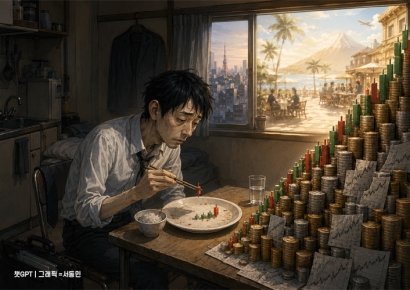 "Surviving on One Meal a Day to Invest 3.5 Million Won Monthly... 'FIRE' Craze Sparks 'NISA Poverty' in Japan"
- "Correction Over for Samsung and SK hynix" "670,000 for Samsung, 4.7 Million for SK hynix": Why Global IBs Remain Optimistic
- "Used for the Wedding" 300,000-Won Ring and Dress...Changing Wedding Trends
- Causing Trouble Without a Simple "Sorry"... The Reason Behind the 'Gen Z Stare' Revealed
- Nongshim Third-Generation Executive Sangyul Shin to Wed SKT Employee on the 13th
Workplace Gapjil 119 explained, "The extent to which workers are excluded from adjustments to work arrangements during disasters was more severe among those with unstable employment, those at low-wage jobs, and those at small workplaces, such as daily workers and in-house contract workers." The organization further stated, "Currently, the Ministry of Employment and Labor recommends remote work or staggered commuting hours when heatwave or heavy rain warnings are issued, but since it is only a recommendation, there is no legal basis to sanction employers who do not comply." They emphasized, "Guaranteeing the right to stop work when danger is detected during commuting or work is essential to prevent fatalities in the workplace."
© The Asia Business Daily. All rights reserved. Unauthorized AI training and use prohibited.