President Lee Meets Global VCs: "Let's Create the Next Generation of Samsung, Hyundai, and Naver Together" (Comprehensive)
President Lee Attends Silicon Valley Venture Investment Meetup
"Bold Visa Reforms... Creating the World's Most Attractive Environment for Investment and Entrepreneurship"
Linking Korea Venture Investment Fund, National Growth Fund, and Pensi
While visiting Silicon Valley in the United States, President Lee Jae-myung called on global venture capitalists to invest in Korean startups on the 25th (local time). He emphasized, “Korea and the United States should expand the scope of their cooperation beyond a longstanding security alliance to partnerships in technology, innovation, and startups.” He also unveiled plans to ease visa regulations that hinder the influx of overseas entrepreneurial talent into Korea, and to support promising startups’ expansion abroad by linking policy and private-sector funds.

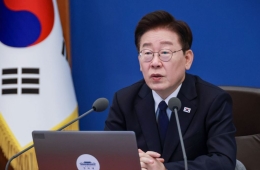
President Lee Jae-myung is speaking at the Silicon Valley venture investment meetup held at a hotel in San Francisco, USA, on the 25th (local time). July 26, 2026 Yonhap News Agency
View original imageIn his opening remarks at the “Venture Investment Meetup” held in Silicon Valley, President Lee stated, “The Korean government will create the world’s most favorable environment for investment and entrepreneurship.” The event was attended by Martin Casado, General Partner at Andreessen Horowitz; Alfred Lin, Co-Managing Partner at Sequoia Capital; Hemant Taneja, CEO at General Catalyst; Tony Florence, Co-Managing Partner at New Enterprise Associates; Barry Eggers, Founding Partner at Lightspeed Venture Partners; and Vinod Khosla, Founder of Khosla Ventures. The combined assets under management of these six participating firms amount to 313 billion dollars (about 458 trillion won).
President Lee cited Korea’s rapid execution, world-class manufacturing base, robust digital infrastructure, outstanding human resources, and cultural competitiveness as key strengths. He noted, “Korea is an irreplaceable innovation hub that can offer global investors new growth opportunities. The fact that the number of foreign founders in Korea has more than doubled over the last three years demonstrates that Korea is solidifying its position as an open innovation hub, where global talent and companies can jointly tackle new challenges.”
He also outlined government support measures to foster the global startup ecosystem. President Lee said, “We will boldly improve visa regulations that block the entry of overseas entrepreneurial talents and further expand the collaborative foundation connecting domestic and international companies, research institutions, and investors.”
He continued, “By organically connecting the Korea Venture Investment Corp. (Mother Fund), the National Growth Fund, pension funds, and private capital, we will comprehensively support promising startups so that they move beyond the early stage and develop into global companies—through investments, financing, and expansion into overseas markets.”
President Lee also proposed combining the strengths of Korea and the United States to jointly nurture world-class innovative companies. He explained, “The United States boasts world-leading venture investment capabilities and a global network, while Korea possesses outstanding technological prowess, manufacturing competitiveness, and a dynamic startup ecosystem.”
He added, “When the strengths of both countries are combined, we can together give rise to a new generation of global innovation leaders such as Samsung, Hyundai, SK, and Naver.”
President Lee stated, “When Korean startups connect with U.S. capital and markets, and American investors and innovative companies connect with Korea’s technology, manufacturing, and talent ecosystem, the two countries will become partners in innovation for the next three decades. I hope today’s event marks the starting point for promising Korean startups and global investors to open new doors to growth.”
Global venture capitalists also expressed strong confidence in Korea’s manufacturing and semiconductor capacity as well as the competitiveness of its talent pool, signaling their intent to increase investment. Martin Casado, General Partner at Andreessen Horowitz, who recently opened an office in Seoul earlier this year, praised Korea’s world-class companies and outstanding engineering talent in the manufacturing and semiconductor sectors, saying that Korea holds a unique position in AI. He also noted that combining Korea’s hardware and manufacturing strengths with America’s software and AI technology would yield major benefits for both countries.
Hemant Taneja, CEO of General Catalyst, underscored collaboration opportunities between Korea and the U.S. in physical AI and AI applications in critical industries such as defense, healthcare, and energy. Having met with Korean companies in recent years to review cooperation models, he said, “We will develop more plans in Korea.” Alfred Lin, Co-Managing Partner of Sequoia Capital, noted the firm’s role as an early investor in Coupang, pledging to further boost investment in Korea. Vinod Khosla, Founder of Khosla Ventures, praised Korea as a talent powerhouse and revealed ongoing projects in robotics in the country.
Barry Eggers, Founding Partner at Lightspeed Venture Partners, described cases of Korean startup investments and the entry of its portfolio companies into Korea, vowing to establish long-term collaborative relationships with Korean founders and institutions. Tony Florence, Co-Managing Partner at New Enterprise Associates, called Korea “a key market” and predicted the country would play a pivotal role in the global AI ecosystem going forward.
On that day, chief presidential spokesperson Kang Yoo-jung explained in a written briefing, “Global venture capitalists cited a culture that embraces failure and appropriate investment as the most crucial factors for Korean startups’ success.” In response, President Lee said, “That’s a very meaningful suggestion,” and pledged policy efforts to make Korea a society where everyone—including the youth—can be given opportunities to start businesses. He reportedly also asked policy chief Kim Yong-bum and First Vice Minister for SMEs and Startups Noh Yong-seok whether there might be more feasible ways to connect universities and investors.
Hot Picks Today
 "Surviving on One Meal a Day to Invest 3.5 Million Won Monthly... 'FIRE' Craze Sparks 'NISA Poverty' in Japan"
- "Correction Over for Samsung and SK hynix" "670,000 for Samsung, 4.7 Million for SK hynix": Why Global IBs Remain Optimistic
- Tongyeong City Designated Entirely as Special Disaster Zone: "A Major Turning Point for Returning to Daily Life"
- Causing Trouble Without a Simple "Sorry"... The Reason Behind the 'Gen Z Stare' Revealed
- Nongshim Third-Generation Executive Sangyul Shin to Wed SKT Employee on the 13th
Meanwhile, during the event, the National Pension Service and six venture capital firms signed a business agreement (MOU) to construct and advance a close cooperation system.
© The Asia Business Daily. All rights reserved. Unauthorized AI training and use prohibited.