Park Hongkeun: "AI Dominance at a Turning Point... Strategic Investment and Fiscal Stabilization with Future Fund"
“Preparing a Plan to Break the 20.79% Local Education Grant Linkage”
“Basic Pension to Be Restructured Using the Median Income Standard, Prioritizing Those in Greater Need”
Hongkeun Park, Minister of Planning and Budget, reaffirmed his plan to channel additional tax revenues, generated by the current artificial intelligence (AI) and semiconductor boom, into future growth initiatives and balanced regional development. He also shared that the government is preparing measures to revise the current system, under which 20.79% of domestic tax revenue is allocated to the Local Education Financial Grant Fund.
During his appearance on KBS’s “Sunday Diagnosis” on the morning of July 26, Minister Park stated, “Now is the era when AI dominance will be decided,” adding, “Whether we lead or fall behind in this transition will determine the country’s fate.”

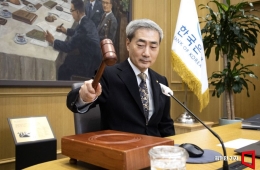
Minister Hongkeun Park of the Ministry of Planning and Budget is speaking at the 2027 budget negotiation meeting held at the National Assembly on the 21st. July 21, 2026 Photo by Hyunmin Kim
View original imageOn the Future Response Fund (FRF), he explained that it “began from the idea of channeling funds into productive expenditures that will open Korea’s future growth platform,” adding, “The fund will be used for strategic investment to expand growth potential or as a fiscal stabilization device.”
The Future Response Fund is to be established using tax revenues that have exceeded expectations due to the semiconductor boom. Park cited strategic investment areas such as supporting the younger generation, securing new growth engines for the age of AI, bolstering non-metropolitan regions, and fostering talent.
As a fiscal stabilization tool, he noted that the FRF is intended “to supplement fiscal capacity so that such funds can be flexibly utilized when tax revenues fall short or a supplementary budget is urgently required.” He added, “If it’s all spent within a single year, how can you hope to achieve all the intended effects in just one year? The intention is to overcome the limitations of single-year budgeting and accounting, arguing that allocating these precious funds entirely within one fiscal year would not be appropriate, which marks a significant departure from conventional budget policies.”
He emphasized that the government will move forward with these policies based on national consensus and will scrupulously comply with legal procedures, such as establishing the fund under the National Finance Act and creating corresponding legislation as required.
Minister Park further explained that the government is working on revising the mechanism in which 20.79% of domestic tax revenue is allocated to the Local Education Financial Grant Fund. “Now that domestic tax revenues have increased, we are developing new proposals that break away from the current 20.79% linkage structure,” Park said. “Discussions with the Ministry of Education are ongoing, and once the government reaches a consensus, a bill will be submitted to the National Assembly for consideration.”
He pointed out that the tax linkage structure currently used was “introduced in the 1970s when one million babies were born annually,” and noted that with the annual number of births now down to around 200,000, it is no longer a reasonable approach.
Minister Park clarified his guiding principle for reforming the Education Financial Grant Fund: “We must strengthen the quality of primary, secondary, and kindergarten education, so we will not reduce our investments; we will continue to invest in line with long-term trends.” He stressed that the total grant amount of approximately 13 million won per student per year will not be reduced and that resources saved will be redirected toward higher education, lifelong learning, and early childhood education. He added, “With the declining number of school-aged children, some kind of adjustment is necessary.”
Minister Park also reiterated the administration’s plan to restructure the basic pension into a form that prioritizes those in greater need, by providing monthly payments to the bottom 70% of seniors aged 65 and over. He said the basic pension was “introduced to reduce elderly poverty, and while it has had some effect, as coverage has expanded to the bottom 70%, there are now cases where individuals with monthly incomes of 4.6–4.7 million won, and couples with combined incomes of 7–8 million won, are still eligible to receive it.”
He referred to the median income standard, saying, “It is about determining the median value of total household income for the nation. By restructuring around this standard, we can provide more substantial support to those in greater need.” Park noted that discussions with the Ministry of Health and Welfare on this new structure are already nearing completion.
The median income standard is the midpoint of national household income, determined by the Minister of Health and Welfare through deliberation and resolution of the Central Living Security Committee, and is used as a basis for basic livelihood benefits. For this year, the median income is 2,564,238 won for single-person households, 4,199,292 won for two-person households, and 5,359,036 won for three-person households.
Regarding the 2027 budget proposal projected to reach over 800 trillion won, Minister Park reiterated that it would be prepared “in a way that the public can feel in their daily lives,” with a focus on three mega projects, reversing the declining potential growth rate, and strengthening the social safety net for vulnerable groups.
In response to concerns that expansionary fiscal policy could prolong high inflation and burden ordinary citizens, he stated, “While pursuing active fiscal policy, we must also minimize the inflationary impact.”
Minister Park referenced Governor Shin Hyun-sung of the Bank of Korea’s comment that “if fiscal policy translates into investments that genuinely raise overall economic potential, it will not necessarily be at cross purposes with monetary policy.” He highlighted that the government will focus on tailored fiscal support, targeted investment to boost potential growth, and expanded support for vulnerable groups.
To support locally-led growth, including the “five poles, three special zones” strategy, Park said a super-regional budget account will be created to designate key industries as regional growth engines and improve living conditions in non-capital areas. He explained, “The super-regional budget account is aimed at significantly increasing fiscal support appropriate for metropolitan areas. By creating a much larger fiscal pool, local governments will have more funds available for the Regional Balanced Development Special Account starting next year.”
Hot Picks Today
 "The Transfer Failed, but 'Ding Dong' Money Came In"... 32.5 Billion Won Financial Incident at Toss Bank
- "They Wouldn't Give It a Second Look When Offered to Ancestors"... MZ Goes Wild for 80-Year-Old Ceremonial Liquor as a Household Must-Have
- Pinky swear: "I'll become a female soldier"... An elementary school student's moving letter of support from 11 years ago
- "Even If He's Handsome, That's a Bit Much"... The "Behavior" That Turns Off 7 in 10 Women
- The 'Hangover Legend' That Had You Waking Up the Day After Tomorrow Returns After 11 Years... Lee Sunmin's Captain Q Sells Out
He added that Gwangju-South Jeolla Unified Metropolitan City will receive up to 20 trillion won in incentives over four years, as previously announced. He also stated that a new plan for the second phase of relocating public institutions to regional areas will be released soon, emphasizing a firm commitment to a national strategy for coexistence between metropolitan and non-metropolitan regions.
© The Asia Business Daily. All rights reserved. Unauthorized AI training and use prohibited.