Daejeon City Announces First Organizational Restructuring Under Ninth Administration, Reducing Headquarters from 19 to 18
Establishment of AI Innovation Office and Civil Society Bureau,
Reorganization Including the New Future Strategy Office

Daejeon City will implement its first organizational restructuring under the ninth popularly elected administration, adjusting the current 19 headquarters system to 18 headquarters.
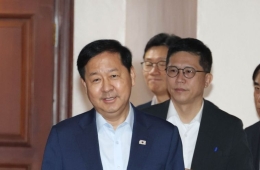
Yoo Deukwon, Deputy Mayor for Administrative Affairs, held a press conference at City Hall's briefing room on July 24 and stated, "This restructuring aims to realign functions in response to changes in policy environments and administrative demands, and to establish an administrative system that can stably and responsibly pursue key policies of the ninth administration."
He further emphasized, "We will clarify the functions and responsibilities of each department and ensure that the reorganized structure is established promptly to achieve substantive policy outcomes and improvements in administrative services."
The focus is on integrating similar or overlapping functions previously divided among multiple bureaus or divisions, and on readjusting the role of each bureau and division according to policy targets and the nature of their work. The position of Deputy Mayor will also be adjusted, with the Deputy Mayor for Political, Economic, and Science Affairs being changed to Deputy Mayor for Political Affairs, who will oversee overall policy coordination, external cooperation, and communication on municipal affairs. While streamlining the overall organization, functions have been strengthened in high-priority areas such as livelihood, safety, and future growth.
The main directions for the restructuring are as follows: ▲ Large-scale transition to artificial intelligence (AI) ▲ Safe city ▲ Innovation in future industries ▲ Recovery of the livelihood economy ▲ Citizen sovereignty and respect for labor. These constitute the five key policy axes.
◆ Establishment of Grade 3 AI Innovation Office
This office will be newly established within the Planning and Coordination Office, systematically promoting the city’s transition to AI by connecting AI policy planning, administrative AI applications, improvement of citizen services, public sector innovation, and informatization functions. A tentatively named AI Innovation Strategy Committee, involving private experts and representatives from industry, academia, research, and government, will also be formed to enhance policy expertise and on-site applicability.
The Future Strategy Industry Office and the Corporate Support Bureau will be merged into a single Future Strategy Office. This will unify the nurturing of strategic industries such as semiconductors, biotechnology, defense, and aerospace, as well as corporate support, start-ups, and investment attraction, under one system, so that industrial innovation leads directly to corporate growth. The city plans to expand the integration and application of AI technology across all industries to strengthen the competitiveness of companies and the growth base of local industries.
◆ 24-Hour Disaster Response and Enhanced Livelihood-Focused Policies
The Citizen Safety Office will create a Safety Response Officer position and expand the functions of the Comprehensive Disaster Situation Room, strengthening 24-hour situation management, cooperation with relevant agencies, and initial response systems.
The Economic Bureau will be reorganized into the Livelihood Economy Bureau. By comprehensively managing key economic functions closely related to citizens’ lives—such as employment, prices, small businesses, neighborhood markets, traditional markets, and energy—in a single bureau, the ability to address livelihood issues will be enhanced.
The Ontong Daejeon 2.0 Promotion Task Force will also be established to link policies across welfare, youth, transportation, and culture with the Ontong Daejeon program, developing it into a Daejeon-style win-win platform that supports both the alleviation of citizens’ daily burdens and the virtuous cycle of the local economy.
◆ Establishment of the Civil Society Bureau
The Civil Society Bureau will promote policies on citizen participation, communities, labor, youth, universities, and education/youth. The aim is to expand public participation in policymaking, establish an administrative foundation that respects labor, and connect youth and university/education policies to support the growth and settlement of local talent.
◆ Reorganization of Culture, Medical, and Environment Sectors to Strengthen Policy Linkage and Specialization
The Culture, Arts, and Tourism Bureau and the Sports and Health Bureau will have their functions adjusted and be reorganized into the Culture, Sports, and Tourism Bureau and the Medical and Health Bureau. Cultural, arts, tourism, and sports functions will be integrated in the Culture, Sports, and Tourism Bureau, while the Medical and Health Bureau will strengthen public and emergency healthcare functions, reinforce infectious disease response, and exclusively manage regional medical systems such as establishing a locally complete emergency care system.
The Environment Bureau and the Green Land and Agricultural Life Bureau will be merged into a Climate Environment and Green Land Bureau, bringing together climate crisis response, carbon neutrality, air and water environment, forests, parks, and green land policies under a unified framework.
◆ Traffic, Construction, and Urban Functions to Be Reassigned by Work Characteristics
General and metropolitan railway policy will be assigned to the Transportation Bureau; construction, roads, and housing functions will be assigned to the Construction and Housing Bureau; and urban planning, regeneration, and maintenance will fall under the Urban Bureau.
The Urban Rail Construction Bureau will maintain a dedicated team for tram construction to ensure continuity and specialization in project management.
◆ Promotion of Spokesperson from Grade 4 to Grade 3
Under the Spokesperson, there will be a Public Affairs Officer and Public Relations Officer. The Public Affairs Officer will handle media responses and press support, while the Public Relations Officer will oversee content creation and media management, comprehensively coordinating message and communication strategies for overall municipal affairs.
Hot Picks Today
 What Threatens Baby's Health More Than Alcohol or Cigarettes During Pregnancy?..."Parents' Wallet"
- "I Was Shocked by the Daycare Meal Plan"... 'Ten-Pocket' Meals Crafted by Major Corporations Pull Out All the Stops
- "Already Listed Before Release?" Store Owners Hoard and Resell First... Japanese Convenience Stores in Uproar
- "Price Soars Past 40 Million KRW"...This Company Hits 152 Billion KRW Jackpot Amid New Drug Development Surge
- "Offering Up to 90% Off"... Why Today's 20s and 30s Flock Here: The Emerging Beauty Powerhouse to Add 100 Stores [Why&Next]
The organizational restructuring proposal will be publicly announced from July 24 to August 3, followed by a review of local legislation regulations, and is scheduled to be submitted to the Daejeon City Council by August 12. After deliberation and approval by the City Council and subsequent regulation adjustments during August, the restructuring is set to be implemented on August 31.
© The Asia Business Daily. All rights reserved. Unauthorized AI training and use prohibited.