Retention Money Practice to Disappear Among Mid-Sized Builders... Construction Firms Ranked 21st–50th Sign Mutual Growth Agreement With KFTC
Responsibility Sharing Clause Added for Opaque Defect Lawsuits
Full Abolition of Subcontractor Retention Money and Relief of Cash Flow Difficulties
The chronic practice of "retained payments" against subcontractors at construction sites will be completely abolished, and the structure that previously shifted all liability for defect-related lawsuits onto subcontractors in apartment construction will be improved. With 30 mid-sized construction firms joining win-win regulations following the 19 top-ranked builders based on construction capability evaluation, 60% of Korea's total construction subcontracting market is now brought under the framework of fair trade.
'Sharing Liability for Defect Lawsuits' Clearly Stated, Absent from First Major Company Agreement

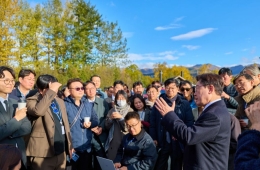
On July 24, the Fair Trade Commission announced that it held the "Construction Industry Win-Win Cooperation and Fair Trade Agreement Ceremony" at the Specialized Construction Hall in Dongjak-gu, Seoul, attended by some 40 people, including the representatives of comprehensive construction companies ranked 21st to 50th in construction capability and officials from the Korea Specialty Contractors Association.
The most notable point in this agreement is the inclusion of a "provision for sharing responsibility in defect lawsuits." Until now, when apartment residents or other multi-family housing occupants filed lawsuits for damages due to defects against comprehensive constructors (primary contractors), these firms would often proceed with litigation without even notifying the subcontractors. If the main contractor lost the case, it frequently unilaterally passed on the costs of defeat and excessive compensation amounts to the subcontractors.
This clause was not included in the initial agreement signed in May with the major construction companies, but has been added following the Fair Trade Commission's consultations with specialty contractors on their challenges since the first agreement. Upon facing a defect lawsuit, the primary contractor must immediately notify the subcontractor, and the compensation amount determined by the court must be jointly and sincerely discussed and shared according to the degree of responsibility.
Abolition of 'Retained Payments' and Rapid Reflection of Raw Material Price Increases
The "retained payments" practice, in which around 10% of progress payments were withheld until project completion, will now be completely abolished. The Fair Trade Commission has established the principle of cash payment within the legal deadline and agreed not to keep any retained funds. This is expected to alleviate the cash flow difficulties of subcontractors, who have struggled to cover labor and raw material costs because they could not receive payments in a timely manner.
In addition, the parties agreed to self-review and delete unfair special clauses that passed industrial safety or waste disposal costs on to subcontractors. In cases where raw material prices surge due to external factors, such as the recent increase in geopolitical risks in the Middle East, both the primary and subcontractor parties pledged to establish in advance the criteria and procedures for promptly adjusting contract prices, even before the scheduled adjustment cycle under the price linkage system.
Covers 60% of Market Transactions..."A Catalyst to Ease Polarization in the Corporate Ecosystem"
With this agreement, the reach of win-win cooperation is dramatically expanding throughout the construction market. As of last year, there were approximately 61,673 construction subcontract contracts nationwide, worth a total of 54.1316 trillion won. Of these, the top 50 comprehensive construction companies, which participated in the first and second agreements, were responsible for 12,269 contracts (32.2270 trillion won), representing 19.89% of all contracts and 59.53% of total transaction value. As a result, about 60% of market transaction volume will now be directly subject to voluntary win-win regulations.
In his opening address, Fair Trade Commission Chair Joo Byung Ki emphasized, "As pointed out by last year's Nobel laureate in economics, Philippe Aghion, a major barrier to innovation is inequality and an abnormally polarized corporate ecosystem," adding, "This soft regulation, the voluntary win-win agreement created by the top 50 construction firms, will become the foundation for the growth of the Korean economy by ensuring fair compensation and opportunities for growth for all businesses and workers in the subcontracting chain."
Hot Picks Today
 "Auntie, When Will Dried Shredded Squid Return as a Side Dish?"...Once Vanished from Restaurants, Now Making a Comeback
- Monthly Salary Soars 3.7 Times from 8.25 Million Won to 30.59 Million Won... 86 Fair Trade Commission Retirees Join Law Firms Over 10 Years
- "Is It Right to Pay This Much on a Fixed Salary?"... Seoul Ranks 1st or 2nd Globally for Smartphone Fees
- Illegal Webtoon and Video Sites Repeatedly Return Even After Being Blocked Over 200 Times
- Gucci Starts Selling 'Made in China' Shoes Amid Sluggish Sales... What’s Happening with Luxury Sneakers Priced at 1.2–1.3 Million Won?
Meanwhile, to enhance the effectiveness of this agreement, the Fair Trade Commission and the construction industry plan to hold joint public-private consultative meetings in September (for large companies) and November (for mid-sized companies) to continuously monitor the implementation status and address on-site issues.
© The Asia Business Daily. All rights reserved. Unauthorized AI training and use prohibited.