'US Finalizes Forced Labor Tariffs... Blue House: "Close Coordination to Maintain 15% Korea-U.S. Agreement"'
U.S. Implements Section 301 Tariffs as 10% Global Tariffs Expire
"Korea and the U.S. Agree on Upholding the 15% Tariff Deal"
Oversupply Investigation Also Underway
On the 24th, the Blue House commented on the United States' confirmation of "Section 301 Forced Labor Tariffs" for 60 major trading partners, including Korea, stating, "Both South Korea and the United States share a consensus that the agreed tariff arrangement must be upheld." The statement continued, "We plan to closely coordinate with the U.S. side to ensure that the final mutually agreed-upon tariff ceiling of 15% is maintained, including issues such as the ongoing Section 301 investigation into structural oversupply."

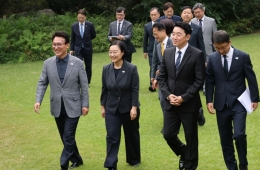
President Lee Jae-myung commuted to the Blue House, and on the 29th, marking the official restart of the Blue House era after 3 years and 7 months, the phoenix flag was hoisted at the Blue House in Seoul. 2025.12.29 Photo by Cho Yongjun
View original imageA Blue House official explained on this day, "These Section 301 forced labor tariffs have been imposed on 60 major countries, depending on whether they have enacted a law banning the import of goods produced with forced labor."
The United States Trade Representative (USTR) announced on the 23rd (local time) its final decision to impose tariffs of 10–12.5% on 60 economies that have not established or effectively enforced systems banning the import of products made using forced labor.
For Korean-made products, the general principle is that the total tariff rate will be 12.5%, calculated by combining the existing Most-Favored-Nation (MFN) tariffs with the new Section 301 tariffs. If the existing tariff rate is less than 12.5%, a Section 301 tariff will be added to reach a combined rate of 12.5%. If the existing tariff rate is already 12.5% or higher, no additional Section 301 tariff will be imposed.
Accordingly, not all Korean products will uniformly face an extra 12.5% tariff in addition to existing duties. Products subject to Section 232 of the Trade Expansion Act, as well as USTR-designated items such as certain raw materials, pharmaceuticals, and specific agricultural goods, are excluded from these new tariffs.

The new tariffs took effect at 12:01 a.m., U.S. Eastern Time, on the 24th. This timing coincided with the expiration of the 10% global tariff imposed via Section 122 of the Trade Act by the Trump administration, following the U.S. Supreme Court's ruling last February that reciprocal tariffs based on the International Emergency Economic Powers Act (IEEPA) were unlawful.
Tariffs under Section 122 of the Trade Act can be imposed for up to 150 days without congressional approval. Analysts note that, by introducing the Section 301 forced labor tariffs as the global tariff expired, the Trump administration effectively filled a gap in tariff coverage.
Currently, the effective forced labor tariff rate on Korean products is below the 15% cap agreed upon between South Korea and the United States. However, the U.S. is also conducting a separate Section 301 investigation into structural overcapacity in the manufacturing sector.
Hot Picks Today
!["Don't Use Chinese-Made Products": One U.S. Warning Triggers a 5 Trillion Won Jackpot for Korean Batteries [Weekend Money]](https://cwcontent.asiae.co.kr/asiaresize/93/2025121709393659037_1765931975.jpg) "Don't Use Chinese-Made Products": One U.S. Warning Triggers a 5 Trillion Won Jackpot for Korean Batteries [Weekend Money]
"Don't Use Chinese-Made Products": One U.S. Warning Triggers a 5 Trillion Won Jackpot for Korean Batteries [Weekend Money]
- "Dividend Payouts of 40 Million Won Before Their First Birthday"...'Baby Shareholders' Put Ordinary Workers at a Disadvantage
- Mixing Leftover Hemp from Hemp Cloth into Film... Biodegradable Plastic's Remarkable Strength Boost [Reading Science]
- "Planning a Trip to Japan?"... Accelerating Yen Strength [Weekend Money]
- "Wasn't It a Huge Trend Among Millennials and Gen Z Just Recently?"... '12 Billion Bottles Inventory Bomb' Enough to Last the World for Three Years
The government intends to monitor the possibility of additional tariffs being imposed based on the results of the oversupply investigation and will continue consultations to ensure the final cumulative tariff burden—inclusive of the forced labor tariffs and any subsequent U.S. measures—does not exceed the mutually agreed ceiling of 15%.
© The Asia Business Daily. All rights reserved. Unauthorized AI training and use prohibited.