EU Fines Google 1.5 Trillion Won for Digital Markets Act Violation

The European Union (EU) has imposed a fine of 890 million euros (approximately KRW 1.5 trillion) on the U.S. tech giant Google for violating the Digital Markets Act (DMA).
On July 23 (local time), the EU announced the sanctions, stating that Google leveraged its dominant market position to favor its own services and restrict competition.
The EU determined that Google, through its de facto monopolistic search engine and app marketplace Google Play, steered users toward its own services and applications, thereby disadvantaging competing companies.
The fine consists of 460 million euros for violations related to its search service, and 430 million euros for restricting consumers’ access to alternative purchase channels during the operation of Google Play.
The Digital Markets Act prohibits ‘gatekeepers’—companies with dominant market power—from prioritizing or preferentially displaying their own services in search results over those of competitors.
The EU explained that Google violated this law by placing its own services, such as shopping, transportation, and travel, at the top of search results and using more prominent screen configurations to maximize visibility.
In addition, app developers using Google Play must be allowed to freely inform consumers of less expensive alternative purchase channels, such as websites or other app marketplaces, but the EU found Google has failed to properly fulfill this obligation.

Under the ruling, Google must complete corrective measures within 60 days. If it fails to comply with the order, the EU may repeatedly impose penalty payments of up to 5% of Google’s total worldwide annual turnover.
This is not the first time Google has been hit with a large fine from the EU. In 2018, the EU fined Google 4.343 billion euros (approximately KRW 7.67 trillion) for abusing its dominant position in the Android operating system (OS) market.
Google contested the fine with eight years of litigation, but recently lost its final appeal at the European Court of Justice (ECJ), which upheld the penalty.
Recently, the EU has been stepping up regulations on both Chinese technology companies such as Huawei and U.S. big tech firms. Consequently, both the United States and China are pushing back against the EU's ramped-up regulatory efforts.
The U.S. administration under former President Donald Trump expressed dissatisfaction with the EU’s big tech regulations, and there are concerns this could spark a new trade dispute between the two sides.
China, for its part, has also strongly protested as the EU has moved to exclude Chinese tech products from public procurement markets on national security grounds, further escalating tensions.
Hot Picks Today
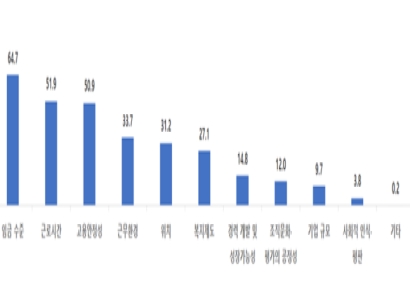 "Please Pay Me at Least 3 Million Won a Month": More Than Half of Young People Today Prioritize "Working Conditions" Over Company Size
- Selling Like Crazy Every Year... 30-Year-Old Hetbahn Takes on a New Challenge: Tastes Better Than "Mom's Home Cooking" [On-Site Report]
- Ran 18 km With 9-Year-Old Tied to Him at the Waist... "Man Banned From Competing for 3 Years"
- "Hey, Lady, Teach Your Kids to Behave!" ... 300,000 Won in Cash and a Bodily Injury Claim Demanded Over Child's Door Ding
- Beachgoer Finds 'Plastic' That Turns Out to Be Perfume Ingredient Worth More Than Twice as Much as Gold
By imposing a 1.5 trillion won fine on Google for violating the Digital Markets Act, the EU has raised the bar for global regulation of big tech companies.
© The Asia Business Daily. All rights reserved. Unauthorized AI training and use prohibited.





![[Market ING] KOSPI Seeks Rebound in Superweek Packed with Corporate Earnings and FOMC](https://cwcontent.asiae.co.kr/asiaresize/307/2026102514484873155_1792907327.jpg)