[Q&A] President Lee Jae-myung Holds 193-Minute 'Marathon Debate' on Real Estate with 28 Participants
Lee Attends National Real Estate Policy Debate on the 23rd
Session Runs Well Beyond Intended 100 Minutes
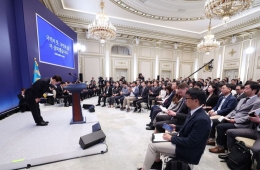
President Lee Jae-myung attended the National Real Estate Policy Debate held at the KBS Annex in Yeouido, Seoul, on July 23, and listened to the opinions of 28 out of 140 participants.
The forum was attended not only by government officials, including Prime Minister Han Seong-sook, but also by YouTubers, real estate community administrators, professors, researchers, university students, journalists, and actual homeowners, all of whom voiced their opinions.
As participants' remarks were lengthier than expected, the discussion lasted 193 minutes, far exceeding the initially scheduled 100 minutes.
Below are the key points raised by the participants and the responses from President Lee.

President Lee Jae-myung is listening to participants' remarks at the National Real Estate Policy Debate held at the KBS annex in Yeouido, Seoul on July 23, 2026. Photo by Yonhap News
View original imageSupply
Limit the redevelopment period and strengthen the process for gathering residents’ opinions
While the number of households may increase with reconstruction, the growth doesn't seem significant. In the case of redevelopment, it appears that the number of households usually decreases. Although living environments improve and higher-quality housing is supplied, many existing residents are forced to leave. There is an ongoing debate over whether reconstruction and redevelopment effectively increase new housing supply.
Foster private rental housing providers and introduce supply-side financing
If a private developer already possesses land for new construction, why would they offer rentals? They would likely go for sales. The fundamental issue is that there is no available land for new construction. This isn’t a matter of choosing between rental and sale when numerous plots are available. Without land, how would one secure sites? (Since there are many parcels that could be repurposed, let’s consider giving full benefits for conversion.) We will look into this.
Please accelerate the development of the third phase new towns. The public is frustrated.
The delayed start of construction in previously announced areas, including the third phase of new towns, is a serious problem. Internally, it is said to take over 60 months. We are reviewing ways to reduce it to less than half. The administrative process is too slow, so we are considering changing regulations or parallelizing procedures to save time.
Despite brokers pressuring for finishing material price hikes, which drive up house prices, investigations are not being conducted
This is a very valid point. I will make sure to look into whether the rise in finishing material prices is truly unavoidable due to objective factors or if wrongdoing is involved. It seems likely that there were unjustified increases during opaque processes. The rate of price increases is truly shocking. I will address this separately. We will conduct a systematic review.
Consider a land lease system in which public sites are not sold to the private sector, but only buildings are sold to private owners
I wonder whether this can be realized ideally. In the past, Seoul saw some lots fully sold and others partially leased, but over time the prices became similar. It appears that people become confident that they, too, can eventually acquire the land. While the intention is good, in the end, the building owner will likely have to be given priority. Actual sales prices may drop, but I question whether it would achieve the intended effect of conserving land for public use.

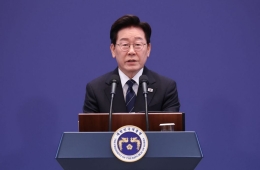
President Lee Jae-myung is asking attendees for their opinions at the Real Estate Policy Public Forum held at the KBS Annex in Yeouido, Seoul on the 23rd. July 23, 2026. Photo by Yonhap News
View original imageFinance
Current regulations only apply to new borrowers, but debt restructuring should also be considered for existing borrowers
This is a new perspective. I believe you are right. Parents and older generations have already benefited from opportunities for growth, but for young people it has become extremely difficult to even begin. As for existing borrowers, we already require them to repay in full and meet new conditions when their loans mature.
Please establish exceptions to loan restrictions for genuine homebuyers who have already signed contracts
This point has been raised quite often. It’s a valid concern when someone has already made a decision, but then policy changes afterward. Planning was done based on the existing system, so enforcing new rules could lead to unfair situations. When drawing policy boundaries, we must minimize the number of people negatively affected.
The current guarantee system fully guarantees those who meet the requirements and denies others completely
There is a demand to allow partial guarantees. Currently, if you are within permitted limits, partial guarantees don’t appear to exist, but providing such options is a reasonable suggestion.
Regarding Jeonse (lump-sum housing lease) loans
Jeonse loans were practically limitless. It was too easy to obtain Jeonse financing. This has contributed to the rise in home prices. When Jeonse loans cover up to 100% of house prices and full guarantees are provided, fraud becomes an issue. Jeonse loans are intended as a policy to stabilize housing for ordinary citizens, but they have also become a major driver of price spikes. Now is the time for adjustments.

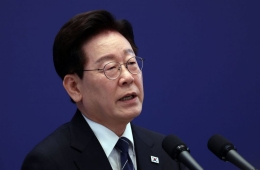
President Lee Jae-myung is speaking at the National Public Debate on Real Estate Policy held at the KBS Annex in Yeouido, Seoul on July 23, 2026. Photo by Yonhap News.
View original imageTaxation
Is it right for property tax to drive people from their homes? If someone sells their house in Seoul and moves to their hometown, provide benefits
To reach the level of developed countries, property tax would have to be tripled. If that happened, it would almost trigger civil unrest. Had we normalized this in the past, these spikes wouldn’t have occurred. In the end, a compromise is necessary, but we must prepare for the future. One day, the issue will explode. No one knows who will be affected, but it will be a massive shock for South Korea. Even at political cost, I believe we must be prepared.
What about setting a baseline? For owners of a single home, set a reasonable holding tax, and offer relief if the owner resides there or is part of the low- or middle-income class. Regional factors should also be considered. On the other hand, for luxury homes, multiple properties, or clear speculative ownership, we could introduce a graduated surcharge.
Tax benefits for residents should not become a windfall for those who own only the most valuable property
The phenomenon of putting all one’s resources into a single expensive property has caused major problems in our society. It has created highly efficient opportunities for speculation. There is some validity to the argument that the price of top-tier apartments drive up prices elsewhere.
Capital gains tax exemptions should be limited to one instance per lifetime
I think this is a good idea. Providing unlimited exemptions seems problematic. We might also consider a total exemption limit. It is reasonable to question whether individuals who repeatedly buy and sell high-priced homes should receive the same capital gains tax relief each time.
As in developed countries, allow the tax-free benefit for a single home per household only once
I would like to hear more specifics. When defining ultra-high-priced homes, there may be tremendous resistance to taxation. It is difficult to determine what qualifies as an ultra-high-priced home. However, in the short term, the most urgent matter is the tax system itself, as there are no time constraints for reform.
When assessing capital gains tax, the increase in property tax should be deducted
That makes sense. I will consider it in the future. If done this way, it would seem fairer.

President Lee Jae-myung is entering the National Public Discussion on Real Estate Policy held at the KBS Annex in Yeouido, Seoul on July 23, 2026. Photo by Yonhap News
View original imagePolicy
The objectives of real estate policy must be clearly defined
The goal isn’t to forcibly lower prices. It is not sound policy to ignore market dynamics and forcibly adjust supply and demand to drive prices up or down. Rather, it is to prevent prices from being determined by distorted or abnormal demand and supply dynamics. The aim is normalization. For those who strongly desire apartments overlooking the Han River, I believe their intentions should be respected.
Seoul’s unearned real estate income should be curbed, and regional infrastructure and housing welfare should be enhanced to form a virtuous cycle
These are all valid opinions. Thanks to the semiconductor industry’s success, there is some surplus tax revenue, and we decided to invest it intensively in the regions, youth, education, and the future. The housing issue is closely tied to reducing concentration in the capital area, and I will keep this in mind.
Consideration must be given to newlyweds and young people
I have heard about the so-called “marriage penalty.” There are reports that getting married makes it even harder to get loans, purchase homes, or win pre-sale lotteries, so many young couples do not register their marriage after the ceremony. I have asked the prime minister to conduct a thorough investigation. We will identify all such cases of disadvantage and rectify them.
Standards for property and capital gains taxes should be explicitly stated in law, not executive orders, to prevent people from waiting out an administration change
This is a crucial point. We are paying close attention to tax policy and consolidating public opinion to make it as reasonable as possible. Our aim is to ensure there are no loopholes or opportunities for abuse, and we will legislate these measures wherever possible.
Unavoidable reasons such as inheritance are not considered in determining first-time ownership
I assume there are quite a few such cases. It is difficult to change the rules for rare but extremely unfair situations. I hope the prime minister will consider it. Perhaps we could have a committee to review and decide on these cases. Unless a president directly orders a change, it seems these cannot be resolved. Such issues exist in every area.
Hot Picks Today
!["How Little Do Koreans Read? Who Will Acquire Munhakdongne Now on the Market [Weekend Money]"](https://cwcontent.asiae.co.kr/asiaresize/93/2026091716280432990_1789630084.jpg) "How Little Do Koreans Read? Who Will Acquire Munhakdongne Now on the Market [Weekend Money]"
"How Little Do Koreans Read? Who Will Acquire Munhakdongne Now on the Market [Weekend Money]"
- "Bank Offers 3.5%, but... Which ETF Hit a 21% Dividend Yield? [Weekend Money]"
- "Holiday Liquor Price Hits 1.8 Billion Won"... The Identity of the Whisky That Sold Out Instantly After Launch
- "Please Be Quiet"... China to Fine Up to 210,000 Won for Disruptive Passengers Using Speakerphones
- "Raised a Stray Kitten, but..." Scientific Community Stunned: First New Wild Cat Species Discovered in 100 Years
© The Asia Business Daily. All rights reserved. Unauthorized AI training and use prohibited.