Lee Signals Comprehensive Overhaul of Real Estate Supply, Finance, and Taxation: "Will Take Necessary Action Despite Political Cost" (Comprehensive)
President Lee Presides Over Real Estate Policy Debate; Session Lasts Over Three Hours
"Goal Is Not Forcible Price Drops, But to Normalize an Abnormal Market"
Helicopter Inspections Planned for Metropolitan Area; Third New Town Construction T
President Lee Jae-myung assessed the real estate market as a situation where risks are accumulating and could eventually burst. He announced that his administration would take meticulous measures across supply, finance, and taxation, even at the cost of political liability. He also expressed an intention to directly identify new development sites in the Seoul metropolitan area, significantly shorten the procedures for breaking ground on the third-phase new towns, and block the inflow of speculative funds through rental and business loans. The upcoming tax reform proposal may also include a multi-layered property holding tax system, which could protect residential, mid-priced, and regional housing while increasing the burden on ultra-high-priced, multi-home, and speculative investment properties.
On July 23, during the National Public Debate on Real Estate Policy at the KBS Annex, President Lee stated, "The policy goal is not to forcibly lower prices. We want to prevent prices from being formed abnormally due to unusual demand and supply factors and to normalize the market."
In particular, President Lee warned that the persistent upward pressure on real estate prices is reminiscent of Japan's real estate bubble collapse, stating, "It will burst at some point. We don't know which generation or who will be hit, but it will bring a tremendous shock to Korea." He added, "Even if there is political damage, we need to prepare. We must do what needs to be done for the nation as a whole, for the country's future, and for better conditions in the long run."

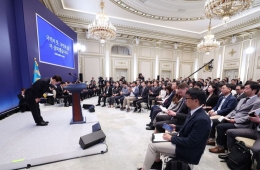
On the 23rd, attendees are requesting the floor during the National Real Estate Policy Debate presided over by President Lee Jae-myung at the KBS Annex in Yeouido, Seoul. 2026.7.23 Photo by Yonhap News
View original image"There's now no land left in Seoul... I will personally inspect new development sites in the Seoul metropolitan area by helicopter"
President Lee reiterated the difficulty of securing new development sites in Seoul and the broader metropolitan area. He said, "It is almost impossible to find land for residential development anywhere in Seoul," and added, "Obstacles like relaxing greenbelt restrictions and resident opposition to redeveloping existing urban areas highlight the clear limitations in supply."
Nonetheless, he outlined plans to personally inspect available land in the capital region. "I plan to fly over the metropolitan area in a helicopter," he said, adding, "What civil servants think is impossible may look different from my perspective." He further noted, "We are making every effort to identify as many new development sites as possible," and called on the public to share their opinions regarding available idle land suitable for development.
President Lee expressed strong concerns about delays in third-phase new towns and public land development projects. He said, "Delays in groundbreaking for previously announced sites are a very serious issue," noting that it currently takes more than 60 months for some administrative procedures and that the administration is considering changing regulations or processing steps in parallel to cut that time at least in half. He also announced a plan to convert idle land in industrial and commercial areas into residential sites and to roll out high-quality, long-term public rental housing units (at about 82–99 square meters) around transit hubs so that even the middle class can access them.
President Lee ordered a comprehensive review of the recent sharp increase in reconstruction and redevelopment costs. In response to concerns raised during the debate—such as the roles of rising construction material prices, luxury finishing materials, and opaque transactions among brokers, housing associations, and construction companies driving up costs—he said, "I will closely examine whether these increases are truly unavoidable or if they involve structural misconduct." He also cited his own experience of seeing hundreds of billions of won in housing association construction costs reduced following an audit and adjustments, saying, "If those increases had truly been inevitable, it would have been hard to lower them," and concluded, "There is a clear need for a comprehensive review."

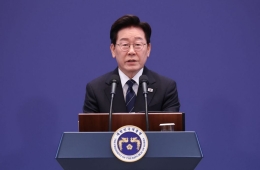
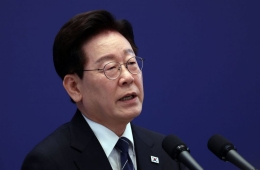
President Lee Jae-myung is asking participants for their opinions at the National Public Debate on Real Estate Policy held at the KBS Annex in Yeouido, Seoul on July 23, 2026. Photo by Yonhap News Agency
View original image"For holding tax to reach advanced country standards, it must at least triple... Phased adjustment is necessary"
On taxation, President Lee placed the normalization of property holding tax at the center of discussion, indicating that the standard burden should be set based on a typical single-homeowner while offering reductions for residential, mid-priced, and regional homes, and increasing the burden on ultra-high-priced, multi-home, and clearly speculative properties. The government plans to announce the "2026 Tax Reform Plan" as early as the end of July.
President Lee said, "Once we set the basic standard for a single home, reductions can be considered for residential use and for homes for working-class, middle-class, and regional residents. By contrast, if the home is exceptionally expensive, if multiple homes are owned, or if the intent is clearly speculative, additional charges should be considered." He also suggested that instead of using "actual residence" as the criterion, application should be based on "residential use," to accommodate cases where homeowners are temporarily unable to reside due to work or children's education.
He diagnosed that the previous system, which provided blanket protection for single-homeowners, fostered the so-called "smart single property" preference. This is interpreted as a reference to the measures under the previous administration, when the property holding tax for multi-homeowners was raised up to 3.2% annually and transfer income taxes were further increased.
President Lee stated, "This 'smart single property' phenomenon has caused serious problems in our society. By trying to protect single-home households, we ended up treating cheap and expensive homes the same and failing to distinguish between residential, investment, or speculative purposes. This has provided the most efficient route for speculation." He emphasized that, rather than focusing on the formal status of single-homeownership, tax burdens should be tailored based on property value and actual holding purpose.
With regard to the level of holding tax, President Lee pointed out that Korea’s property holding tax is significantly lower than that of advanced economies, emphasizing the necessity of gradual adjustment. He said, "To reach the standard level of developed countries, the holding tax must at least triple. If we were to triple it today, it would almost be a riot, so gradual adjustment is required." He added, "Had we normalized the holding tax in the past, housing prices would not have risen this much."
Alongside a stronger property holding tax, President Lee also intends to facilitate the release of more homes onto the market by easing transaction barriers. He stated, "If we only tighten holding tax, that's not enough. We must also provide an exit route," suggesting there is a need to consider adjusting taxes on transactions such as capital gains tax.
He also raised an issue with the structure that allows single-homeowner capital gains tax relief to be applied repeats without limit each time a property is sold and purchased. When proposals were raised during the debate for limits based on number of lifetime transactions or by amount, President Lee commented, "Allowing this benefit to be used infinitely is problematic. There is sense in providing more relief the first time, and then gradually reducing it from the second time onward."
President Lee expressed support for proposals to enshrine the key criteria for taxation within law, not just administrative decrees, to prevent homeowners from stalling in hopes of a future change in administration. He stated, "We should thoroughly gather public opinion, create a rational policy, and ensure that there are no loopholes or opportunities for abuse, pursuing legislation as far as possible."

On the 23rd, participants requested speaking rights at the National Real Estate Policy Forum held at the KBS Annex in Yeouido, Seoul, presided over by President Lee Jae-myung. 2026.7.23 Yonhap News Photo by Yonhap
View original imageJeonse Loans as "Primary Driver of Soaring Home Prices"... Signs of Across-the-Board Financial Regulation Tightening
In the field of finance, President Lee indicated that the flow of loans into real estate would be broadly tightened. However, a "targeted finance" policy will be implemented, selectively supporting genuine demand groups such as young people, newlyweds, and first-time homebuyers. Regarding financial institution lending, President Lee remarked, "Part of the state-granted authority to issue currency is inherently public," and asked, "Should the system really allow the use of finance to buy homes for profit? The structure in which public funds are mobilized for speculative property purchases must be re-examined."
President Lee particularly pointed to the expansion of jeonse loans as a cause of rising home prices and rental scams, stating, "In an effort to make jeonse easier for working people, we allowed nearly unlimited jeonse loans. Jeonse loans have become the main factor behind the surge or continued high price of homes, and the time has come for adjustments." He also noted that large-scale loans and guarantees nearly matching total jeonse deposits have enabled rent fraud by allowing multiple homes to be secured without any personal capital, and signaled overall curbs on jeonse lending, with targeted support reserved for young people, newlyweds, and first-time borrowers only.
Hot Picks Today
!["How Little Do Koreans Read? Who Will Acquire Munhakdongne Now on the Market [Weekend Money]"](https://cwcontent.asiae.co.kr/asiaresize/93/2026091716280432990_1789630084.jpg) "How Little Do Koreans Read? Who Will Acquire Munhakdongne Now on the Market [Weekend Money]"
"How Little Do Koreans Read? Who Will Acquire Munhakdongne Now on the Market [Weekend Money]"
- "Bank Offers 3.5%, but... Which ETF Hit a 21% Dividend Yield? [Weekend Money]"
- "Holiday Liquor Price Hits 1.8 Billion Won"... The Identity of the Whisky That Sold Out Instantly After Launch
- "Please Be Quiet"... China to Fine Up to 210,000 Won for Disruptive Passengers Using Speakerphones
- "Raised a Stray Kitten, but..." Scientific Community Stunned: First New Wild Cat Species Discovered in 100 Years
President Lee also called for closing regulatory loopholes allowing business loans collateralized by high-value homes to be used to bypass restrictions on home purchasing. While loans for home purchases are restricted, some could still secure a business loan backed by an expensive property, then refinance with a different type of collateral. President Lee observed, "By briefly raising funds to acquire a home and then offering it as collateral with a new loan under a different pretext, de facto circumvention is possible." He continued, "The practice of granting unlimited collateral value on general loans needs to be reconsidered," and ordered financial authorities to strengthen both loan-purpose tracking and post-loan reviews. However, he also stated that transitional measures should be put in place to address cases where genuine buyers who have already signed sales contracts become unable to obtain final loans due to newly introduced lending limits.
© The Asia Business Daily. All rights reserved. Unauthorized AI training and use prohibited.