President Lee: "General Consensus on Strengthening Holding Tax... The Key is How Far and How Much"
"To Match Advanced Countries, Holding Tax Must Triple... Doing So Immediately Would Cause Near-Riot"
Calls for Gradual and Precisely Calibrated Policy Design
"Recognizing Paid Holding Tax as a Capital Gains Expense... A Reasonable Approach"
On July 23, President Lee Jae-myung stated that while there is a broad national consensus on the need to strengthen property holding taxes, the core of the actual policy lies in the scope of taxable subjects and the extent of the tax burden. He pointed out that, according to some analyses, to bring holding taxes up to the levels of advanced nations, they would need to be increased by about three times compared to current rates. However, he warned that such a dramatic increase, if implemented in a short period of time, could result in "near-riot situations," and therefore called for a phased and sophisticated design of the system.

President Lee Jae-myung is asking participants for their opinions at the National Real Estate Policy Debate held on July 23, 2026, at the KBS Annex in Yeouido, Seoul. Photo by Yonhap News
View original imageAt the "National Real Estate Policy Debate" held at the KBS Annex in Seoul, President Lee remarked, "There is a general agreement that the holding tax should be strengthened," but added, "What matters is the scope of the strengthening, the degree, and which differentials will be applied." He explained that designing specific standards, such as definitions and rates for ultra-high-priced housing and the differentiation between single homeowners for residence and multiple homeowners, is more challenging than the general argument for raising holding taxes. He said, "For people living in provincial areas, a market value of 3 billion won is an extremely expensive home and certainly considered ultra-high-priced," while acknowledging that "people living in Seoul may see it differently, so it is difficult to determine an appropriate threshold."
Rather than raising holding taxes across the board, President Lee proposed first defining an appropriate tax burden for a typical single-homeowner, and then adjusting the burden up or down based on factors such as housing price, purpose, number of owned properties, and region. He said, "If we set a reasonable tax burden based on a standard single-homeowner and provide reductions for those residing or holding for residential purposes, it would be fairer. Further reductions could be given for homes aimed at the working class or middle class, as part of protection measures, and regional factors such as locations outside Seoul could also be taken into account."
In contrast, he suggested ultra-high-priced or luxury homes and properties owned for clear investment or speculation purposes, as well as multiple homes, should be subject to heavier taxation. President Lee stated, "If a property is classified as extremely expensive or as a luxury home, or if it's a case of holding multiple homes or clearly for speculation, these are factors for increased taxation," adding, "We are considering ways to apply step-by-step differentials by taking these factors into account."
President Lee also reaffirmed that the longstanding policy of granting the same benefit to all single-homeowners, regardless of price or purpose, has fueled demand for what is referred to as 'the one smart property' investment. He pointed out, "While it was meant to respect and protect one household-one home ownership, treating all homes the same regardless of cost created a highly efficient speculative opportunity. Failing to distinguish between residential and investment or speculative purposes opened a small loophole that led to massive consequences."
However, President Lee recognized practical limitations to sharply raising holding taxes in a short period. He said, "To align our property holding tax with the typical level of advanced countries, it would need to be nearly tripled. If we did that now, it might practically cause a riot." He further remarked, "If holding taxes had been normalized in the past, real estate prices would not have risen this much. Now, since prices have already soared, it has become difficult to lower them, so some realistic compromise is ultimately necessary."
Nonetheless, he stressed that the prolonged surge in real estate prices and wealth concentration is exactly why the government cannot keep postponing action due to political concerns. President Lee said, "The pressure keeps building and could explode at any time. While no one knows which generation will be affected, the result could be a fatal blow to Korea, so even if it is politically costly, we must prepare for the dangers ahead."

On July 23, participants are requesting to speak at the National Real Estate Policy Debate presided over by President Lee Jae-myung, held at the KBS Annex in Yeouido, Seoul. 2026.7.23 Photo by Yonhap News
View original imagePresident Lee also responded positively to the idea of recognizing holding taxes as necessary expenses in the calculation of capital gains tax. This was in response to a suggestion from a debate participant that a portion of the holding taxes paid during the ownership period should be deducted from the capital gain when a home is sold, thereby reducing the capital gains tax burden. He said, "It makes sense to recognize the holding tax paid as a necessary expense when calculating capital gains," and noted, "This is worth considering in the future. That way, taxpayers would feel less unfairly treated." This indicates that even while strengthening holding taxes, adjustments can be made between tax categories to prevent the burden from simply overlapping when a property is sold.
He also mentioned that creating a temporary exit route for multiple-homeowners to sell their properties is under consideration. The concern is that if only the holding tax is raised while the additional capital gains tax for multiple-homeowners remains, it could exacerbate 'locked-in sales,' discouraging people from selling. President Lee said, "The idea of strengthening the holding tax while at the same time providing an exit route is appropriate," but added, "At the same time, we need to carefully consider what period and scale of opportunity will be fair, so that those who disposed of their homes based on previous government policies don’t feel disadvantaged."
Hot Picks Today
 "Surviving on One Meal a Day to Invest 3.5 Million Won Monthly... 'FIRE' Craze Sparks 'NISA Poverty' in Japan"
- "Spend 200,000 Won, Get 100,000 Won Back?"... Government's Bold Move Unveiled [Essential Tips for Benefits]
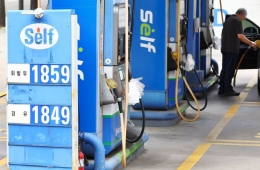
- Nationwide Gas Station Fuel Prices Drop for 16 Straight Weeks... International Oil Prices Rise
- "Is Extended Fasting Risky Beyond This Age?... The Twist in 'Intermittent Fasting' [Experiment Note]"
- "I'm Getting Married, But Please Don't Come"... Gen Z's Changing Wedding Trends [World is Z-gold]
President Lee agreed with the need to increase the predictability and consistency of the tax system by directly stipulating key tax standards in law rather than in lower-level administrative regulations. He said, "It is the right approach to thoroughly deliberate, create a rational system with no loopholes for abuse, and then legislate it instead of relying solely on executive orders."
© The Asia Business Daily. All rights reserved. Unauthorized AI training and use prohibited.

![Listings Pile Up in Gangnam, While Gangbuk Has None Left to Sell... As Seoul Transactions Dwindle, Buying Sentiment Diverges [Real Estate A to Z]](https://cwcontent.asiae.co.kr/asiaresize/307/2026090415531016688_1788504791.jpg)
![[Report] "From AI Homes to Premium Lineups"... Chinese Electronics Dominate IFA 2026](https://cwcontent.asiae.co.kr/asiaresize/307/2026090505514216935_1788555102.jpg)
![[New York Stock Exchange] Interest Rate Hike Concerns Rise on Strong Employment Data... Dow Down 0.51%](https://cwcontent.asiae.co.kr/asiaresize/307/2026090223194913207_1788358790.jpg)