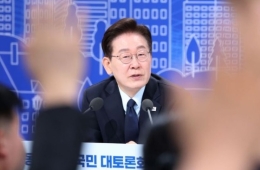
'National Real Estate Policy Debate' President Lee: "Difficult to Find Development Land... Clear Limits on Supply"
President Lee Presides Over the "National Real Estate Policy Debate"
"Why Did Permits and Construction Starts Plunge Since 2022?"
Separating Real Demand from Speculative Demand… "Suppressing Demand Through Taxation Should Be Exceptional"
On July 23, President Lee Jaemyung addressed the demand for increased real estate supply, stating, "It is now difficult to even find land for development in Seoul." He pointed out that, to resolve the so-called "supply cliff," it is ultimately necessary to establish large-scale residential complexes, yet there is a clear lack of available land. He also commented that on the demand side, it is important to approach the issue by distinguishing between end-user demand and investment or speculative demand, and that intervention in the real estate market through taxation requires a more cautious approach.

At the ‘National Real Estate Policy Debate’ held at the KBS Annex on the same day, President Lee remarked, “Some people say that increasing supply alone can solve the real estate issue, but the real question is where and how, and there is no clear answer.” He added that, unlike in the past, lifting green belts or building new towns is also no longer easy, and thus, "There is a clear limit to supply-side policies."
President Lee's remarks reflect deep concerns about increasing supply. According to Real Estate R114, the number of apartment move-ins scheduled for Seoul next year is 13,019 households—the smallest total since such statistics began. The ongoing ‘move-in drought’ in Seoul is expected to continue for some time, with no bold new supply strategies on the horizon.
President Lee also voiced skepticism regarding the recent emphasis by Seoul Mayor Oh Se-hoon and others on reconstruction and redevelopment projects. “In some instances, reconstruction raises the number of units, but as average floor space increases, supply expansion overall appears to be limited,” he said. “For redevelopment, it seems commonplace for the total number of move-in households to actually decrease.” He continued, “There is debate as to whether these measures truly generate a net increase in housing supply.”
The President's first question at the debate also concerned supply. After listening to an expert’s presentation, President Lee remarked, “I’d like to fact-check something. The number of construction permits and groundbreakings dropped sharply starting in 2022. Why did supply decrease so dramatically from 2022 to 2025? Are there structural reasons for this?” To this, Jin Miyoon, head professor at Myongji University’s Graduate School of Real Estate, replied, “Since late 2022, the rise in interest rates has significantly dampened the market.”
President Lee followed up, asking whether policy authorities had played a role in this trend. Professor Jin answered, “Following the Russia-Ukraine war and the COVID-19 period, we saw supply chain disruptions. The environment worsened both at home and abroad due to issues with sourcing materials and rising construction costs, slowing the start of new projects.” When asked by President Lee about the current situation, she reported, “It appears those circumstances are still ongoing.”
On the demand side, President Lee stressed the need to distinguish between end-user demand and investment or speculative buying. He stated, “There’s normal demand from people seeking a stable home, but as home prices rise faster than inflation, there’s also investment and speculative demand—people borrowing to buy multiple homes or more expensive homes—as well as artificial demand.”
He called for a cautious approach to intervening in the real estate market via taxation. “The original purpose of taxation is for all members to fairly contribute to state finances,” said President Lee. “Using taxes specifically to suppress demand in a given sector or increase supply is somewhat exceptional.”
He added, “There needs to be a debate on whether it’s justifiable to intervene in supply and demand via taxation, and to what extent such intervention is appropriate.” It can be understood that he intends to closely examine policies such as holding and transaction taxes, considerations for actual residency, and taxes on multiple or ultra-high-value homes—not only in terms of policy effectiveness but also in terms of tax principles and public acceptance.
With regard to real estate loans from financial institutions, President Lee emphasized the public interest. “A financial institution’s lending capacity is, in fact, also the property of the people,” he said. “Finance is half-public in nature and forms part of the sovereign power delegated by the people to the nation.”
He continued, “Who should be given the opportunity to access financial resources is ultimately a matter of policy. If people use financial loans to buy homes simply for profit and this in turn causes home prices to rise excessively, hurting those who actually need housing, we need to consider whether this aligns with the public interest.”
Nonetheless, President Lee reaffirmed his principle that real estate is one of South Korea’s greatest challenges, stating, “Housing should be a foundation for a comfortable life for citizens, not just a means to make money.” He acknowledged that housing inevitably serves both as shelter and as an investment vehicle, but argued the problem is the excessive weight of investment and speculation.
In particular, he pointed out the heavy weighting of real estate holdings in Korean household assets and the concentration in the capital region, adding, “There are quite a few people worrying that, like Japan, we may be heading toward a bursting bubble after repeated real estate price hikes.”
Referring to the results from the recent topic-specific discussions on supply, finance, and taxation, President Lee said, “Unlike in the past, there is now a much stronger emphasis on viewing housing as the basis of a comfortable life rather than simply an investment vehicle. There has been a notable increase in voices calling for special consideration for young people, newly married couples, and families with multiple children.” He also highlighted that the housing issue is increasingly cited as a major reason for falling birth rates and delayed marriage, reinforcing the growing need for policy support targeting young people, newlyweds, and other genuine end-users.
As for the direction of future policy decisions, President Lee stated, “While we won’t necessarily decide everything by majority vote, if most people’s opinions are reasonable, we should follow them. After verifying the facts and having all parties present their arguments precisely, we should seek to adjust interests as much as possible, but where agreement remains elusive, the responsible official must ultimately make a decision.”
Hot Picks Today
 "I Thought Only Korea Was Struggling, but Japan Is Worse": Yen-Dollar Exchange Rate Hits 40-Year Low... What’s Happening to the Yen?
- "Waiting for the Right Time to Invest in Stocks, Won't Buy Even Under Pressure"... Advice from Comedian-Turned-Investment Expert Hwang Hyunhee
- [Breaking] Hyundai Motor Posts Q2 Operating Profit of 2.85 Trillion Won, Down 20.8% YoY
- "No Air Conditioner at Home? Come Here"...Rome Takes Extraordinary Measures Amid Record Heat Wave
- "Worked as a Hostess After Retirement"... Japan Shocked by the Current Status of Former Two-Time Olympic Gymnast
Meanwhile, a total of 140 people attended the debate, including YouTubers, members of real estate and mom communities, related civic groups, licensed realtors, employees of financial institutions, journalists, and professors.
© The Asia Business Daily. All rights reserved. Unauthorized AI training and use prohibited.