"Even with Negative Growth in the Second Half, Annual 3% Achievable"…Second Quarter GDP Growth Momentum Strengthens (Comprehensive)
Q2 Real GDP Up 0.6% Quarter-on-Quarter, Far Surpassing Forecasts
Export Growth Led by Semiconductors, With Private Consumption Bolstering Domestic Demand
3% Annual Growth Within Reach Even If H2 Averages -0.1% per Quarter
Real Purchasing
Korea's economy grew by 0.6% in the second quarter of this year. Overcoming the high base effect of the previous quarter's “1.8% surprise growth,” the country achieved growth that significantly exceeded forecasts. Not only solid exports centered on semiconductors, but also domestic demand such as private consumption supported this expansion. In particular, as semiconductor prices surged in the second quarter, the real purchasing power index—real Gross Domestic Income (GDI)—marked its highest growth rate in 38 years.
It has now become highly likely that annual growth will exceed 3% this year. Even if the economy were to contract by an average of 0.1% per quarter in the second half, the full-year growth rate would still reach 3%, thanks to strong growth in the first half. The Bank of Korea has already indicated it will sharply revise its May forecast of 2.6% upwards next month. The market is also preparing to raise growth outlooks. However, uncertainties remain, particularly regarding a lasting peace agreement in the Middle East and how the semiconductor industry will perform in the second half.

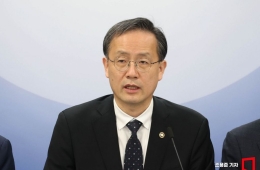
From left: Hyun-Young Lee, Head of National Income Expenditure Team at the Bank of Korea; Dong-Won Lee, Director of Economic Statistics Division 2; Jung-Seok Seo, Head of National Income General Team; and Geon Kim, Manager of National Income General Team, are attending the briefing on the preliminary estimate of real GDP for the second quarter of 2026 held at the Bank of Korea in Jung-gu, Seoul on the 23rd, answering questions. Bank of Korea
View original image0.6% Growth Despite High Base Effect... Exports and Domestic Demand Drive Expansion
On the 23rd, the Bank of Korea announced that the preliminary estimate for real GDP growth in the second quarter was 0.6% quarter-on-quarter. To be precise, it was 0.62%. This sharply exceeds the Bank of Korea’s previous estimate of 0.2% from May. Typically, when the previous quarter’s growth is high, the following quarter tends to register negative or substantially lower growth. However, the 0.6% increase following the strong 1.8% in the first quarter suggests momentum is actually intensifying. Compared to the same period last year, growth was 3.7%, sustaining the rapid growth recorded in the first quarter (3.8%).
Dong-Won Lee, Director of Economic Statistics Division 2 at the Bank of Korea, analyzed, “Despite concerns over the high base effect from the first quarter’s strong growth as well as intensification of the Middle East conflict, robust growth persisted in the second quarter.” He attributed this to two main factors: continued boom in the semiconductor sector and the limited negative impact from the Middle East conflict. Although the Middle East war disrupted supply for related industries, affecting production activity and employment, the government’s policies—including stabilization of naphtha supply, strategic oil reserves swaps, and diversification of import sources—offset these negative effects on growth.

Of note, not only did semiconductor-led exports perform as expected, but domestic demand remained strong as well. Both consumption and facility investment continued to grow. Private consumption rose 0.4% compared to the previous quarter, driven both by goods such as home appliances and services like food and hospitality. Hyun-Young Lee, Head of the National Income Expenditure Team at the Bank of Korea, pointed out, “Private consumption benefitted substantially from government support policies alongside Samsung Electronics’ cashback promotions, which alone generated over 3 trillion won in spending on home appliances, leading to significant growth in durable goods consumption. Robust stock prices through the second quarter also supported strong consumer sentiment.”
Government consumption increased by 0.2%, centered on National Health Insurance benefits, rebounding after a decline in the previous quarter. Facility investment rose by 0.2% as equipment such as semiconductor production machinery increased, continuing the sharp uptrend from the first quarter (6.6%). In contrast, construction investment fell by 0.2% as civil engineering work declined.
Exports increased by 1.4% quarter-on-quarter, largely thanks to semiconductors and machinery/equipment. Imports grew by 0.8%, as automobiles and machinery/equipment increased.
Looking at growth contributions by expenditure component in the second quarter, both domestic demand and exports contributed evenly to overall growth. The contribution of domestic demand was 0.3 percentage points, with consumption up 0.2 percentage points and intellectual property product investment up 0.2 percentage points. Examined by economic agent, private consumption contributed 0.6 percentage points—much higher than the government's contribution of -0.3 percentage points, signaling private-sector-led growth. The contribution from net exports (exports minus imports) was 0.3 percentage points; although imports rose by 0.3 percentage points, exports jumped by 0.7 percentage points, boosting overall contribution.

Semiconductor Price Surge Improves Terms of Trade... GDI 'Surprise' Grabs Governor’s Attention
Bank of Korea Governor Shin Hyun Song's focus on GDI proved prescient, as it also showed rapid growth. Real GDI, an indicator of real purchasing power earned through production activity, increased by 3.6% quarter-on-quarter, building on the previous quarter’s solid rise. Year-on-year, it surged by 15.6%, surpassing last quarter’s surprise growth of 13.2% and marking the highest figure since the first quarter of 1988 (16.4%), a record after 38 years and three months. This is the result of improved terms of trade brought about by surging semiconductor prices. Despite the Middle East conflict driving up import prices—especially for crude oil—the rise in export prices, led by semiconductors, was much larger, as Lee explained.
The gap between real GDP growth and real GDI growth widened even further compared to the first quarter. Lee said, "Sustained real GDI growth expands investment capacity for firms and purchasing power for households, which could positively affect domestic demand." However, he also noted that this is a factor pushing up demand-side inflation, as Governor Shin previously pointed out.
With both GDP and GDI growth surpassing forecasts, expectations for a back-to-back base rate hike in August have increased. Yong-Goo Cho, a researcher at Shin Young Securities, said, “In addition to strong second-quarter growth, renewed tensions in the Middle East have pushed up oil prices quickly, making the likelihood of a back-to-back rate hike higher than before.”

3% Growth on the Horizon This Year... Second Half Hinges on Middle East Fallout
A 3% annual growth rate for Korea is now essentially a foregone conclusion. Even with an average -0.1% quarterly contraction in the second half, the economy would still meet the 3% mark for the year. Back in May, the Bank of Korea forecast quarter-on-quarter growth of 0.0% in the third quarter and 0.4% in the fourth quarter. Lee explained, "If annual growth reaches the 3% range, it would be the first time since 2021 (4.7%) in five years."
The market also views growth above 3% as highly likely. Researcher Cho noted, “Even assuming zero growth in the second half, the annual growth rate will be 3.05–3.06%. Neither semiconductor prices nor corporate earnings forecasts have declined. We plan to revise our growth outlook from the current 3.1% to 3.3%.” The Bank of Korea’s revised economic outlook will be announced on the 27th of next month.
Hot Picks Today
 "Is This Serious? Should I Go Back to Korea?"... New U.S. Internship Guidelines Put International Students on Edge
- "South Korea Excels" Even Mongolians, Renowned for Good Eyesight, Flock In... Chinese Spend 57.7 Billion, Japanese 28.5 Billion on K-Medical
- Lee Jaemyung Congratulates on Childbirth: 1990-Born Yong Hyein Nominated as Minister of Gender Equality and Family [Profile]
- [Breaking] Deputy Prime Minister for Economic Affairs Nominee Lee Hyungil: "Will Do My Best for Livelihood Policies Including Overcoming Polarization"
- Actress Runs 100km Marathon in Sweltering Heat for Daughter With Rare Disease... TV Show Faces Criticism for "Enforced Emotion" [Sunday Culture]
The biggest variable is the Middle East conflict. Lee pointed out, “If the anticipated peace agreement in the Middle East does not proceed as expected, and with last year’s ‘low-then-high’ growth pattern creating a high base effect in the second half, these remain potential risks.” How long the upturn in the semiconductor industry—including price increases—will continue is also a key issue. The contribution of computers, electronics, and optical devices, including semiconductors, accounted for more than half of growth in the first quarter. While this dropped to less than 30% in the second quarter, the first half average remains at an elevated level.
© The Asia Business Daily. All rights reserved. Unauthorized AI training and use prohibited.