Alphabet Fuels Stock Rally... KOSPI Surges Over 3%
KOSPI Rises on Strong Alphabet Earnings
Core Business Fundamentals and Funding Structure Under Scrutiny
'Upgraded Guidance' Seen as Key to Semiconductor Stock Rebound

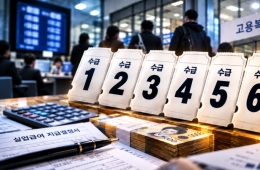
On the 23rd, the KOSPI index recovered above the 7,000 mark during the trading session. Various indices, including the KOSPI, are displayed on the status board in the dealing room at the Hana Bank Headquarters in Jung-gu, Seoul. Photo by Yoon Dongju
View original imageAlphabet, the parent company of Google, raised its capital expenditures (CAPEX) guidance, contributing to the upward trend in the domestic stock market. With major Big Tech companies set to announce their earnings in the near future, attention is focused on whether lingering doubts over the profitability of artificial intelligence (AI) and the sustainability of infrastructure investments can be fully dispelled.
On July 23, the KOSPI opened at 6,963.35, up 2.44% from the previous trading day, and as of 9:50 a.m., it was trading at 7,045.48, up 3.65%. At the same time, the KOSDAQ was trading at 779.99, up 3.85%.
Overnight, the New York stock market closed lower. On July 22 (local time), the Dow Jones Industrial Average fell by 6.06 points (0.01%) to close at 52,218.58. The Standard & Poor's (S&P) 500 index declined by 10.24 points (0.14%) to 7,498.96, while the tech-heavy Nasdaq Composite lost 146.30 points (0.57%) to finish at 25,690.90.
However, after the market closed, Alphabet reported stronger-than-expected results, posting second-quarter revenue of $119.8 billion, which has had a positive effect on the Korean stock market. In addition to raising this year’s capital expenditure guidance, Alphabet stated that next year's capital spending would increase significantly compared to this year. However, as a result of expanded investment in AI infrastructure, the company’s cash flow turned negative. As a result, Alphabet's Class A common stock price dropped by 1.46% during the regular session and fell by an additional 3% in after-hours trading.

Key points to watch in Big Tech earnings announcements, in order to confirm the sustainability of AI investments, include the performance of existing businesses, the AI cloud segment, capital raising strategies, and capital expenditure guidance. iM Investment & Securities noted that the overall scale of capital expenditures is no longer a central focus, and the phase in which the market rewarded increased spending as a sign of growth ambition has passed. The market is now looking for earnings that support investment, as well as the willingness to sustain such spending.
Whether the AI cloud segment can further accelerate revenue growth is also essential, and it is necessary to review the cash flows and funding methods related to large-scale investments. Shinhan Investment & Securities pointed out that the key structural risk lies not in the size of the expenditures but in how the funding is secured, and that the messages delivered by each company in their earnings calls will serve as the benchmark for valuation reassessments.
Hot Picks Today
 "Such chaos for the first time in 140 years"... Even illnesses surge, Tokyo stunned by 'unbelievable' event
- Furious After Elbow Was Touched While Sleeping, Passenger Threatens to Kick and Forces Flight Attendant to Kneel
- "With the Push of a Remote Button, Cash Pours Out"... U.S. Cartel Steals 55.2 Billion Won by Hacking ATMs
- "After 'Cannot Be Dismissed as a Conspiracy Theory' Remark: Lee Dongjin Says 'No Retraction or Apology'"
- "Nothing Left to Buy, Feeling Indifferent"... 'Rich Daughter' Vibe in Department Stores with 'Hyunbaek Core'
Revisions to Big Techs' capital expenditure forecasts are seen as a factor that could drive a rebound in semiconductor stocks overall. Han Jiyeong, a researcher at Kiwoom Securities, said, "It is important to note that growth momentum in Alphabet’s core businesses, including the cloud division, is improving," adding, "Strong results and upbeat guidance have helped ease concerns around domestic semiconductor stocks."
© The Asia Business Daily. All rights reserved. Unauthorized AI training and use prohibited.