'Ports to Become Giant AI Robots'... Government Opens the Era of Physical AI
AI to Control All Equipment and Operations
Full-Scale Implementation at Jinhae New Port After Gwangyang Test Bed
Aiming for 30% Productivity Increase by 2035

The government is officially launching the construction of a "Physical AI Port," which will integrate artificial intelligence (AI) into all aspects of port operations. Going beyond simple automation, the plan is to establish a system where AI independently perceives, makes decisions, and controls port equipment and the entire operational process. This initiative aims to boost the competitiveness of Busan Port and foster related technologies and equipment as a new export industry.
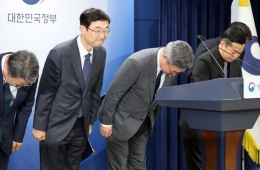
On July 23, the Ministry of Oceans and Fisheries announced the "Physical AI Port Strategy" at the 11th Meeting of Ministers Related to Science and Technology. With a vision of "Leading Global Smart Ports Through K-Physical AI," the government aims by 2035 to lead in four core technology areas of physical AI, raise port productivity by 30%, completely eliminate safety accidents in high-risk tasks, and achieve a 10% share of the global port equipment market.
The government's decision to position physical AI as a national port strategy comes as global port competition enters a new phase. Busan Port, which handles 99.7% of the nation's import and export cargo, is the world’s seventh-largest container port and second in transshipment. However, its cargo throughput ranking has remained stagnant for an extended period, and its hourly container handling performance lags behind that of Qingdao Port and Singapore Port. Meanwhile, global competition in AI is expanding from the digital realm to the physical world, where real equipment and robots operate autonomously. As a result, ports are emerging as a central arena for technology competition.
To address this, the government will first develop full automation technology for port cranes and Automated Guided Vehicles (AGVs), and unmanned solutions for high-risk tasks such as fastening and releasing container securing devices and mooring vessels. In addition to automating individual pieces of equipment, the government will also develop an AI-based port operation system (AI TOS) that allows AI to analyze the real-time status of vessels, ports, and trucks to optimize all operations. Furthermore, the government will establish a system for the collection, management, and utilization of port data, which is the foundation for technological development. It also plans to establish the tentatively named "Advanced Port Technology Institute" at Gwangyang Port, which will link real and virtual environments.

Once the technology is complete, Jinhae New Port will be the first site for implementation. The government plans to complete Phase 1 of Jinhae New Port, scheduled to open in 2032, as a world-leading model of a physical AI port, and then expand to Phase 2 by 2040. Fully autonomous port cranes, AGVs, and the AI-based port operation system will be introduced comprehensively. Real-time integration will be established not only with Busan New Port but also with land, sea, and air logistics. Gwangyang Port will serve as a test bed for technology verification, after which the solutions will be gradually expanded to other major ports. Through this, the government expects a new AI port technology market worth approximately 2.5 trillion won to be created.
The government will also focus on building AI infrastructure in port hinterland complexes. Plans include developing AI-specialized data centers for ports and smart joint logistics centers. At the Jinhae New Port hinterland complex, a P.AX (Port AX) cluster will be established by bringing together shipbuilding, defense, and port equipment companies, creating a new industrial ecosystem that connects manufacturing, ports, and logistics.
The government will establish support measures to expand the industrial ecosystem. The "AX Support Platform" will assist port operators and equipment/solution companies in transitioning to AI. Using policy finance such as Korea Ocean Business Corporation funds, the government will support technology demonstration and commercialization by small and medium-sized enterprises. The plan also includes expanding the training of professionals and upskilling existing employees. Through a "One Team" approach—combining the government, port authorities, operators, and equipment/system companies—the "K-Physical AI Port Solution" will be packaged for entry into overseas markets. Intergovernmental cooperation, such as the Korea-UAE Physical AI port and logistics project, will also be actively utilized.
Hot Picks Today
 “Washing Dishes and Folding Clothes 200 Times a Day”... China’s “Robot Trainers” Earn Up to 1.2 Million Won a Month
- "Even New York Taxi Drivers Are Talking About the KOSPI; South Korean Market to Top 9,000 Again Within a Year"... 'Wall Street's Stock-Picking Ace' Names His Picks
- “Made 2 Billion Won in One Year in Prison,” PPP Lawmaker Retorts: “If You’re Jealous, Go There Yourself”
- City Bus Driver Who Fell Asleep at the Wheel While 'Drunk' Bought Meth via 'Drop-Off'... Sentenced to 2 Years and 6 Months
- Idol Member Posts Letter Saying "Suspending Activities Due to Pregnancy"... Turns Out She's AI?
In addition, the government will revise the Port Technology Industry Act to establish legal grounds for supporting physical AI equipment and systems, and will formalize standards and performance certification systems. Efforts to enhance reliability and field adoption during technology implementation will include strengthening cybersecurity, participation in the Physical AI Alliance, and operating labor-management-government consultative bodies. If the strategy proceeds as planned, the government projects that, by 2035, approximately 3.3 trillion won will be invested from public funds, generating an economic effect of 36 trillion won in production inducement, 12 trillion won in value-added inducement, and 110,000 jobs.
© The Asia Business Daily. All rights reserved. Unauthorized AI training and use prohibited.