Kang Hoon-sik: "A Korean-Style Universal Support System Needed in the AI Era... Complete Redesign of the Social Safety Net"
Kang Hoon-sik Orders Joint Review with Ministries and Local Governments at Senior Secretaries' Meeting
"Preparing for Job Losses and Polarization... Sustainability First, No Burden on Future Generations"
Launch of Youth Future Secretary's Office
The Office of the President has begun preparations for a mid- to long-term roadmap to fully redesign the nation’s existing social safety net in response to potential job losses and increased income inequality arising from the spread of artificial intelligence (AI). The new framework, called “Korean-Style Universal Support,” aims to include groups that are insufficiently protected under the current employment insurance-centered system, such as children, youth, artists, farmers and fishers, and the self-employed. At the same time, it will uphold fiscal sustainability and avoid imposing excessive burdens on future generations as its core principles.

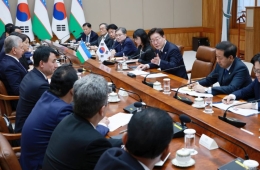
During a senior aides’ meeting presided over on the afternoon of the 22nd, Chief Presidential Secretary Kang Hoon-sik emphasized the need for a Korean-style universal support system, stating, “The AI era will bring opportunities for economic growth and innovation in administrative services, but will also pose grave challenges such as job losses and deepening inequality.” This was announced through a written briefing by Deputy Presidential Spokesperson Ahn Gwi-ryung.
Chief Secretary Kang particularly noted that youth employment instability is intensifying and that a significant proportion of workers, such as platform workers, are left in blind spots of the current support system, making a more robust social safety net essential. He pointed out that, given the rapid transformation of industries and employment types, the welfare and employment safety nets designed mainly for regular wage workers are insufficient to absorb the shocks from the transition to AI.
Kang stated that the government is proactively reviewing the adoption of a universal support system for children, youth, artists, farmers and fishers, and the self-employed. He reiterated, “Welfare policies must be designed with sustainability as the top priority, and we must not pass on an excessive burden to future generations.”
Accordingly, each Senior Secretary’s Office at the Office of the President was instructed to work with relevant ministries, local governments, as well as public and private research institutions to prepare the mid- to long-term roadmap for the Korean-Style Universal Support. Kang also directed that public opinion, particularly from future generations, must be actively sought during the policy design process.
“An integrated approach to comprehensively redesign the existing social safety net is urgently needed,” Kang said. “Because the future belongs to those who prepare for it, we must build a robust social safety net that citizens can tangibly feel in their everyday lives.”
Kang also announced the establishment of the “Youth Future Secretary’s Office” under his direct authority, which has begun its work in earnest. This new organization is tasked with addressing youth policy not merely as an isolated issue or from a welfare perspective, but as an integral part of overall national affairs and future strategy. Kang emphasized, “The perspectives and sensitivities of youth, who are on the frontlines of experiencing change, should be reflected throughout national policy,” noting that the Youth Future Secretary’s Office should analyze issues from the viewpoint of young people and quickly grasp societal changes to connect them to government affairs.
Meanwhile, regarding the recently launched “Blue House Youth Fellowship” recruitment, Kang urged participants to serve as “sensors” who detect changes and issues that may be overlooked from the conventional perspective of government, and as “speakers” who effectively communicate how policies impact the lives of youth in their own language. Kang called for the active participation of young people who, rather than focusing on special credentials, are willing to view familiar problems from a fresh perspective and connect their experiences to social change.
Hot Picks Today
 You Can Receive Monthly Payments Like a Pension Without Selling Your Home... The Local Mutual Growth Housing Pension That Provides 1.69 Million Won Each Month
- "Unimaginable in Korea"...Koreans Surprised by Secondhand Smoke in Japan and China Restaurants
- "Special Skill: Admitting Mistakes"... The Unexpected Edge That Helped Job Seekers Tired of AI Resumes Succeed
- "Canceled After Five Days and Lost 770,000 Won"... Hit by Steep Fees After Pressing the Cancel Button
- "I Thought She Was an Ordinary SKT Employee... The Unexpected Identity of Nongshim's Third-Generation Bride"
Separately, Kang instructed an improvement in the issuance procedures for defense-related certificates, such as military service career certificates. He pointed out that, unlike most other certificates which can be immediately issued via the Government24 platform, the Ministry of Defense still requires applications for its certificates to be submitted through the National Civil Complaint Portal, making the process cumbersome and often resulting in multi-day wait times. He highlighted that young people needing military career certificates for employment or licensing applications can face significant inconvenience, and called upon the Ministry of Defense to swiftly upgrade the system to allow for quicker and easier issuance of relevant certificates.
© The Asia Business Daily. All rights reserved. Unauthorized AI training and use prohibited.


![How Did Tacos Come to Have Two Shells [Delicious Stories]](https://cwcontent.asiae.co.kr/asiaresize/307/2026091410392626963_1789349966.jpg)