Promoting Physical AI Ports... 512 GPUs Allocated for "AI for All" Project
11th Ministerial Meeting on Science and Technology Held
AI Integration Across All Port Operations... Autonomous Equipment Control
520 GPUs to Support AI for All and AI Legal Search
The government is pursuing a "Physical AI Port Strategy" to introduce physical AI technologies at Korean ports. For the "AI for All" project, which aims to provide artificial intelligence (AI) services to the entire population free of charge, the government is deploying 512 GPUs (Graphic Processing Units) from its own resources.
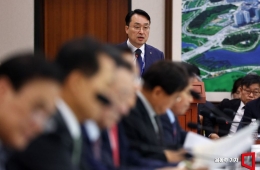
Paik Kyung-hoon, Deputy Prime Minister and Minister of Science and ICT, presided over the 11th Science and Technology Ministers' Meeting held at the Government Seoul Office on July 23, during which these policy items were discussed.

Paik Kyung-hoon, Deputy Prime Minister and Minister of Science and ICT, is presiding over the 11th Science and Technology Ministers' Meeting at the main building video conference room of the Government Seoul Office in Jongno-gu, Seoul, on the morning of the 23rd. Ministry of Science and ICT
View original imageDuring the meeting, the "Physical AI Port Strategy" for applying physical AI to domestic ports was reviewed and approved. A physical AI port refers to the next-generation smart port that goes beyond simple automation by integrating AI technologies across all port operations, autonomously controlling equipment and optimizing the overall management of the port.
The Ministry of Oceans and Fisheries, together with the Ministry of Science and ICT and other relevant agencies, will promote the development of AI technologies to automate key port equipment such as cranes and to optimize port operations. It will also establish a system for collecting, managing, and utilizing data required for technology development and port operation optimization. An "Advanced Port Technology Research Institute" will be established at Gwangyang Port to support development and deployment of technologies in actual port environments.
Jinhae New Port will be developed as the leading model of a physical AI port, with a step-by-step expansion to other ports and support for overseas market entry. Additionally, the government plans to build a foundation for AI adoption by expanding collaboration through the Physical AI Alliance and revising relevant regulations.
The meeting also approved a plan to provide additional GPU support for major government-led AI projects. This agenda includes the allocation of a total of 520 new GPUs to newly emerged government AI projects. Previously, in March, the government had resolved at the 6th Meeting of Ministers in Charge of Science and Technology to provide a total of 2,832 GPUs to 52 projects across 25 ministries as part of the national AI project portfolio.
Specifically, the "AI for All" project, spearheaded by the government, will receive 512 NVIDIA GPU B200 units from government reserves. "AI for All" is a project led by private companies with experience in developing national services, aimed at providing AI services tailored to citizens’ needs free of charge to everyone in Korea. The government plans to select two to three private companies to participate in this project. The GPUs being allocated will be supplied to the selected companies to facilitate the rapid rollout of the AI for All service.
In addition, eight GPUs will be provided for the "AI Statute Search Service." This service delivers legal information, including statutes, case law, and interpretations, in a user-friendly format, with GPUs leveraged to enhance service quality.

Deputy Prime Minister and Minister of Science and ICT, Background Hoon (right), and Kyunghee Song, Chairperson of the Personal Information Protection Commission, are speaking at the "11th Meeting of Ministers in Charge of Science and Technology" held at the main building video conference room of the Government Seoul Office in Jongno-gu, Seoul on the morning of the 23rd. Ministry of Science and ICT
View original imageA draft of the "Public AI Transformation (AX) Privacy Protection Guide" was also discussed as an agenda item. The guide was developed to help public institutions address privacy issues they may encounter when promoting AX initiatives.
The guide includes 10 key checkpoints: ▲ verifying the purpose and legal basis for personal information processing; ▲ designing development methods with privacy considerations; ▲ implementing appropriate security measures for data, AI models, and AI systems at each level; and ▲ ensuring transparency and protecting the rights of data subjects. Application types are categorized as basic work assistance, information integration/analysis/recommendation, and selection/judgment, with checkpoint requirements differentiated by risk level.
Hot Picks Today
 "'A Shortcut to Ruining Your Health - I Never Buy These': 3 Foods a Doctor Says to Avoid"
- "Female Teachers Must Wear Skirts in Class"... Outrage Erupts Over Principal's Demand: What's Happening in North Korea?
- "I Put in 10 Million Won, but Only 2 Million Won Is Left" ... 77% Plunge Leaves Retail Investors in Samsung Electronics and SK hynix Leveraged ETFs Crying Out
- Japan at 15x, Korea at 4x... Samsung Electronics and SK hynix Back to Levels Seen 8 Years Ago
- "The leggings are all see-through. It's so embarrassing to look at," complaints prompt Lululemon to fire development staff.
The Personal Information Protection Commission plans to support broader adoption of public AX by providing tailored consulting and linking with institutional policies via the Public AX Privacy Help Desk.
© The Asia Business Daily. All rights reserved. Unauthorized AI training and use prohibited.