Byungdo Han: "Even a Small Loophole in Prosecution Reform Means a Return to the Past"... Effectively Declares Plan to Abolish Supplementary Investigative Authority
Separation of Investigation and Prosecution Is the Fundamental Principle of Reform
Protecting the Disadvantaged Is the State's Responsibility, Not an Individual Prosecutor's
Democratic Party Aims to Make the Right to Request Supplementary In
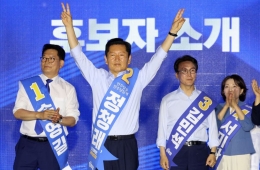
Byungho Han, Acting Leader and Floor Leader of the Democratic Party of Korea, stated on the 22nd regarding the amendment of the Criminal Procedure Act related to prosecution reform, "It is now time for the party to unite its collective will." Declaring an effective stance to abolish the supplementary investigation rights—currently a matter of controversy both inside and outside the party—he emphasized, "This time, we are determined to complete prosecution reform without fail."
At the Supreme Council meeting held at the National Assembly on this day, Han introduced the party meeting that functioned as a public hearing on the Criminal Procedure Act, as well as the discussions in the Legislation and Judiciary Committee, the party’s Criminal Procedure Act task force, and the government's committee for prosecution reform. He remarked, "The discussions have sufficiently matured," and repeated, "It is now time for the party to unite its collective will."

Byungho Han, Acting Leader and Floor Leader of the Democratic Party of Korea, is speaking at the Supreme Council meeting held at the National Assembly on July 22, 2026. Photo by Hyunmin Kim
View original imageHe criticized, "During the era of military dictatorships, the prosecution became a tool for maintaining the regime, suppressing democracy and human rights. Even after democratization, the prosecution held both investigative and indictment powers in one hand, directly and indirectly intervening in politics; at times, it acted as if it could even decide the destiny of the country." Han added, "They turned a blind eye to the illegal actions of those in power and even created false accusations against the opposition." He also referenced the tragedy of the late former President Roh Moo-hyun, saying, "I can never forget the deep pain of having done nothing in the face of a ruthless investigation and media manipulation that drove a person's life to the edge of a cliff."
He clearly reaffirmed the fundamental principle of separating investigation and prosecution. Han stated, "If we leave intact a system where investigators also have the authority to decide whether to indict, where they can put their own cases on trial, then the history of politically driven prosecution can always repeat itself. The Democratic Party’s principle has been unwavering from the beginning: investigations should be conducted by investigation agencies, and prosecution and the maintenance of public prosecution should be handled by the public prosecution office." Regarding internal discussions, he explained, "Prosecutors do not investigate; this is the starting point of prosecution reform based on separating investigation and prosecution. There are no objections within the party to this core principle. There has only been intense debate over how to create better systems, such as methods for mutual checks and cooperation between investigative agencies and measures for victim protection." Han emphasized that the ongoing debate "should not undermine the principle of separating investigation and prosecution or become a means to restore investigative powers to the prosecution."
On the issue of protecting socially disadvantaged groups, which has been cited as the basis for maintaining supplementary investigative powers, Han said, "Victim protection should not be left to the goodwill or discretion of any particular agency. Rather than having the fate of a case depend on which prosecutor is assigned, we must establish a system in which anyone can receive the same, robust protection from the state."
With regard to specific adjustments to investigative powers, Han stated, "Protecting the rights of the people is not about unchecked authority, but about a system designed with no blind spots. The Democratic Party will ensure that the right to request supplementary investigations becomes substantive, and we will make investigative agencies clearly responsible for carrying out such requests quickly and thoroughly."
He added, "We will prevent investigative delays and ensure accountability for insufficient investigations, including investigator replacement and disciplinary measures. We will establish a cross-checking investigative structure between the police and the newly established Serious Crime Investigation Office, and enhance investigative review and external monitoring. In addition, we will further guarantee the rights of victims to file objections, review investigation records, and receive legal support, establishing new mechanisms for control and collaboration in line with the new criminal justice system."
Hot Picks Today
![Conspiracy Theories Arise After Sudden Death of Famous Actor... What If Someone Close Is Deeply Invested? [Conspiracy Theory Business]](https://cwcontent.asiae.co.kr/asiaresize/93/2026062510421223178_1782351733.jpg) Conspiracy Theories Arise After Sudden Death of Famous Actor... What If Someone Close Is Deeply Invested? [Conspiracy Theory Business]
Conspiracy Theories Arise After Sudden Death of Famous Actor... What If Someone Close Is Deeply Invested? [Conspiracy Theory Business]
- Employees Earning Over 5 Million Won or With 5+ Years Service Receive More Work Calls During Vacation
- "Foreign Media Highlights Retail Investors Fleeing KOSPI: 'Brace for Wild Swings in the Coming Months'"
- South Korea Moves Opposite of Advanced Countries: Capital Region Population Concentration Highest Among OECD Members
- “There Is No Eternal Number One”: Black Yak, Once a Billion-Won National Brand, Seeks a Breakthrough in [Heirs]
Han once again reiterated his unwavering commitment to prosecution reform. He stated, "If we leave even the smallest loophole, the forces seeking to revert to the past will be given room to operate. If we stop or compromise here, only the nameplate on the prosecutor's office will change to 'public prosecution office,' while the essence of prosecutorial power remains untouched." Han concluded, "If, in the future, the people ask why we did not act when we could, what answer could we possibly give? We will not postpone this to the next administration or the next National Assembly."
© The Asia Business Daily. All rights reserved. Unauthorized AI training and use prohibited.