Koo Yoon-chul: "Uncertainty at Its Highest Due to Heightened Middle East Tensions... Thorough Energy Supply Management"
Emergency Economic Headquarters Meeting Held on the 22nd
Deputy Prime Minister and Minister of Economy and Finance Koo Yun-cheol stressed on July 22, “External uncertainties are higher than ever due to renewed tensions in the Middle East, so we will remain highly vigilant and ensure robust management of both energy supplies and supply chains.”
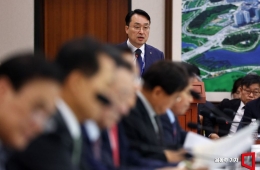
Deputy Prime Minister Koo made these remarks at the Emergency Economic Headquarters Meeting and the Ministerial Meeting on Strengthening Economic-Industrial Competitiveness, held at the Government Seoul Office. He stated, “We have secured more crude oil and naphtha volumes than last year through August, and inventories of key items such as naphtha derivatives also remain at a stable level. However, in light of high uncertainty going forward, we will maintain the existing stabilization measures and proactively seek additional ones.”

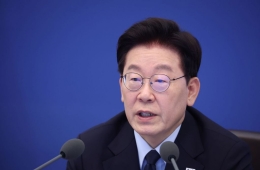
Deputy Prime Minister and Minister of Economy and Finance Koo Yun-cheol attends and speaks at the Emergency Economic Headquarters Meeting and the Ministerial Meeting on Strengthening Economic-Industrial Competitiveness held at the Government Seoul Office in Jongno-gu, Seoul on July 22, 2026. Photo by Jo Yong-jun
View original imageHe also pledged to revitalize the Korean economy through structural reforms. Deputy Prime Minister Koo said, “For industries experiencing structural difficulties, we will support swift business restructuring and foster a healthy industrial ecosystem that allows everyone to grow. At the same time, we will fully support the three mega projects. We plan to concretize our strategies to achieve a potential economic growth rate of 3%, place Korea among the world’s top four exporters, and reach $50,000 in income per capita.”
The meeting also discussed the government’s response to the Middle East conflict, ▲progress on business restructuring and support packages for the ‘Yeosu 1’ project, ▲plans to establish and operate an electronic payment system for construction projects, and ▲the formation and operation of research task forces for the three mega projects.
The government will step up restructuring of the petrochemical industry with the ‘Yeosu 1’ project—the second restructuring plan—following February’s announcement of the ‘Daesan 1’ petrochemical restructuring project. Deputy Prime Minister Koo explained, “By suspending two outdated NCC facilities, we expect to ease oversupply and strengthen competitiveness by transitioning to high-value-added and eco-friendly operations. We will allocate KRW 545 billion to improve the financial structure, and invest approximately KRW 253.2 billion in the shift to high-value-added products and infrastructure development.” He added, “We will join creditor banks in supporting the successful restructuring of Yeosu 1, backing it with a support package exceeding KRW 700 billion.”
The government also plans to provide KRW 450 billion in new financing for high-value-added conversion and an additional KRW 200 billion in import loan guarantees. Deputy Prime Minister Koo stated, “We will ease requirements for employment retention subsidies and consider designating employment crisis areas.”
The government is establishing a next-generation electronic payment system to fundamentally improve multilevel subcontracting in construction and create a healthy ecosystem free from wage and payment delays. Currently, accounts for contractors, subcontractors, and workers are managed separately; however, the payer (project owner) pays contractors, who then pay subcontractors, and then the workers. Under the upcoming revision of the Construction Industry Basic Act, the project owner will pay subcontractors and workers directly, thereby preventing payment delays at their source.
Hot Picks Today
 "A Shortcut to Ruining Your Health? I Never Buy These": 3 Foods a Doctor Warns Against
- "Female Teachers Must Wear Skirts in Class"... Outrage Erupts Over Principal's Demand: What's Happening in North Korea?
- "Your Highness, Please Lift Your Dress Slightly and Smile"... Photo Studios Today Sell Customers an "Experience"
- 'Big Investor' NPS Has Already Cut Its Losses... Sold Department Store Stocks in Q3 Despite Strong Earnings Outlook
- "The leggings are all see-through. It's so embarrassing to look at," complaints prompt Lululemon to fire development staff.
To ensure the successful implementation of the three mega projects, joint research task forces from national research institutes will be formed to actively support policymaking and business activities. In addition, task forces dedicated to each project—drawing on the research institutes’ expertise—will be set up. Broader development strategies linked to various economic and social sectors will also be formulated.
© The Asia Business Daily. All rights reserved. Unauthorized AI training and use prohibited.