[Click eStock] "Excessive Discount is Over"... NRB Expected to Rebound on Policy and Earnings Recovery
![[Click eStock] "Excessive Discount is Over"... NRB Expected to Rebound on Policy and Earnings Recovery](http://www.asiae.co.kr/news/img_view.htm?img=2026072107443851713_1784587477.jpg)
An analysis has found that NRB, a modular construction specialist, is poised to enter a full-fledged growth phase, backed by government policies to foster the modular housing sector and large-scale public projects. The recent share price correction has been attributed to a combination of policy delays, differences in the timing of revenue recognition, and heightened market volatility, rather than a decline in business competitiveness. It is expected that, once policy momentum and earnings visibility are confirmed, a revaluation of the share price will be possible.
Lee Junseok, a researcher at Hanyang Securities, positively assessed NRB's growth potential and stock attractiveness, stating that it is "the strongest candidate for a rebound after excessive market discounts."
Established in 2019, NRB is a modular construction company that manufactures major components and space modules in factories and assembles them onsite. The company was listed on the KOSDAQ market in July. Modular construction can reduce construction periods by approximately 20 to 30 percent compared to conventional methods, making it increasingly useful in public housing, schools, dormitories, and various other sectors.
The company first built a stable profit structure through the relocatable school leasing business and has since shifted its business focus to the more profitable multi-family housing manufacturing sector. The portion of revenue from the manufacturing business has grown from about 18 percent in 2024 to 53.6 percent in the first quarter of this year.
Researcher Lee explained, "The company is a leading pioneer in moving from leasing to manufacturing, especially for high-rise modular buildings. NRB has established a stable profit base with its relocatable school leasing business, and is now expanding into the highly profitable multi-family housing manufacturing sector."
NRB is also recognized for its technological competitiveness. The company holds all key certifications and qualifications required for domestic modular housing business and is currently undertaking projects such as the Korea Land & Housing Corporation (LH) Uiwang Chopyeong Project, which consists of 22 stories and 381 units, the tallest in Korea, as well as the Gyeonggi Urban Innovation Corporation (GH) Hanam Gyosan Project, which is planned for over 25 stories.
Production capacity is also expanding rapidly. Currently, Plant 1 in Gunsan can manufacture 4,600 modules per year, and to meet the increased demand following the enactment of the Modular Special Act, the company is expanding its annual production capacity to 5,600 modules.
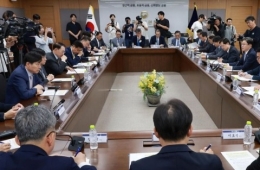
Government policies are also creating a favorable environment. In December of last year, the Modular Housing Special Act was proposed, and on the 10th of this month, Yoon-deok Kim, Minister of Land, Infrastructure and Transport, visited NRB’s Gunsan Plant to inspect the Uiwang Chopyeong manufacturing site, reaffirming the government’s commitment to fostering the modular industry.
Researcher Lee said, "The government’s commitment to fostering modular housing is materializing through legislation and increased order volumes. In the second half of this year, policy support and expanded public procurement are expected, so order intake and earnings growth are anticipated for the company, which possesses both technological and production bases."
In fact, NRB has secured the 90 billion won LH Uiwang Chopyeong Project and the 83.6 billion won GH Hanam Gyosan Project, and is further expanding applications to schools, dormitories, and military barracks. The company's order backlog, including Hanam Gyosan, stands at approximately 200 billion won, more than three times last year's revenue of 59.5 billion won.
Global market growth is also a positive factor. The global modular market is forecast to grow from 94.8 billion dollars in 2025 to 175.6 billion dollars in 2034. In Singapore, a 56-story modular residential facility is being constructed, further proving the potential of high-rise modular construction.
The recent share price correction is seen as being due more to external variables than underlying fundamentals. The enactment of the Modular Special Act has been delayed, the timing for revenue recognition of key projects has been pushed back, volatility surrounding single-stock leveraged exchange traded funds (ETFs) has increased, and the overall KOSDAQ market has been weak — all of which have collectively dampened investor sentiment in growth stocks.
However, policy uncertainty appears to be gradually easing. Minister of Land, Infrastructure and Transport, Yoon-deok Kim, personally visited the Gunsan Plant to reiterate both the establishment of the special law and the intention to expand public housing procurement. The sluggish earnings are also explained as a result of delays in revenue recognition, not order cancellations, heightening the likelihood of future earnings improvements.
Researcher Lee emphasized, "What’s been delayed is only the timing of revenue, not the basis for orders and growth. If the discount factors priced into the stock ease and revenue recognition gains momentum, the current valuation is significantly undervalued."
Hot Picks Today
 "I Ate at Home to Save Money, But My Account Balance Was Still a Shock"
- Suddenly Called Out During Class, Awarded $100,000 as Students Cheer in the Gym
- "Bought It Cheaper in Japan Than Korea"... Improper Use Leads to Vomiting and Abdominal Pain, Official Warning Issued
- "After a Dream About Feces, Bought a Lottery Ticket and Won 20,000 Won... Scratched Again and Hit a 2 Billion Won Jackpot"
- "Uncle Will Buy Them All for Wonie"... Men in Their 30s Sweep Up 600,000 'RESCENE Bread'
He added, "The order backlog has increased from 44.5 billion won in 2023 to 150.8 billion won in 2025, and about 70 percent of the 90 billion won Uiwang Chopyeong order is expected to be recognized as revenue this year. With revenues from these existing orders, NRB has strong visibility to achieve sales of at least 120 billion won in 2026."
© The Asia Business Daily. All rights reserved. Unauthorized AI training and use prohibited.