President Lee: "Even Public Interest Donations Could Be Considered Third-Party Bribery"... Calls for Clear Legal Enforcement Standards (Comprehensive)
President Lee Presides Over Cabinet Meeting
During Corporate Social Contribution Talks:
"A Structure Where Any Job-Related Link Triggers Charges"
Vice Minister of Justice: "There Have Been Past Indictments... The Burden Is Real"
"Re-ex
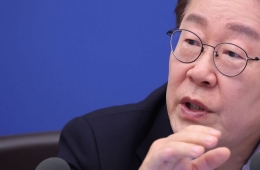
President Lee Jae-myung stated on the 21st that the current investigative and prosecutorial practices, in which government ministries are penalized for inducing donations from companies to public interest institutions as third-party bribery, must be reformed. He noted that if public officials are exposed to criminal liability simply for linking social contributions by companies under their jurisdiction, public interest projects themselves could be stifled. He called for the establishment of clear standards and guidelines for the enforcement of the law.

President Lee Jae-myung is speaking at the Cabinet Meeting held at the Blue House on the 21st. July 21, 2026. Photo by Yonhap News Agency
View original imageAfter being briefed on measures to promote corporate social contribution during a Cabinet meeting held at the Blue House on this day, President Lee said, "Currently, the prosecution operates under the notion that if there is an occupational connection, any discussion with companies to have them donate to third-party public interest entities leads to a guilty verdict," adding, "This issue needs to be addressed one way or another."
His remarks came as Unification Minister Chung Dong-young introduced exemplary cases of corporate social contribution. Minister Chung explained that, during the construction of a new school building for Yeomyung School—an institution for children of North Korean defectors—on a recently closed school site in Seoul's Gangseo District, Hyundai Motor Group provided KRW 6 billion out of the total KRW 16 billion construction cost.
In response, President Lee joked, "That could very well be considered third-party bribery," before pointing out, "If each ministry communicates with companies even slightly related to their affairs and encourages donations to third-party public interest institutions, under the current framework, all of these become instances of third-party bribery."
He further criticized, "We have reached this point because the penal system has been operated for political purposes. If you talk to a person related to your official duties, and that person contributes something to a public interest organization—and if the company’s pending issue is related to the ministry’s work—every such act is caught in the net." He emphasized, "If one wanted to press charges, they could. Since civil servants' public interest activities themselves can become problematic, there must eventually be clear guidelines established."
Vice Minister of Justice Lee Jin-su replied, "There have been cases where the prosecution indicted such matters as third-party bribery in the past," and explained, "Although a third-party bribery charge, as outlined in the relevant law, requires an improper solicitation, in reality, the current interpretation places a burden on officials."
However, under current precedents, the mere fact that there is an association between an official’s duties and a company’s donation does not immediately establish third-party bribery. Article 130 of the Criminal Act stipulates that a third-party bribery offense is established only when a public official, in connection with their duties, receives an 'improper solicitation' and causes a third party to be provided with money or benefits. The improper solicitation does not need to be made explicitly, but there must be a shared understanding or acceptance between the parties that the handling of official business and the provision of benefits to a third party constitute a quid pro quo. The Supreme Court has also ruled that the mere fact that a public official first requested a donation or that the company’s donation was actually made cannot, by itself, be recognized as an improper solicitation.
President Lee's comments on this day are therefore interpreted as raising the issue that, to further encourage corporate social contributions, there must be more concrete criteria for distinguishing between public interest donations and indirect bribes involving quid pro quo for official work. The intent is that, even as the government expands social contribution platforms connecting companies and public interest entities, it must make clear the boundaries of criminal liability that can arise if a public official's solicitation for donations is related to corporate licensing or regulatory matters.
Furthermore, considering that President Lee himself has previously been indicted on charges of third-party bribery in relation to the Seongnam FC sponsorship case and the Ssangbangwool remittance to North Korea case, these remarks can also be interpreted as a message targeting the reasoning and investigative practices employed by the prosecution against him. The prosecution previously argued there was a quid pro quo between resolving corporate issues or supporting Gyeonggi Province's North Korea projects and the provision of money or benefits to a third party. President Lee’s side, however, has contended that these were public interest or policy projects and that the indictment was motivated by political considerations.
According to chief spokesperson Kang Yoo-cheong, in the following closed session, President Lee stated that a review of the abuse of authority statute is needed in order to establish proactive administration as an ordinary culture within the public sector. Citing the need to revise the Criminal Act, President Lee asked the Chairman of the Board of Audit and Inspection, "I understand that the Board can provide prior opinions before policy decisions are made. What systems have you put in place?" and requested proper maintenance of the system.
Hot Picks Today
 Retail Investors Regain Hope: "Leverage Unwinding Nears End, KOSPI 12,500 Target Intact," Says J.P. Morgan
- "$300 Gone in One Date"...U.S. Gen Z Ditches Restaurants for Parks
- "There Are Rules About Fines!" Even Presidential Rebuke as Turkey's Anti-Smoking Crackdown Imposes 21.8 Billion Won in Penalties
- After Much Deliberation, We End Up Saying "Just an Iced Americano"... What Happens When There Are Too Many Choices
- Zara 'Death Pants' Too Stylish to Give Up: "I Almost Died Just 30 Minutes After Putting Them On"
To Prime Minister Han Sung-sook, he asked, "Please consider ways to reduce the burden (of punishment) on civil servants so they can work voluntarily, actively, and proactively." In response, Choh Wonchul, Chief of the Government Legislation Office, answered, "We have established an Advisory Bureau within the office to consult on legal questions received from multiple ministries."
© The Asia Business Daily. All rights reserved. Unauthorized AI training and use prohibited.