If AI Takes Jobs, Who Pays the Taxes? Rising Concerns Over U.S. Fiscal Deficit
83% of Federal Revenue Comes from Individuals
Corporate Taxes Account for Only 9%, Insufficient to Offset Loss of Labor Tax
Concerns Over Rising Fiscal Burden
While there is anticipation that advances in artificial intelligence (AI) technology will boost productivity across industries, securities analysts have warned that it could also become a "time bomb" that shakes the very foundation of the U.S. federal government's fiscal soundness. This is mainly because if AI rapidly replaces human labor, the government's largest source of revenue—personal income tax receipts—could decline sharply.
"AI Does Not Pay Taxes"
According to Hana Securities on July 22, researcher Hur Seongwoo stated the previous day, "For the 2025 fiscal year, approximately 83% of federal government revenue comes from taxes imposed on individuals. Personal income tax and payroll tax are the most important pillars of U.S. public finances." In a situation where wages and salaries account for 60% of taxable personal income, if AI begins to replace human jobs, the government's biggest source of tax revenue will be undermined.

In particular, the hit to payroll taxes—which account for 32% of total tax revenue and are the main source for Social Security and Medicare taxes—would be especially damaging. Hur emphasized, "Payroll tax is only collected when a person provides labor—AI does not pay Social Security or Medicare taxes." He further explained, "As labor is increasingly replaced by capital, the government will lose a stable source of tax revenue."
Corporate Tax Increases Cannot Fill the Gap Alone
Even if automation through AI reduces labor costs and increases productivity, which may lead to higher corporate profits, the increase in corporate tax alone is not expected to be sufficient to make up for the loss of labor-related tax revenue. Corporate taxes make up only about 9% of total tax revenue, and because of tax avoidance by multinational corporations and competition among countries to lower tax rates, it is difficult to significantly increase corporate tax revenue.

On April 28, job seekers participating in the "2026 Korea Win-Win Job Fair" held at the aT Center in Seocho-gu, Seoul, are lining up to enter the exhibition hall. Photo by Kang Jinhyung
View original imageThe problem is that such cracks could threaten the circulation of funds throughout the entire economy. If labor income declines due to AI, household spending power will decrease, and sluggish consumption will eventually lead to falling sales and profits for companies. From the government's perspective, both personal income tax and payroll tax receipts will shrink, while at the same time, spending on unemployment benefits and social welfare will increase, resulting in a double burden.
Hot Picks Today
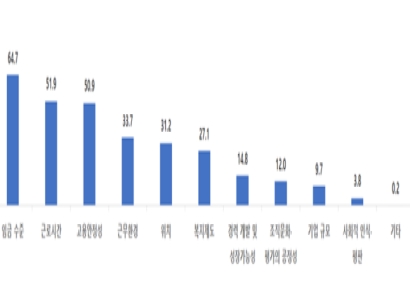 "Please Pay Me at Least 3 Million Won a Month": More Than Half of Young People Today Prioritize "Working Conditions" Over Company Size
- Selling Like Crazy Every Year... 30-Year-Old Hetbahn Takes on a New Challenge: Tastes Better Than "Mom's Home Cooking" [On-Site Report]
- I Thought Only 'Old Guys' Ate It... Young People Are Hooked on This 'Unusual Food' at Risk of Disappearing? [Delicious Stories]
- "Hey, Lady, Teach Your Kids to Behave!" ... 300,000 Won in Cash and a Bodily Injury Claim Demanded Over Child's Door Ding
- Beachgoer Finds 'Plastic' That Turns Out to Be Perfume Ingredient Worth More Than Twice as Much as Gold
Currently, the U.S. government's net interest expense already stands at 15% of total expenditure and is close to 20% compared to revenue. Hur commented, "Ultimately, rather than asking ‘How many jobs will AI replace?’, we need to ask ‘How quickly will new jobs be created and how much labor income will be generated from them?’" He added, "AI is a technology that boosts productivity and grows the economy, but it could also pose another structural risk to U.S. public finances."
© The Asia Business Daily. All rights reserved. Unauthorized AI training and use prohibited.