President Lee: "Even Public Interest Donations Could Be Treated as Third-Party Bribery"...Calls for Clear Enforcement Standards
President Lee Presides Over Cabinet Meeting
During Corporate Social Contribution Discussion, Says "Any Job Relevance Leads to Charges"
Vice Minister of Justice: "There Have Been Past Prosecution Cases... The Practical Burden Is Real"
On July 21, President Lee Jae-myung stated that the current investigative and prosecutorial practice, under which government agencies may be punished for third-party bribery simply for engaging in discussions with companies to encourage donations to public interest organizations, must be reexamined. He emphasized that public interest projects could be undermined if public officials are exposed to criminal liability merely for linking the companies under their jurisdiction with social contribution activities, and called for clear standards and guidelines for law enforcement in this area.

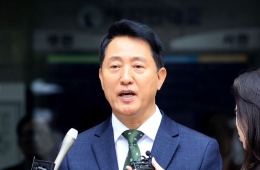
President Lee Jae-myung is speaking at the Cabinet meeting held at the Blue House on the 21st. July 21, 2026 Photo by Yonhap News
View original imageAfter receiving a report on measures to promote corporate social contribution during the Cabinet meeting he presided over at the Blue House on the same day, President Lee said, "Currently, prosecutors operate on the assumption that if a government official is involved in a matter related to their work and discusses making a donation to a third-party public interest organization with a company, it is invariably treated as a crime." He added, "This issue must be resolved in some fashion."
His remarks came in the context of Minister of Unification Jeong Dong-young introducing exemplary cases of corporate social contribution. Minister Jeong explained that the Hyundai Motor Group supported Yeomyung School, which educates children of North Korean defectors, by providing 6 billion won out of the total construction cost of 16 billion won for building a new facility on the site of a closed school in Gangseo-gu, Seoul.
In response, President Lee jokingly remarked that "this is likely to fall under third-party bribery," but then pointed out more seriously that "under the current concept, if a ministry communicates with a company even slightly related to its work and encourages it to donate to a third-party public interest organization, it is treated as third-party bribery."
He further criticized, "This situation has arisen because the criminal punishment system has been operated for political purposes. If a public official communicates with someone related to their work, and that person gives something to a public interest organization—if the company's pending issues are related to the ministry's work—everyone gets caught up in this system." He added, "If the authorities want to catch you, they can, which means the very act of government officials participating in public interest activities could become problematic. At some point, it is necessary to establish clear guidelines."
Vice Minister of Justice Lee Jin-soo responded, "There have been cases in the past where prosecutors charged similar matters as third-party bribery offenses," and admitted, "Although third-party bribery requires an improper solicitation, due to the existing interpretation, in reality it does pose a burden."
However, under current precedents, the mere existence of a connection between the public official's work and a company's donation does not automatically constitute third-party bribery. For the crime of third-party bribery as defined in Article 130 of the Criminal Act to be established, the public official must have received an improper solicitation in relation to their duties and arranged for a third party to receive money or benefits. The improper solicitation does not need to be explicit, but there must be a shared understanding or agreement between the involved parties that the provision of money or benefits to the third party is in exchange for the handling of official duties. The Supreme Court has also ruled that a public official's request for a donation or the mere fact that a donation was actually made by a company cannot alone justify recognizing the existence of an improper solicitation.
Nonetheless, President Lee's remarks on this day are interpreted as raising the issue that, in order to promote corporate social contribution, a more concrete standard is needed to distinguish between public interest donations and indirect bribes that are given in exchange for work-related favors. As the government expands platforms that connect companies with public interest organizations, he means that it is essential to clarify the boundary of criminal liability that could arise if a public official's request for donations becomes tied to a company's licensing or regulatory issues.
Hot Picks Today
 "Can't Hold On Any Longer" 80,000 Stores Shut Down... The Fall of China’s Bakeries That Relied on SNS Buzz
- "Unknown Sources of Infection"... Ebola Death Toll Nears 1,000 as Outbreak Spirals in DR Congo
- Fired Over a $2 Snack: Why a 300 Million KRW Engineer Lost His Job
- South Korean Wins KRW 5.8 Billion Lottery While Working in Vietnam: "Checked the Numbers Several Times"
- "Joey Wong Returns After 22 Years: The Secret Behind Her Unchanging Beauty"
In addition, since President Lee himself has previously been indicted on third-party bribery charges in relation to the Seongnam FC sponsorship and Ssangbangwool’s alleged transfer of money to North Korea, these comments can also be seen as targeting the prosecutorial legal logic and investigation practices that have been applied to him. Prosecutors judged there was a connection between resolving corporate issues or Gyeonggi Province’s North Korea-related projects and the provision of money to third parties, but President Lee's side has rebutted that these prosecutions are politically motivated, criminalizing public interest and policy initiatives.
© The Asia Business Daily. All rights reserved. Unauthorized AI training and use prohibited.