Why Blackstone Is Betting on Robot Joints: Why Retail Investors Are Flocking to a Fridge Motor Company [This Week's Stock to Watch]
Money Moves from AI to Humanoids
SPG, the Only Domestic Producer of All Three Types of Reducers
Low Sales Contribution for Now; Global Competition Is Key
Blackstone, the world’s largest alternative investment manager, stated on July 20, “The humanoid·automation market is at an early stage of explosive growth,” as it announced an investment in a domestic robotics company. While the investment amount was not disclosed, investment banks estimate this company’s value to be around 1 trillion won. The reason that a major global player with 1.3 trillion dollars in assets under management is betting on it comes down to the 'actuator'—robot joints—which make up more than 60% of the humanoid robot’s production cost. In an era where global capital is flocking to robot joints as much as to the brain (AI), this week’s spotlight among retail investors has also landed squarely on SPG, a robot joint parts manufacturer.
A Company That Used to Make Fridge Fans Now Takes on Robot Joints
![Why Blackstone Is Betting on Robot Joints: Why Retail Investors Are Flocking to a Fridge Motor Company [This Week's Stock to Watch]](http://www.asiae.co.kr/news/img_view.htm?img=2026072110511952375_1784598679.jpg)
SPG had humble beginnings. Founded in 1991, the company started as an unknown components maker producing fan motors for white goods like refrigerators and geared motors for factory automation. It quietly grew by supplying to leading global appliance brands such as GE and Whirlpool but did not attract much attention from the market, as the operating profit margin for fan motors, a mass-produced general-purpose product, remains around 3%.
The turning point was the 'reducer.' This is the component that slows fast motor rotations into slower, but more powerful, movements—just like shifting to a lower gear to pedal uphill more easily while the wheels spin forcefully. For a robot to lift heavy loads while moving its fingers with precision, each joint must be equipped with a reducer. In a market long dominated by German and Japanese firms, SPG became the only domestic company to localize all three major types of industrial robot reducer (planetary·SH·SR). That's why the “motor company” is now being called a “robotics parts company.”
Being able to manufacture all three types means SPG can respond no matter what form the robot takes or where its customers go. In the humanoid market, which has yet to converge on a standard form factor, industry observers believe a 'full lineup' company with flexible offerings is more likely to survive than a company that bets on a single product. This transformation is also evident in the numbers. Last year, sales fell by about 12% year-over-year to 341.7 billion won, but operating profit surged over 45% to 17.9 billion won. This was due to a higher share of high-margin reducers compared to low-margin motors, boosting overall profitability. However, since precision reducers accounted for just 4% of sales last year, SPG is at this stage closer to “a motor company that has just started making robot joints” rather than a full-fledged robotics company.
Supplying Robot Joints to Samsung... U.S. Market Entry in Sight
![Why Blackstone Is Betting on Robot Joints: Why Retail Investors Are Flocking to a Fridge Motor Company [This Week's Stock to Watch]](http://www.asiae.co.kr/news/img_view.htm?img=2026072110512052376_1784598680.jpg)
The decisive factor that turned SPG into a famed robotics stock is its relationship with Rainbow Robotics. SPG is the exclusive supplier of reducers for the full lineup of collaborative robots, dual-arm robots, and quadruped robots at this robotics company, in which Samsung Electronics holds a stake. SPG is not just a mere supplier; the more Samsung Electronics pours resources into robotics, the more the benefit flows straight to SPG. Particularly as Rainbow Robotics expands the use of quadruped robots to the defense industry, there is increasing potential for SPG’s performance to move beyond expectations and turn into tangible results if stable national defense orders are secured. Securities companies project that revenue from supplies to Rainbow Robotics will reach around 16 billion won in 2027, roughly double the estimated level for 2026.
The second key point is its proprietary actuator, “SDD.” SPG is trying to go beyond supplying reducers and become a finished product supplier by integrating reducers, motors, and controllers—succeeding in reducing heat generation by more than 30% compared to previous products. Jointly developed with the Korea Institute of Machinery and Materials, it has already secured domestic orders, and, following participation at North America’s largest automation expo in June, is in NDA discussions with multiple U.S. companies. Although no contracts have been signed yet, the market is watching closely as a domestic component firm tests its chops on the global stage.
IBK Investment & Securities projects that SPG's 2026 sales and operating profit will rise by 6.2% and 24.2%, respectively, over the previous year. The firm has a 'buy' rating and a target price of 100,000 won, implying 51.5% upside potential from the closing price of 66,000 won on July 16.
Points Individual Investors Should Check
![Why Blackstone Is Betting on Robot Joints: Why Retail Investors Are Flocking to a Fridge Motor Company [This Week's Stock to Watch]](http://www.asiae.co.kr/news/img_view.htm?img=2026072110183852246_1784596717.jpg)
However, the market has already factored in significant expectations into SPG's share price. Over the past year, its stock has soared 144%, reaching a 52-week high of 158,100 won before being corrected to a closing price of 66,000 won on July 16. Even so, based on last year’s net profit, the price-to-earnings ratio (PER), which shows how many times the share price is relative to earnings, stands at a lofty 197 times.
Competition is also fierce. The robot reducer market has long been dominated by the Japanese firms Harmonic Drive and Nabtesco, with these two controlling nearly 75% of the global market. While SPG’s status as the only domestic provider with a full lineup is a strength, internationally, it still remains more of a challenger.
Hot Picks Today
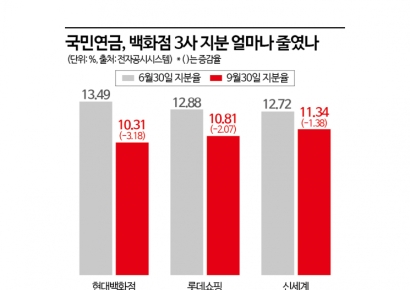 'Big Investor' NPS Has Already Cut Its Losses... Sold Department Store Stocks in Q3 Despite Strong Earnings Outlook
- "There's a Drink Like This?"... Chinese Beverage With "Korean" in Its Name Rakes in 85 Million Won in Monthly Sales
- "Bump," Then "My Phone's Broken"... Man in His 20s Arrested for Scamming 22 Million Won in Repair Costs
- "I Put in 10 Million Won, but Only 2 Million Won Is Left" ... 77% Plunge Leaves Retail Investors in Samsung Electronics and SK hynix Leveraged ETFs Crying Out
- "The leggings are all see-through. It's so embarrassing to look at," complaints prompt Lululemon to fire development staff.
The main point to watch is “the speed at which expectations turn into concrete results.” Whether the NDAs surrounding SDD with U.S. companies turn into real orders—and whether supplies to Rainbow Robotics expand as projected—are the key points. Given this high dependence, the progress of Samsung’s robotics business will have a direct impact on SPG’s results.
© The Asia Business Daily. All rights reserved. Unauthorized AI training and use prohibited.