[Finance Microscope] "August vs. October" Rate Hike Hints Found Here
Checking Trends in Second-Quarter GDP and GDI
Key Variable in Assessing Demand-Side Inflationary Pressure
Monitor July Core CPI and Cost of Living Index
If Second-Quarter Growth Momentum is Confirmed, Probability of Back-to-Back Rate Hi
"The timing and pace of the base interest rate increases will be determined through a 'live meeting' based on the data."
The anticipated base rate hike by the Bank of Korea was carried out this month. The market is now busy searching for signs of the next increase. As the Monetary Policy Board's official statement and the press briefing by Bank of Korea Governor Shin Hyun-song were both assessed as hawkish (favoring monetary tightening), expectations for a consecutive hike in August following the July increase have grown compared to earlier predictions. Nevertheless, there is still a prevailing expectation that the next increase will come in October.
Experts emphasized that in order to gauge whether the next Monetary Policy Board meeting on August 27 will result in another rate hike, it is important to closely examine not only the preliminary second-quarter gross domestic product (GDP) figures and July’s consumer price index—both referenced by Governor Shin—but also key domestic and international economic indicators and financial market trends released over the coming month.

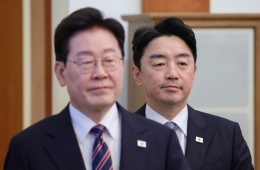
Shin Hyun-song, Governor of the Bank of Korea, is attending the Monetary Policy Committee plenary meeting held at the Bank of Korea in Jung-gu, Seoul on the morning of the 16th, striking the gavel. Photo by Joint Press Corps
View original imageMore Expectations for Back-to-Back Hikes: "Second Quarter Growth Trajectory Will Be Confirmed"
Following the Monetary Policy Board meeting on the 16th, market expectations for a consecutive 0.25 percentage point base rate increase have increased compared to before. The official statement and Governor Shin’s remarks revealed a more hawkish tone regarding the pace of rate hikes than the market had anticipated.
Growth is the first key factor. Governor Shin noted that the surge in global artificial intelligence (AI) investments led to a rise in semiconductor prices, which not only drove domestic economic growth but also significantly improved terms of trade. As a result, real Gross Domestic Income (GDI) jumped 13.2% year-over-year in the first quarter, far outpacing the real GDP growth rate of 3.8%. He identified whether this GDI growth momentum continues as a crucial variable for assessing demand-side price pressures. He emphasized that it is essential to monitor upcoming releases of second-quarter GDP and GDI data, as well as July’s core and living cost inflation indicators.
Experts anticipating an August back-to-back rate hike generally believe that stronger-than-expected growth will be confirmed for the second quarter as well. Jinwook Kim, economist at Citibank Korea, said, “Assuming robust second-quarter GDP figures and persistent demand-side inflationary pressures, I expect a consecutive rate hike at next month's Monetary Policy Board meeting.” He added, “Reflecting stronger-than-expected net export momentum in the second quarter, I am revising my second-quarter GDP forecast to a 0.7% quarter-on-quarter rise.” The previous forecast was for a 0.3% increase. He also revised this year’s GDP growth outlook from 3.5% to 3.7%.
Chanhee Kim, a researcher at Shinhan Investment & Securities, likewise said, “If second-quarter GDP slips only marginally from the previous quarter, it is highly likely that the annual growth rate will be revised up to above 3%. In this case, it would leave open the possibility of a preemptive consecutive base rate hike in August.”
![[Finance Microscope] "August vs. October" Rate Hike Hints Found Here](http://www.asiae.co.kr/news/img_view.htm?img=2026072208535453547_1784678034.png)
The next key factor is prices. In its July official statement, the Bank of Korea said that this year’s consumer price inflation would largely match the May forecast of 2.7%, but that core inflation would be somewhat higher than the previous projection (2.4%). Joonwoo Park, a researcher at Hana Securities, remarked, “It is significant that the main basis for monetary tightening is shifting from ‘oil prices’ to ‘demand.’ Even if oil prices fall, the tightening stance may persist and the risk of further strengthening remains considerable.” He added that if the current growth momentum is maintained, there is ample possibility for a rate hike in August.
![[Finance Microscope] "August vs. October" Rate Hike Hints Found Here](http://www.asiae.co.kr/news/img_view.htm?img=2026072109543852171_1784595279.jpg)
"Not a Bicycle, but a Tanker": More Weight to Gradual Hike Scenario
However, there is still a dominant expectation that the Bank will hold at a hawkish stance in August and opt for a hike in October. Kyongrak Kong, a researcher at Daishin Securities, noted, “While the monetary authorities specifically mentioned the need to clarify and continue the rate hike stance at each opportunity, which made the July Monetary Policy Board a fundamentally hawkish policy event, they avoided giving direct answers on the possibility of consecutive hikes. This can be seen as suggesting a type of tightening the market can digest over time.”
Jaemin Choi, economist at Hyundai Motor Securities, similarly commented, “While board members are wary of upside risks to both growth and inflation, they do not seem to view the situation as urgent enough to warrant consecutive hikes. Governor Shin’s analogy, ‘you’re not riding a bicycle but steering a large tanker vessel,’ suggests recognition that policy must account for the delayed impacts of key factors, which implies that the pace of hikes may need to be adjusted.”
In terms of financial stability, there is broad consensus that further restrictive rate hikes are needed, especially as household loans led by housing-related lending are increasing and metropolitan area home prices continue to rise. However, there are differing opinions about the pace of further hikes. Jinseong Kim, a researcher at Heungkuk Securities, said, “Given the overall slump in the construction market and weakness in regional real estate, relying on interest rate-centered stabilization measures is burdensome. In addition, with the won undervalued and forex supply-demand factors dominant, the impact of rate hikes will likely be limited.”
Hot Picks Today
 "I've Already Booked My Trip to Japan, But This Is Serious"...Highest Number of Measles Cases in Japan in a Decade Spurs Emergency Alert
- In Korea, Studying Medicine Is in High Demand, but in China, It's Shunned: "Why Become a Doctor When You Can’t Make Money?"
- "I'm Sorry, but I Can't Stop Thinking About Yangnyeom Chicken"... What Happened After a 93-Year-Old Father's Words
- "50 Million Won for Weekly Encounters"... Man in His 60s Sentenced for Deceiving Woman in Her 20s with Forged 1.4 Billion Won Account
- "I Went for the Cheap Coffee, but Now I Feel Uneasy"... Major Coffee Franchises Cited for Violations One After Another
The trajectory of US policy rates is also likely to affect the pace and timing of the Bank of Korea’s own cycle. While US policymakers are increasingly leaning toward further hikes, a rate increase this month is viewed as unlikely. Governor Shin considers it necessary to narrow the Korea-US rate gap, partly to attract offshore non-deliverable forward (NDF) funds back onshore and manage won-dollar exchange rate volatility. Following this month’s hike, the Korea-US rate gap stands at 1.00 percentage point (based on the upper end of the US policy rate range). Governor Shin noted, “As the Bank of Korea continues its rate hike policy, the Korea-US interest rate gap will narrow, and this will also affect NDF trading.”
© The Asia Business Daily. All rights reserved. Unauthorized AI training and use prohibited.