[One Year Since Commercial Act Revision] ④ Namgeun Kim: "Top Priority is Mandatory Tender Offer System... Dual Listing Ban Also to Be Legislated"
Interview with Namgeun Kim, Executive Secretary of the K Capital Market Special Committee
Key Capital Market Legislative Agendas for the Second Half of the Year
One year ago, with the implementation of amendments to the Commercial Act focused on strengthening shareholder rights, Korea's capital market took its first steps toward resolving the "Korea Discount." Over the past year, a series of institutional reforms has been introduced, starting with expanding directors' fiduciary duties, to further strengthen shareholder rights and improve corporate governance. However, there still remain many tasks to enhance the effectiveness of these new systems. Marking the first anniversary of the amended Commercial Act, The Asia Business Daily presents a four-part series analyzing the impact of these changes on the capital market, drawing on surveys and interviews with experts from financial investment, academia, industry, and legal circles, and outlines the key tasks ahead for ushering in an era of "Korea Premium."
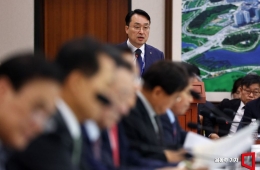
Namgeun Kim, Member of the Democratic Party of Korea and the executive secretary of the National Assembly's K Capital Market Special Committee, announced his top priorities for the second half of the year: the introduction of the mandatory tender offer system, establishing fair value assessment for mergers and acquisitions (M&A), and the legislative prohibition of dual listings.
In a recent interview with The Asia Business Daily marking the one-year anniversary of the amended Commercial Act, Assemblyman Kim stated, "If amendments to the Commercial Act created mechanisms to protect shareholders and investors, it is now the turn of the Capital Markets Act to resolve recurring issues that cause shareholder losses in specific cases." He emphasized his intention to push forward with these priorities.

First and foremost, Kim cited the introduction of the mandatory tender offer system as the highest legislative priority for the second half of the year. The mandatory tender offer system is designed to protect the rights of general shareholders by requiring any acquirer of management control in a listed company to also make tender offers for a portion of the remaining shares held by minority shareholders.
Assemblyman Kim explained, "In many M&A scenarios, only the controlling shareholder receives a premium, while the rest are bought out at a much lower price, resulting in significant losses for general shareholders. Recently, even business circles no longer strongly oppose (the mandatory tender offer system), recognizing that it may serve as a defense mechanism against hostile takeovers." He noted that this is also one of the national policy agenda items of the Lee Jaemyung administration.
Secondly, Kim argued that it is urgent to introduce a fair value assessment system for listed companies undergoing mergers—one that comprehensively considers not only share prices, but also the overall value of company assets. The amendment to the Capital Markets Act including this provision already passed the National Assembly's Political Affairs Committee in May. Assemblyman Kim said, "Similar to the Samsung C&T–Cheil Industries merger, there have been instances where unfair merger ratios, rather than fair price assessments, caused shareholder damages. The aim is to reduce shareholder losses during mergers between conglomerate affiliates. Since the amendment has cleared the Political Affairs Committee and is now up for a plenary vote, it should be processed at any time."
As the current Capital Markets Act requires companies to determine merger prices based on market value, it has been criticized for failing to properly reflect a company's intrinsic value. In particular, some controlling shareholders have reportedly abused this system to set merger prices in ways favorable to themselves, shifting the damage to minority shareholders.
Regarding dual listings, Kim commented on the recent guidelines announced by financial authorities, stating, "While the government says it will resolve this by revising the exchange's listing rules, we (the ruling party) believe it needs to be addressed through legislation." He criticized the dual listing practice, saying, "Companies, after developing new businesses and spinning them off as subsidiaries for separate listings, have caused losses for existing parent company shareholders. This is a representative case that has eroded trust in Korea's stock market." He reiterated, "All three issues—the mandatory tender offer system, fair M&A valuation, and the prohibition of dual listings—are directly related to causes of the Korea Discount. I will focus on addressing them."
In the interview, Assemblyman Kim cited the improvement in trust toward Korea's stock market as the biggest achievement in the first year since the amended Commercial Act took effect. He commented, "Participation in the main board market increased. There was a widespread perception that it was difficult to recover profits from investments in Korea's stock market, but this (amendment) helped resolve such concerns and encouraged foreign investors to participate more actively." He added, "It is now more difficult for companies to make decisions that arbitrarily harm shareholders because they are more aware of changes and conscious of investor interests." However, he expressed concerns that some companies are circumventing the system's intent through bylaw revisions and other workarounds during the phased implementation process.
Kim also emphasized the active role of institutional investors. He stated, "Institutional investors need to be allowed to form coalitions, but the Financial Services Commission's interpretation of the 5% Rule (the large-shareholding reporting rule) is ambiguous. The FSC must clarify its interpretation. If needed, I will push for additional legislation in this area." The 5% Rule requires shareholders who own 5% or more of a listed company's shares to disclose their holdings' purpose and any changes, and has often been cited as limiting institutional shareholder engagement.
Related Articles
![Lee Yongwoo: "Leverage ETFs Undermine Stock Market Reform Momentum... Predictable Markets Are Essential" [Commercial Act Amendment 1 Year] ①](https://cwcontent.asiae.co.kr/asiaresize/37/2026070915331840619_1783578798.jpg) Lee Yongwoo: "Leverage ETFs Undermine Stock Market Reform Momentum... Predictable Markets Are Essential" [Commercial Act Amendment 1 Year] ①
Lee Yongwoo: "Leverage ETFs Undermine Stock Market Reform Momentum... Predictable Markets Are Essential" [Commercial Act Amendment 1 Year] ①
- [One Year Since the Commercial Act Revision]① 75% of Experts Say It Helped Resolve the "Korea Discount"
- [One Year After the Commercial Act Amendment]② "No Real Changes to Boards as Companies Attempt to Undermine Reform Intent"
- [One Year After Commercial Act Revision]② "Institutional Investors Must Exercise Voting Rights Properly... Role of National Pension Service Is Also Crucial"
As prerequisites for the era of Korea Premium, Kim pointed to long-term institutional reforms and the active participation of market players. "Like Japan, we must look ten years ahead and set goals to triple or quadruple the size of our capital market through steady reforms," he said, "Changing the law alone is not enough; all market participants must practice these reforms. Stewardship code activities by institutional investors such as the National Pension Service are crucial in this regard."
© The Asia Business Daily. All rights reserved. Unauthorized AI training and use prohibited.


!["Please Take Them Off!" They Made It All the Way to the Bed... Then "80% of Fecal Bacteria" Struck [Deep Scroll]](https://cwcontent.asiae.co.kr/asiaresize/307/2026101610053063338_1792112730.png)