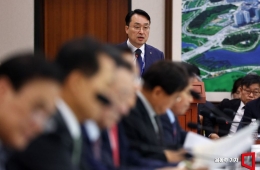
Samsung Electronics Establishes RX Business Promotion Office Under Roh Taemoon... Accelerates Humanoids and Autonomous Factories
Workforce Consolidation at Seoul R&D Campus
Key Hires Including Donggun Lee from Boston Dynamics
AI-Powered Autonomous Factory Initiative Planned for 2030
Samsung Electronics is consolidating its previously dispersed robotics capabilities under a new organization reporting directly to the CEO. This move signals the company’s intent to actively participate in the commercialization race for humanoid robots.

A robot OHT transporting internal materials in Samsung Electronics' semiconductor production line. Samsung Electronics
View original imageOn July 21, Samsung Electronics announced that it has designated robotics as a key pillar of its future growth engine and is establishing the Robotics eXperience (RX) Business Task Force, which will report directly to the CEO. This integrated system will manage everything from developing mid- to long-term strategies to core technology research and business commercialization under a single organization.
The RX Business Task Force will be led directly by Tae Moon Roh, President and CEO as well as head of the Device eXperience (DX) Division. The intention is to streamline decision-making processes in order to accelerate technology development and respond more quickly to market changes.
RX Business Task Force will use the Seoul R&D Campus in Umyeon-dong as its main hub. Robotics R&D personnel, previously scattered among various units, will now be brought together to create a collaborative environment. A data factory will also be established at the Gumi plant to secure on-site data, which is crucial for robotics competitiveness. The collected data will be utilized in partnership with the R&D teams at the Seoul R&D Campus to advance robot intelligence and enhance control systems.
Samsung Electronics is also preparing to establish overseas hubs. Plans are in place to set up global research centers in the United States, China, and Japan—countries with fast-evolving robotics technologies—in order to secure specialized local technology and talent.
A number of external experts have joined as well. Donggun Lee, who led Boston Dynamics' robotics strategy at Hyundai Motor Group and is now Vice President of Samsung Electronics’ Strategy Team, has been appointed head of the Robotics Strategy Team, and will be responsible for the company’s mid- to long-term robotics business roadmap. In the technology domain, Samsung has recruited Hyunjin Kim, a professor at Seoul National University and renowned authority in intelligent autonomous robotic systems and control, and Euigyeom Kim, an expert in robotic hand manipulation from Ajou University. As a result, Samsung expects to significantly strengthen its technological edge in hand manipulation and autonomous control—two critical areas for humanoid robot commercialization. The company also plans to bring in additional executive-level experts in robot hardware, artificial intelligence (AI), and software.
The business will be rolled out in stages, starting with technology validation on manufacturing sites before expanding into broader markets. Manufacturing humanoids will first be deployed on production lines to accumulate process data, which will later support the development of highly intelligent, multi-purpose humanoid robots. The company aims to progressively expand from business-to-business (B2B) operations into business-to-consumer (B2C) markets.
This strategy is closely tied to Samsung Electronics' ongoing plans for AI-powered autonomous factories. The company has set the goal of converting all domestic and international production plants into AI autonomous factories by 2030. The plan includes introducing digital twin-based simulations and employing AI agents for quality, production, and logistics, as well as deploying humanoid manufacturing robots such as operating, logistics, and assembly bots in phases.
Subsidiary sites will also serve as learning bases. In addition to its own semiconductor, smartphone, and home appliance manufacturing sites, Samsung Electronics will leverage data from affiliates engaged in displays (Samsung Display), electronic components (Samsung Electro-Mechanics), batteries (Samsung SDI), as well as shipbuilding and plant operations (Samsung Heavy Industries and SAMSUNG E&A), to support the development of general-purpose robots.
The business community is keeping a close eye on follow-up investments. There are expectations that, through this organizational restructuring, Samsung Electronics will secure talent in critical areas such as bipedal locomotion, full-body control, and robotics foundation models (RFMs), and will accelerate mergers and acquisitions (M&A) and investments in robotics startups.
Hot Picks Today
 "If You Don't Apply, My KRW 1.7 Million Will Be Gone"... Unclaimed National Pension Refunds Vanish After 'This Deadline'
- U.S. Alarmed as Infections from "Brain-Melting Fungus" Surge... 70% Fatality Rate, Cause Unknown
- Lee Juwan, Who Forecast Samsung at 70,000 Won and SK hynix at 200,000 Won, Says They're "Still Overvalued"; Others Counter: "Fundamentals Are Solid, Correction Is Excessive"
- "An Opinion, Not False Information"... Man in His 40s Who Called May 18 a "Riot" on Ilbe Acquitted on Appeal
- Kang Minkyung Raved, "Worth the Money," Then It Sold Out in 10 Minutes... Convenience Store Collaborations Pay Off
A representative of Samsung Electronics stated, "Through continuous innovation and the strengthening of our technological competitiveness, we will create new customer value and proactively develop future growth businesses, leading the global robotics market."
© The Asia Business Daily. All rights reserved. Unauthorized AI training and use prohibited.

!["Please Take Them Off!" They Made It All the Way to the Bed... Then "80% of Fecal Bacteria" Struck [Deep Scroll]](https://cwcontent.asiae.co.kr/asiaresize/307/2026101610053063338_1792112730.png)