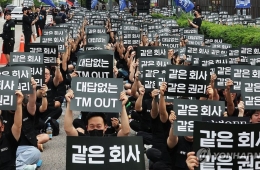
89% of Women Entrepreneurs Feel Burdened by Work-Life Balance Due to Pregnancy, Childbirth, and Childcare
The Smaller the Company, the Greater the Caregiving Burden
Social Norms That Place Caregiving Roles Primarily on Women Are a Major Cause
Eight out of ten women entrepreneurs report that they feel burdened by managing both work and life, citing management gaps caused by pregnancy, childbirth, and childcare.

According to a report titled "The Status of Work-Life Balance for Women Entrepreneurs and Policy Implications," published on July 21 by the Women's Economic Research Institute, an affiliate of the Korea Center for Women in Business (WCWB), 88.5% of women entrepreneurs responded that they feel stressed about work-life balance due to pregnancy, childbirth, childcare, and family care.
This study was conducted from June 8 to June 14 and targeted 645 women-owned companies that received the official women entrepreneurial certification.
The burden of care was found to be higher for smaller businesses. Among one-person companies, 91.7% reported feeling this burden, while 91.4% of companies with annual sales below 300 million won also felt pressured.
When asked why women entrepreneurs have more difficulty achieving work-life balance than men entrepreneurs, the most common response, at 65.3%, was "the prevalent social atmosphere that assigns family caregiving roles mainly to women." The next most-cited factor was "the burden of childcare" (54.6%).
Difficulties also varied depending on the type of caregiving involved. During pregnancy and childbirth, the main challenge was "business operation disruptions due to the absence of the company representative" (24.3%). Many respondents (23.6%) said that "short-term support staff to cover management gaps" was needed.
For childcare and similar responsibilities, the greatest difficulty cited was "temporary care gaps caused by children's illness or closure of nurseries and schools" (36.5%). As for the most needed support, women business owners most frequently mentioned "financial support for using child-care and babysitting services" (19.3%).
Regarding family care for parents or relatives, the most challenging issue was "accompanying family members to hospital visits, checkups, hospitalizations, or rehabilitation treatments" (38.0%), while "support for accompanying assistants" accounted for 26.0% of the needed policies. In total, 97% of women entrepreneurs responded that they believe support policies for work-life balance are necessary.
The Women's Economic Research Institute suggested that a practical mid- to long-term support system should be established to reduce the caregiving burden on women entrepreneurs and minimize management gaps. The institute also emphasized the need for customized support reflecting business size and type, as well as diversified support according to caregiving needs.
Hot Picks Today
!["Spend 200,000 Won, Get 100,000 Won Back?"... Government's Bold Move Unveiled [Essential Tips for Benefits]](https://cwcontent.asiae.co.kr/asiaresize/93/2022101316351067863_1665646511.jpg) "Spend 200,000 Won, Get 100,000 Won Back?"... Government's Bold Move Unveiled [Essential Tips for Benefits]
"Spend 200,000 Won, Get 100,000 Won Back?"... Government's Bold Move Unveiled [Essential Tips for Benefits]
- "Why Did Snacks Fly Off the Shelves Near the Pork Belly Display?... Sold Out in a Month at Five Times the Expected Pace [The Way We Shop Now]"
- Starbucks' Sales Slump Reverses: Surprise Comeback Against Twosome Place as Card Payments Rebound
- "Surviving on One Meal a Day to Invest 3.5 Million Won Monthly... 'FIRE' Craze Sparks 'NISA Poverty' in Japan"
- "I'm Getting Married, But Please Don't Come"... Gen Z's Changing Wedding Trends [World is Z-gold]
The institute added, "Current work-life balance support systems are mainly designed for wage workers. This means women entrepreneurs can easily fall through the cracks when they themselves need support due to pregnancy, childbirth, childcare, or family caregiving. There is an urgent need to establish effective support systems and measures that will allow women entrepreneurs to continue to grow and manage their businesses stably."
© The Asia Business Daily. All rights reserved. Unauthorized AI training and use prohibited.




![[Report] "From AI Homes to Premium Lineups"… Chinese Electronics Dominate IFA 2026](https://cwcontent.asiae.co.kr/asiaresize/307/2026090505514216935_1788555102.jpg)