['N% Performance Bonus' Aftermath]② Industry-Level Distribution Rules Must Be Refined
Detailed Rules for Performance Bonus Thresholds in the US
Need for Clear Standards on Operating Profit, Net Profit, etc.
Payment Method—Stock or Cash—Should Also Be Specified
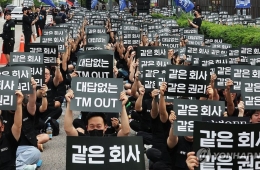
How to distribute a company’s achievements has now become an issue that extends far beyond simple labor-management negotiations, evolving into a central topic for the entire manufacturing sector. Discussion of performance-based bonuses linked to operating profits, which began in the semiconductor industry, has expanded into the automotive, shipbuilding, and information technology sectors—and even to demands from subcontractor unions for a share of primary contractors’ profits. However, current debates remain focused on how much more to receive, with no sign of social consensus on who should share the results and under what principles and procedures. Despite frequent references to American-style performance compensation, the employment flexibility and sector-wide standards that underpin it are largely absent from Korea’s discourse. Result-based distribution without clear principles now risks generating division not only within companies, but across the entire industrial ecosystem—potentially stoking wider social conflict. The Asia Business Daily examines the social challenges posed by the ‘N%-performance bonus’ debate through expert interviews and opinion columns.
As the next challenge in the performance bonus debate, some experts suggest that detailed rules for distribution must be developed on an industry-wide basis. They argue that if only the share to be divided during profit growth is set—without defining how losses are borne when performance declines—such disputes are bound to recur. As a relevant example, the collective bargaining agreement between General Motors (GM) and the United Auto Workers (UAW) in the United States was cited.
Lee Jonghoon, Professor Emeritus at Myongji University, explained, “Profit-sharing systems at major U.S. corporations typically conclude base salary negotiations in a single page, but the criteria for performance-based pay—such as the reference line and the maximum sharing percentage—are elaborately detailed in lengthy rulebooks.” He noted that even at workplaces where unions have the greatest bargaining power, the distribution rules are meticulously documented in writing.
![['N% Performance Bonus' Aftermath]② Industry-Level Distribution Rules Must Be Refined](http://www.asiae.co.kr/news/img_view.htm?img=2026052208181273321_1779405492.png)
Professor Lee emphasized that the benchmarks must be clearly defined at the outset: Is the target operating profit or post-tax net income? At what threshold does the bonus kick in? What percentage of any excess is to be distributed? Will the bonuses be paid in cash or stock? How will differences among business divisions and individuals be handled? All these are essential components of a robust set of rules. Professor Lee stated, “This round of negotiations concluded without properly clarifying these kinds of principles.”
The design of the payout threshold is also an issue. In Samsung Electronics’ recent agreement, if the company’s Device Solutions division achieves operating profits above a certain scale, the performance bonus fund is calculated by multiplying the agreed business result by a preset ratio. In contrast, while U.S. companies’ profit-sharing systems vary, in many cases only profits exceeding a specified threshold are eligible for profit-sharing. Experts warn that if bonus funds increase dramatically once the hurdle is cleared, it creates incentives to manipulate revenue recognition or contract timing, making the threshold design especially important.
Allowing bonuses to be paid in company stock is also raised as a potential issue, as the agreement can be blocked if the board of directors refuses to approve new stock issuance. Professor Lee stated, “Because the terms are stipulated in the collective agreement, they are binding and must be implemented; if not, the company becomes a debtor and workers are creditors, so the dispute could end up in court.”
Calls have also been made for establishing transparent decision-making procedures. Hwang Yongyeon, Labor Policy Director at the Korea Employers Federation, said, “All major U.S. big tech companies determine bonuses through compensation committees under their boards of directors, with management participating in the process. In Germany, employee councils discuss compensation, but all proposals require prior approval by the board.” He emphasized that as the scale of bonus distribution grows, formal procedures are imperative—otherwise, outcomes will be dictated by the year’s relative bargaining strength.
![['N% Performance Bonus' Aftermath]② Industry-Level Distribution Rules Must Be Refined](http://www.asiae.co.kr/news/img_view.htm?img=2026052815471880303_1779950838.png)
The scope of profit-sharing itself remains an open question. If distribution is limited solely to the original contractors and unionized workers, it may further entrench the dual structure of the labor market rather than resolve it.
Hot Picks Today
!["Spend 200,000 Won, Get 100,000 Won Back?"... Government's Bold Move Unveiled [Essential Tips for Benefits]](https://cwcontent.asiae.co.kr/asiaresize/93/2022101316351067863_1665646511.jpg) "Spend 200,000 Won, Get 100,000 Won Back?"... Government's Bold Move Unveiled [Essential Tips for Benefits]
"Spend 200,000 Won, Get 100,000 Won Back?"... Government's Bold Move Unveiled [Essential Tips for Benefits]
- Starbucks' Sales Slump Reverses: Surprise Comeback Against Twosome Place as Card Payments Rebound
- "I Always Visited When in Japan"...Crowds Flock and Pay Admission for Korean Launch 'Open Run' [Report]
- Lee Seunggi Effectively Wins Another Settlement Lawsuit Against Former Agency... Ordered to Pay 690 Million Won
- "I'm Getting Married, But Please Don't Come"... Gen Z's Changing Wedding Trends [World is Z-gold]
Jung Seungil, Policy Committee Member at Welfare State Society, argued, “Rather than confining a portion of excess profits within large corporations or distributing them solely as bonuses to union members, companies should create a semiconductor ecosystem fund to share gains with partner suppliers.” He observed that subcontractors, with their thin profit margins, are unlikely to have the resources to invest in workforce development or employee welfare on their own. If the current dynamic—in which large companies hire skilled workers nurtured by smaller suppliers—remains unchanged, suppliers will lose both the incentive and the capacity to build their own talent pipelines.
© The Asia Business Daily. All rights reserved. Unauthorized AI training and use prohibited.






![[Report] "From AI Homes to Premium Lineups"… Chinese Electronics Dominate IFA 2026](https://cwcontent.asiae.co.kr/asiaresize/307/2026090505514216935_1788555102.jpg)