Lee Responds to Interference Allegations Over Party Deposit Proposal: "Expressing Opinions on Routine Party Affairs Is a Member's Right"
Responds to Critical Social Media Comment
"Different from Park Geun-hye's Involvement in Nominations and Primaries"
"Expressing Preferences for Candidates Does Not Violate Laws or Party Rules"
"Not Siding with Any Particular Candidate
President Lee Jae-myung addressed criticism that his proposal on July 19 to lower the Democratic Party’s leadership election deposit back to its previous level amounted to “interference in party affairs.” He stated, “Expressing an opinion about the sudden excessive increase in the youth candidate deposit cannot be considered party intervention.” He argued that what the relevant regulations prohibit is presidential involvement in candidate nominations or internal primaries for public office elections—those acts are defined as interference in party affairs. In contrast, he emphasized that a sitting president who is also a party member has the right to express opinions on routine party activities, and this should be distinguished from prohibited interventions.

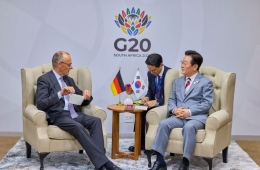
President Lee Jae-myung delivers a congratulatory speech at the opening ceremony of the 48th UNESCO World Heritage Committee held in Busan on July 19, 2026. Photo by Yonhap News
View original imageOn the same day, President Lee shared a post from user ‘Pullipyi’—who had criticized his proposal to lower the deposit—on X (formerly Twitter). Lee responded, “First of all, I sincerely thank Pullipyi for your opinion and criticism,” but he also offered clarification. The user ‘Pullipyi’ argued that it was inappropriate for the president to directly comment on the ruling party’s leadership elections, referencing incidents such as former President Park Geun-hye’s involvement in candidate nominations.
In response, President Lee explained, “What constitutes illegal party intervention is involvement in the nomination or primary process for public office candidates, in direct violation of the Public Official Election Act or other laws.” He added, “The problem with former President Park Geun-hye’s case was intervention in candidate nominations or primaries for public office, not simply expressing opinions on routine party matters.”
President Lee went on to say that, apart from election-related work, sitting presidents are formally recognized as party members and entitled to participate in day-to-day party activities in accordance with the law and the Democratic Party’s rules and constitution. He continued, “While the law and party constitution do not ban even the open expression of preference or disapproval regarding specific candidates in party elections, I choose restraint out of respect for party autonomy.” He explained that he raised the deposit issue not to support a particular candidate, but because it directly concerns the ruling bloc’s—including the Democratic Party and the government—awareness of youth issues.
President Lee emphasized, “When I express my view on the deposit, especially the youth deposit, I am not trying to side with any specific candidate. Youth issues are among the most serious social challenges in Korean society, and the matter of the youth deposit could fundamentally raise doubts among young people about the ruling bloc’s attitude toward youth—including the Democratic Party and the government.” He added, “Please understand that, as a Democratic Party member and partner in governance, I sincerely hope the Democratic Party becomes a strong and competent democratic party that respects the will of its members and the people, and puts it into practice.”
Earlier that day on X, President Lee had also proposed, “If possible, I suggest considering returning the deposit level to its original amount” in response to ongoing controversy about the increase in the Democratic Party’s election deposit.
President Lee explained, “The party’s finances are not in trouble, and there are difficulties facing young people as well as a policy need for consideration.” He expressed disappointment at the sharp increase in leadership election deposits, stating, “This time, the deposit for youth candidates has risen severalfold, making it very challenging for them.” He continued, “Sitting National Assembly members may have fewer concerns because they have income and political funds. However, for those outside parliament, especially youth, the burden is enormous. As a senior who overcame financial hardship in my youth and broke through the walls of vested interests through relentless challenge, I would like at least to help publicize young candidates’ fundraising accounts.”
President Lee also remarked, “It is not only sad but also increases the incentive for corruption if someone cannot run for election because of money.” He noted, “A core part of Roh Moo-hyun’s political reform was the introduction of publicly funded elections—a system for elections without money. If not for President Roh Moo-hyun’s ‘moneyless election’ reform, I never would have dreamed of entering politics myself.”
Hot Picks Today
 "The Transfer Failed, but 'Ding-Dong,' Money Came In"... KRW 32.5 Billion Financial Incident at Toss Bank
- Shark 'Bukkangi' Missing... Oil Spill off Busan North Port Raises Concerns
- "Made 12 Billion Won Cleaning Up Other People's Dog Poop With Just a Rake"... 'Poop Scoop Millionaire' Is All the Rage in the U.S.
- Self-Employed Delinquencies Hit 13-Year High... High Interest Rates and Oil Prices Fuel Fears of Domino Defaults
- Woman Who Bought Economy Ticket Causes Uproar, Demands "Put Me in Business Class," Delays Flight
Recently, as the Democratic Party’s convention approaches, there has been mounting opposition to the increased deposit requirement. Former Prime Minister Kim Min-seok criticized, “Under Lee Jae-myung, youth and disabled candidates now must pay an extra 30 million won for leader and 17.5 million won for Supreme Council member registration compared to the previous period.” Supreme Council candidate Kim Hyung-nam also wrote on social networking services, “This year, the Supreme Council preliminary primary deposit is 20 million won—a sudden 400% increase.”
© The Asia Business Daily. All rights reserved. Unauthorized AI training and use prohibited.