[Market ING] KOSPI Breaks Below 7,000—Will Q2 Earnings Provide a Breakthrough for a Rebound?
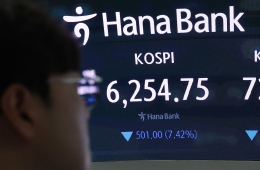
Amid an unprecedentedly volatile market, with sidecar halts on both the buy and sell sides activating in alternation nearly every other day, the KOSPI ultimately failed to maintain the 7,000 mark last week.

Last week, the KOSPI fell by 8.77% and the KOSDAQ by 5.44%. The KOSPI plunged sharply at the start of the week, breaking down through 7,000, then reversed course, briefly recovering the 7,000 level, only to drop again and give up all gains, ultimately closing the week in the 6,800 range. Lee Kyungmin, a researcher at Daishin Securities, analyzed that “the extreme volatility of the KOSPI in July is the result of a chain reaction from deteriorating investor sentiment due to simultaneous weakness in Korean and US semiconductor stocks, along with forced liquidations of leveraged investments amid worsening semiconductor supply and demand conditions.”
There is a consensus that there is currently no clear catalyst for a rebound. Lee Jaewon, a researcher at Yuanta Securities, stated, “On the 16th, even the stronger-than-expected results from TSMC and expectations for the launch of single-stock leveraged ETFs during intraday trading failed to act as triggers for a market rebound,” and added, “Until Alphabet’s earnings are released, there appear to be no definitive drivers for a turnaround.”
With the persistent decline, the KOSPI valuation has entered historically low territory. Researcher Lee Kyungmin said, “Throughout the recent decline, the KOSPI’s 12-month forward price-to-earnings ratio (PER) dropped to 5.78x, moving down to historical low levels,” explaining that “this is even lower than the financial crisis bottom of 6.27x in 2008, making it the first time since 2004—after the card crisis and domestic consumption concerns—that the KOSPI forward PER has fallen below 6x.”
Kang Jinhyuk, a researcher at Shinhan Investment & Securities, also noted, “Last week, the KOSPI’s 12-month forward PER fell to 5.78x, below the financial crisis low of 6.27x. Stock prices are determined both by corporate earnings and the discount rate applied when converting those earnings to present value. In addition to concerns over earnings stability, the PER has dropped rapidly due to changes in the market’s demanded discount rate,” he analyzed.
![[Market ING] KOSPI Breaks Below 7,000—Will Q2 Earnings Provide a Breakthrough for a Rebound?](http://www.asiae.co.kr/news/img_view.htm?img=2026072008492550367_1784504965.png)
Although the market correction continues, experts advise against panic selling. Researcher Lee Jaewon said, “Volatility stemming from leveraged ETFs and the absence of sustained net buyers have left the index plummeting to valuations below those seen during the financial crisis. However, given that most stocks have already experienced excessively large declines from their peaks and show little deviation from their 120-day moving averages at this point, panic selling should be avoided.”
The focus now is whether the upcoming second-quarter corporate earnings reports this week can provide a breakthrough for a rebound. Researcher Lee Kyungmin commented, “Market attention is shifting to the second-quarter earnings season. The results to be announced by SK hynix on the 24th will determine the direction of both the semiconductor sector and the KOSPI. Recent steep declines have already reflected concerns over earnings, and the short-term volatility in supply and demand before and after earnings announcements presents an opportunity to increase exposure.” He added, “As the full-scale second-quarter earnings season unfolds, it will build momentum for a KOSPI rebound. Not only is the KOSPI deeply undervalued, but on a monthly basis 24 sectors (including IT hardware, shipbuilding, machinery, secondary batteries, automobiles, semiconductors, etc.) remain undervalued relative to earnings, so inflows of bargain hunting are anticipated.”
In terms of US corporate earnings, Alphabet’s upcoming earnings report is expected to be of particular significance. Lim Jeongeun, a researcher at KB Securities, stated, “This week marks the real start of domestic corporate earnings announcements. In the US, Alphabet is scheduled to release its results, and it is important to confirm whether the current capital expenditure trend related to artificial intelligence (AI) will continue.”
Key economic events this week include China’s announcement of the July Loan Prime Rate (LPR) on the 20th and the European Central Bank’s interest rate decision on the 23rd.
Hot Picks Today
 "End of Samsung and SK Hynix’s Dominance?" CXMT Soars 466% on IPO Debut... Founder’s Wealth Jumps 300%
- [Breaking] KOSPI Breaks Below the 6,000 Mark During Trading Hours
- "Let’s Give Korea a Spending Spree": Over 10 Million Foreign Tourists Flock In, Credit Card Spending Exceeds 10 Trillion Won
- "Spent Over 60,000 Won, Yet Asked to Order More Drinks?"...Online Uproar Over 'One Drink Per Person' Policy
- "It's Even More Beautiful in Person": Visitors Flock to Samsung Gangnam, Many Making Purchases on First Day of Pre-orders [Report]
The cycle of corporate earnings reports will also continue. In the US, Alphabet, Tesla, IBM, Philip Morris, GE Vernova, and AT&T will release earnings on the 22nd, while Intel, RTX, and Lockheed Martin will do so on the 23rd. In Korea, LG Display, OCI, and Orion will announce results on the 22nd; Samsung Biologics, KB Financial Group, Shinhan Financial Group, and Doosan Bobcat on the 23rd; and SK hynix, Hyundai Mobis, Hyundai Steel, Hyundai Rotem, Samsung Heavy Industries, and Doosan Robotics will release their second-quarter results on the 24th.
© The Asia Business Daily. All rights reserved. Unauthorized AI training and use prohibited.