Advance Reporting Requirement Abolished for Foreigners...Door Opens for Samsung Electronics and SK hynix to Issue Won Bonds in New York [Won Internationalization]
Government Unveils Roadmap for Won Internationalization
No Restrictions on Won Transactions via RFI
Offshore Won Payment Network to Launch Next Year
Substantial Easing of Onshore Won Trading Regulations
Starting next year, the requirement for advance reporting will be waived for all won-denominated capital transactions between foreigners overseas, except for real estate deals. Thanks to an offshore won payment network that operates around the clock, foreigners will be able to trade Korean won with each other during nighttime hours without any time zone gap. The government’s goal is to foster an environment where Korean companies such as Samsung Electronics and SK hynix can issue won-denominated bonds overseas to raise capital, through the introduction of these infrastructure projects and institutional improvements.

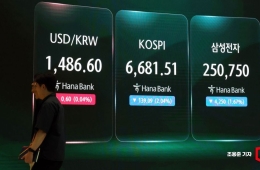
On the 19th, the won/dollar exchange rate information was displayed in the dealing room at the headquarters of Hana Bank in Seoul. On that day, in the Seoul foreign exchange market, as of 9:03 a.m., the won-dollar exchange rate was 1,501.3 won, up 18.2 won from the previous day's weekly closing price (based on 3:30 p.m.). This is the highest level since March 10, 2009 (1,561.0 won) during the financial crisis, based on weekly intraday trading. Photo by Yongjun Cho, March 19, 2026
View original imageOn the 19th, in its “Roadmap for Won Internationalization,” drafted and announced in cooperation with related ministries under the supervision of the Ministry of Economy and Finance, the government detailed these plans. The roadmap’s core objective is to shift the won from a “regulated currency” to a “freely convertible currency,” with a focus on expanding the opening hours of the foreign exchange market and improving infrastructure and accessibility. Lee Hyungryul, Director General of International Finance at the Ministry of Economy and Finance, stated, “Despite Korea becoming a net creditor nation due to long-standing current account surpluses, the won remains bound by the framework of a regulated currency. This roadmap sets out to revamp our infrastructure and redesign the system in line with our status as the world’s fifth-largest trading nation and the thirteenth-largest economy by GDP.”
'Dedicated Won Highway' RFI Enables 24-Hour Offshore Won Trading
First, restrictions hampering offshore won transactions between foreigners will be significantly eased. As early as January next year, foreigners will be able to conduct won transactions in their own names via offshore won payment institutions (RFIs) without having to open a separate domestic account. This is made possible by the system that allows 83 registered overseas financial institutions to hold won accounts in Korea and use them directly.
For example, if a German auto parts company, Company A, purchases parts from a Korean partner, it can now pay for goods and settle payments using the won balance in its local bank (RFI). When Company A uses an RFI, the requirement for prior reporting of capital transactions under the Foreign Exchange Transaction Act is waived, and banks’ obligation to verify the facts of imports and exports is also relaxed.
To facilitate this environment, on July 6, the government switched KRW/USD foreign exchange trading to a 24-hour uninterrupted system. Starting next year, foreigners will be able to conduct won trades with each other offshore without any time zone limitation through the 24-hour offshore won payment network, which is set for a pilot launch this September.
Currently, offshore won trades are mostly conducted through non-deliverable forwards (NDFs), where only the difference is settled in U.S. dollars rather than actual delivery. To encourage direct (delivery-versus-payment, DN) trading, a program offering incentives to foreign exchange banks is also being prepared, with a separate announcement planned for September.
Advance Reporting Requirements Will Be Significantly Eased…Transition to Post-Reporting to Boost Transactions
In addition, the threshold for mandatory reporting when foreigners engage in won-denominated capital transactions with foreign exchange banks, domestic residents, or Korean companies will be raised to more than twice the current limit. Simplified verification procedures for foreign exchange banks will also be introduced, leading to a substantial easing of regulations related to onshore won trading.
![Advance Reporting Requirement Abolished for Foreigners...Door Opens for Samsung Electronics and SK hynix to Issue Won Bonds in New York [Won Internationalization]](http://www.asiae.co.kr/news/img_view.htm?img=2026071909102049857_1784419820.jpg)
The Ministry of Economy and Finance will balance the needs of industries, legislative history, and the necessity of regulatory reform to prepare concrete measures by this September and aims to amend related regulations within the year. A ministry official stated, “We will comprehensively review the types of capital transactions requiring advance reporting and may consider increases even greater than double the current threshold if needed. We intend to proactively loosen the requirements and gradually shift to a system centered on post-reporting.”
It will also become easier for foreigners to issue won-linked foreign currency securities. In particular, for issuances of up to USD 50 million in won-linked foreign currency securities, only a post-report is needed within three months of issuance. This measure is intended to make it easier for foreign investors to invest in won-denominated securities.
Additionally, to address digital finance innovation, a pilot project will be launched next year to tokenize government bonds in connection with the Bank of Korea’s wholesale CBDC, and Korea will become an official member of the BIS Project Agora, a cross-border CBDC initiative involving central and commercial banks.
This Is Not a Short-Term Task…“Risk Management Considered in Balance”
The internationalization of the won is a key task for advancing Korea’s foreign exchange and financial markets, and is closely linked to the inclusion of Korea in the MSCI Developed Markets Index. However, this is not something that can be achieved in the short term. Even China, which holds the world’s second-largest share in the trade finance settlement market, took more than a decade to promote the internationalization of the renminbi after formally declaring its aim of full convertibility and detailing it at the Third Plenum in the fall of 2013.
Hot Picks Today
 "I Only Meant to Try It Once"... 30 Million Won Taken from Father's Account: Youth Caught in Gambling
- "Resale Brings 'Hundreds of Times' the Profit" Crowds Line Up at Dawn... A Bag Harder to Get Than Luxury Brands
- Apartment Building Representative Dies After Dispute... Appeals Court Also Finds 'Not Guilty' of Fatal Assault
- Woman Wins $8.5 Million Lottery After Divorce... Court Rules Ex-Husband Has No Rights
- "Zhungti Nanda? Koreans Flock to China... What’s Behind the Changing Travel Trends?"
A government official commented, “Structural improvements in the foreign exchange market, inclusion in the WGBI, and the MSCI roadmap have matured the conditions for the won’s internationalization. We will pursue internationalization of the won in a manner that matches the sophistication of our economy, while keeping risk management carefully balanced.”
© The Asia Business Daily. All rights reserved. Unauthorized AI training and use prohibited.