[Won Internationalization] "The Economy Is a Dragon, the Won Is a Snake"... Boosting Demand with Lower Rates and Expanded Guarantees
Preparing for Shocks with a Public Backstop and Currency Swaps
The government is advancing its “won internationalization” policy by expanding transaction incentives for foreign investors in won-denominated assets and trade settlements, as well as by establishing an overnight liquidity supply system. It will improve transaction and settlement procedures to meet international standards, enhancing foreign access to the domestic capital market. In addition, it is setting up a safeguard for supplying won during crises through cooperation between the government and the Bank of Korea.
On July 19, the government announced the “Won Internationalization Roadmap” as part of its plan to make the won a freely tradable currency overseas. This plan is not limited to building transaction infrastructure for the won; it is focused on increasing the actual use of the won by individuals and businesses. The goal is to make it easier for foreigners to use the won, thereby naturally increasing demand for the currency in domestic stock and bond investment, as well as in trade settlements.

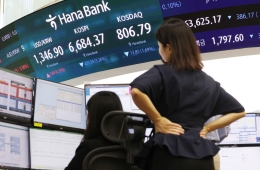
The Bank of Korea announced that last year, the Gross National Income (GNI) per capita was $33,745, an increase of 2.6% compared to the previous year. The photo shows an employee organizing 50,000-won bills at the Hana Bank headquarters in Jung-gu, Seoul, on the 5th. Photo by Jinhyung Kang aymsdream@
View original imageLowering Entry Barriers in the Capital Market and Expanding Won Utilization
The government will first complete the remaining tasks for the inclusion of Korea in the Morgan Stanley Capital International (MSCI) Developed Markets Index. It will connect the Korea Securities Depository system to the international standard transaction and settlement systems (CTM and ALERT), automating processes from transaction to settlement and simplifying investor registration procedures. English disclosures by KOSPI-listed companies will also be fully expanded. In other words, some inconvenient procedures for foreigners to invest in domestic stocks—such as email or manual input—still remain, but going forward, transaction information will be delivered automatically, like in advanced markets such as the U.S., greatly improving investment convenience.
Utilization of won-denominated assets will also be enhanced. The government will allow foreign investors to conduct securities lending for government bonds among themselves through the International Central Securities Depository (ICSD) and will improve regulations so that foreigners can operate their won holdings in short-term financial products. This means foreigners will be able to not only buy and hold Korean government bonds, but also use them as collateral or for short-term funding. The government expects that as the utilization of government bonds increases, the attractiveness of the Korean market for overseas investors will also rise.
In the trade sector, a range of incentives will be offered to companies settling transactions in won, such as preferential policy loan rates and expanded trade insurance limits. Won settlement achievements will also be given priority in the selection of government-supported projects. In addition, the government will increase direct won-local currency trading with major trading partners and promote participation in cross-border QR and small-value payment networks. The goal is to encourage export and import companies to conduct transactions directly in won rather than converting through the dollar, thereby reducing the costs and risks associated with currency exchange and exchange rate fluctuations.
![[Won Internationalization] "The Economy Is a Dragon, the Won Is a Snake"... Boosting Demand with Lower Rates and Expanded Guarantees](http://www.asiae.co.kr/news/img_view.htm?img=2026071817032749767_1784361807.png)
Overnight Liquidity Supply... Establishing a Crisis Response Safety Net
To facilitate smooth won transactions, the government is also preparing liquidity supply mechanisms. Foreign financial institutions will be allowed to obtain the necessary overnight won funds from foreign exchange banks through an overdraft method without limits. If private sector supply is insufficient, the government and the Bank of Korea are considering providing liquidity through a public backstop. The core idea is that private entities will provide initial lending to foreign financial institutions overnight, and in times of crisis, the government and the Bank of Korea will serve as the ultimate safety net to prevent payment failures due to a shortage of won.
The government has also prepared countermeasures for concerns that won internationalization could increase foreign exchange market volatility. It will strengthen its foreign exchange market stabilization capacity, expand bilateral and multilateral currency swaps, and establish a nighttime monitoring desk to check for sudden exchange rate changes and trading volume in real time. New indicators for offshore won market liquidity will be created and incorporated into stress tests, thoroughly reforming the overall foreign exchange soundness management framework.
Hot Picks Today
 You Can Receive Monthly Payments Like a Pension Without Selling Your Home... The Local Mutual Growth Housing Pension That Provides 1.69 Million Won Each Month
- "Unimaginable in Korea"...Koreans Surprised by Secondhand Smoke in Japan and China Restaurants
- "Special Skill: Admitting Mistakes"... The Unexpected Edge That Helped Job Seekers Tired of AI Resumes Succeed
- "Canceled After Five Days and Lost 770,000 Won"... Hit by Steep Fees After Pressing the Cancel Button
- "I Thought She Was an Ordinary SKT Employee... The Unexpected Identity of Nongshim's Third-Generation Bride"
In particular, the government emphasized that 24-hour trading itself will not increase exchange rate instability. There is already ample liquidity during the overnight hours, as the offshore non-deliverable forward (NDF) market operates around the clock. However, the government pointed out that in a global crisis similar to the 2008 financial crisis, a "dollar squeeze" could occur, where financial institutions worldwide sell won and secure dollars, which is regarded as the main risk. Hyung-Ryul Lee, director general of the International Finance Bureau at the Ministry of Economy and Finance, stated, "Even with thorough preparation, the net benefits from further opening far outweigh the risks," adding, "The government will absorb shocks by expanding the public backstop, increasing currency swaps, and strengthening foreign exchange market monitoring in response to such scenarios."
© The Asia Business Daily. All rights reserved. Unauthorized AI training and use prohibited.



![How Did Tacos Come to Have Two Shells [Delicious Stories]](https://cwcontent.asiae.co.kr/asiaresize/307/2026091410392626963_1789349966.jpg)