Former Chief Ha Jung-woo: "AI Side Effects Inevitable... Excess Tax Revenue Should Be Invested in AX for Youth and Local Regions"
Closing Lecture at the FKI Jeju Forum
"K-Semiconductors Should Lead Korea to Become an Intelligence Exporting Nation"
Ha Jung-woo, former Chief AI Future Planning Officer at the Blue House, recommended on the 18th that excess national tax revenues should be invested in AI transformation (AX) for the younger generation and local regions, in order to prevent potential decreases in employment and widening inequality resulting from the adoption of artificial intelligence (AI).

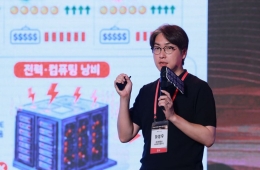
Ha Jung-woo, former AI Future Planning Chief, is giving a lecture on the topic "New Roles of the Nation and Companies in the AI Era" at the '2026 Korea Economic Association Executive Jeju Summer Forum' held at Lotte Hotel Jeju on the 18th. The Korea Economic Association
View original imageDuring his lecture at the Jeju Summer Forum hosted by the Federation of Korean Industries, Ha introduced a remark by Sam Altman, CEO of OpenAI, who stated, "Singularity is Memory." Ha explained, "The singularity has been defined as the moment when AI surpasses humans. This means memory is critically important, and given that Korea possesses world-class memory technology, our country is competitive in this field."
Ha emphasized that the basic unit by which AI understands the world is the "token." He explained that a token is a piece that AI uses to process and generate content—whether it is text, images, or audio—by breaking it down into fragments. He also noted that many major big tech companies are building "intelligence factories" to produce tokens. He added, "Becoming an intelligence-exporting nation will be the path forward for Korea."
Regarding the need to develop an independent "sovereign AI" and a Korean language-specific model, he stated, "With English-centric big tech AI models, even with identical content, the cost per token is twice as high in Korean. The Korean language requires far more tokens to perform the same task," he emphasized, adding, "That is why we must strengthen our own competitiveness."
He also pointed out cases where countries such as the United States immediately imposed export controls as soon as high-performance AI demonstrated its superior capabilities, for example, in cybersecurity. He warned, "In the future, powerful AI will become subject to export controls." He continued, "A nation must possess at least one outstanding AI to respond to strategic asset export controls. The government and the industrial sector must work together to tackle this challenge."
He strongly called for proactive distribution policies to prepare for the side effects of AI proliferation. Ha argued, "When AI increases corporate productivity, a reduction in employment is inevitable. Growth without job creation and K-shaped polarization may follow," he said. "While excess tax revenue should be invested in preparing future sources of income, investments must also be made in fostering the younger generation and local development."
Hot Picks Today
 "Don't Delete Messenger Records": 40 Former Employees Receive Fear-Inducing Warning Letters from Their Ex-Employer
- Samsung and SK hynix Shares Slide: "It's Because of You, the Cash King"—The Graph Explains It [Tech Talk]
- “Senior, Are We Having the ‘Lunch Gathering’ There Today?” Even the Manager Nods... Fierce Competition Returns to Buffets After 10 Years [Why&Next]
- Nam June Paik's 'My Faust' Ruled as Property of Late Kim Woo-choong's Wife; Court Recognizes Ownership
- "Spiders Crawling Across Faces While Sleeping"... Naju Apartment Complex Plagued by Spider Infestation
He further predicted that AI data centers for inference processing will become increasingly important. He suggested linking large-scale data centers to industrial complexes in regional areas, while constructing small-scale inference data centers in the metropolitan area as a realistic approach.
© The Asia Business Daily. All rights reserved. Unauthorized AI training and use prohibited.