Minister Choi Huieong: "K-Culture Is a Core Growth Engine... Export Target Raised to $110 Billion by 2030"
Lecture at Jeju Forum by Korea Chamber of Commerce and Industry
"Expanding the Scope of the K-Culture Industry, Raising Export Targets"
"Enhancing Support for Foundational Arts, Promoting K-Culture Festivals"
Choi Huieong, Minister of Culture, Sports and Tourism, announced plans to expand the industrial scope of K-Culture from food, beauty, and fashion to tourism, with the goal of reaching 110 billion dollars in exports by 2030.
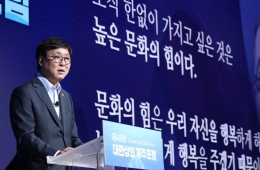
During his lecture at the "49th Korea Chamber of Commerce and Industry Jeju Forum" held at Shilla Hotel Jeju on the 18th, Minister Choi stated, "K-Culture is a much larger industry than previously imagined and will serve as an attractive core growth engine leading the future of Korea’s economy."
The Ministry of Culture, Sports and Tourism has redefined the scope of the K-Culture industry, which was previously calculated around cultural arts and content, to now include domestic consumption by foreign tourists and exports of lifestyle products such as K-Food, K-Beauty, and K-Fashion.
Based on this new standard, the market size of the K-Culture industry last year was valued at 274 trillion won. The government had originally aimed to expand the market from 206 trillion won in 2023 to 300 trillion won by 2030, but with the redefined industry scope, it has now set a higher target of 400 trillion won.
Provisional export figures for the K-Culture industry last year reached 71.8 billion dollars. While slightly lower than the export value of automobiles, this surpasses that of general machinery. The government assessed that K-Culture has already grown to become one of Korea’s top three export industries, alongside semiconductors and automobiles. The 2030 export target has also been raised from 35 billion to 110 billion dollars.

Choi Hwiyeong, Minister of Culture, Sports and Tourism, is giving a lecture at the '49th Korea Chamber of Commerce and Industry Jeju Forum' held at Shilla Hotel Jeju on the 18th. Korea Chamber of Commerce and Industry.
View original imageMinister Choi revealed plans to boost not only direct K-Culture exports but also those of consumer goods such as cosmetics and food, leveraging increased affinity toward Korean culture.
He said, "Yesterday, Chey Tae-won, Chairman of Korea Chamber of Commerce and Industry, spoke about a future where we will export not products but computing capacity and AI services, in essence, intelligence. Going forward, our K-Culture will cover the realms of emotion and sentiment."
To further enhance the competitiveness of K-Culture, the government will also increase support for foundational arts. Literature, theater, performance, music, dance, and fine arts will be seen as the foundation of K-Culture, with measures to ensure artists’ rights and freedom of expression, as well as to strengthen the welfare safety net.
Minister Choi stated, "Discovering talents early and providing opportunities for learning in childhood, as well as providing platforms and spaces for young people to realize their dreams, are tasks that we must pursue even better in the future," adding, "We need well-structured support programs to allow young people to take on new challenges and grow further from these stepping stones."
Plans are also in place to improve aging cultural facilities and expand performance infrastructure. As about 60% of the 280 cultural and art centers nationwide have been in operation for over 20 years, the government sees a need to reinforce large-scale cultural venues such as domed stadiums and blended-use arenas.
The content production process will more actively incorporate technologies like artificial intelligence (AI) and virtual reality. By combining the production expertise of the Korean content industry with visual effects (VFX), computer graphics (CG), virtual production, and AI, the government aims to attract global production projects to Korea.
In addition, the government will pursue global K-Culture festivals and the establishment of overseas hubs. The Presidential Commission on Popular Culture Exchange plans to host a large-scale K-Culture festival called "Phenomenon" in Seoul in December next year. The goal is to bring together leading domestic artists, K-Food, K-Beauty, K-Fashion, film, drama, and webtoons in a festival that can rival the scale of Coachella in the United States.
Establishment of "K-Culture Centers" (tentative name) is also under review in major cities such as Los Angeles, New York, and Paris. The plan involves securing operational rights for stadium-sized venues to host weekly K-pop concerts and to create integrated cultural spaces combining K-Food and K-Beauty experiences with merchandise sales.
Hot Picks Today
!["Hey, are we having the lunch get-together there today?" Nods... Fierce Competition Returns After 10 Years [Why&Next]](https://cwcontent.asiae.co.kr/asiaresize/93/2026071316152044208_1783926919.jpg) "Hey, are we having the lunch get-together there today?" Nods... Fierce Competition Returns After 10 Years [Why&Next]
"Hey, are we having the lunch get-together there today?" Nods... Fierce Competition Returns After 10 Years [Why&Next]
- Samsung and SK hynix Shares Slide: "It's Because of You, the Cash King"—The Graph Explains It [Tech Talk]
- "It's a Daily Sight... 'Please Don't Do This with Wet Wipes,' Chemist Warns"
- "Skipping Cooking for Rest After Work, Lying in Bed"... China's Gen Z Falls for 'Once-a-Week Meals' [Z-World Today]
- "Spiders Crawling Across Faces While Sleeping"... Naju Apartment Complex Plagued by Spider Infestation
Minister Choi emphasized, "Attracting 30 million foreign tourists is a key government policy goal we aim to achieve by 2030, but I believe it could be accomplished one or two years earlier, and we are preparing countermeasures accordingly. If the number of foreign tourists increases by 10 million, it is said that we can generate an additional 15 billion dollars in foreign currency earnings and create 200,000 new jobs."
© The Asia Business Daily. All rights reserved. Unauthorized AI training and use prohibited.