US Strikes Iranian Civilian Facilities Including Airports and Railways... Iran Targets US Assets in the Gulf
Expansion to Civilian Targets
Retaliation Reaches Gulf States
Prolonged Standoff at the Hormuz Strait
The armed conflict between the United States and Iran over control of the Strait of Hormuz, a vital energy shipping route, is intensifying. The U.S. has expanded its airstrikes beyond the coastline’s military facilities to target civilian sites and inland areas, while Iran has broadened its counterattacks to include U.S. assets throughout the Gulf region.
The U.S. Central Command, responsible for Middle Eastern operations, announced via the social media platform X (formerly Twitter) that it launched nighttime airstrikes against Iran at 2 p.m. Eastern Time on July 16.

U.S. military vessel firing ammunition to strike Iranian targets. Photo by Reuters·Yonhap News Agency·U.S. Central Command
View original imageThis marks the sixth consecutive day of U.S. military operations against Iran. The U.S. began the campaign on July 11, stating its aim is to weaken Iranian military power attacking ships in the Strait of Hormuz.
On the night of the 16th, Central Command reported that airstrikes concluded at 9:40 p.m., and that dozens of Iranian coastal, air defense, logistical, and naval power facilities had been struck.
Iranian local media reported that the U.S. strikes have expanded to civilian sites and inland locations.
The southern Iranian port city of Bandar Abbas, as well as Qeshm Island in the Strait of Hormuz and Iranshahr near the Pakistani border, all suffered damage from the airstrikes.
At Iranshahr Airport, at least one bomb was dropped. Although the fire was extinguished, power was cut off. A railroad intersection located about 10 kilometers west of Bandar Abbas was also reportedly attacked and damaged.
According to Iran’s state-run IRIB broadcaster, this railway splits in two directions: one branch leads to Bandar Abbas, home to the Islamic Revolutionary Guard Corps (IRGC) Navy headquarters, and the other to Shahid Rajaee Port, Iran’s largest commercial port.
Iranian media reported that in the early hours of July 17 local time, at least seven people were killed when a bridge in the Bandar Khamir area of Hormozgan province was destroyed by a U.S. airstrike.
At Chabahar Port, which Iran operates with support from India, a surveillance tower collapsed. Attacks on civilian infrastructure, such as bridges, could be considered war crimes depending on the intent and scale of damage.
According to the Associated Press, the latest strikes came after U.S. President Donald Trump recently threatened to target key infrastructure to break the Strait of Hormuz blockade.
The AP analyzed, "Strikes on bridges and railways appear intended to cut off access to Iran’s key port of Bandar Abbas and block critical routes connecting Iran’s central regions to the capital, Tehran." The outlet added that the U.S. may further expand its airstrikes to paralyze both Iranian military supplies and civilian logistics.
The Iranian Ministry of Health stated that since U.S. strikes resumed after a memorandum of understanding (MOU) for ceasefire was signed on June 22, 38 people have been killed and over 400 injured by U.S. airstrikes as of this date.

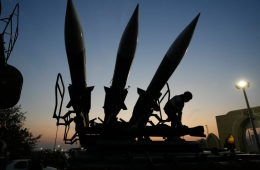
Video of IRGC missile launch released by local Iranian media. Photo by Yonhap News AFP
View original imageFollowing the end of the U.S. airstrikes, Iran launched immediate counterattacks.
According to CNN, Kuwaiti forces activated air defenses in the early morning of July 17 and intercepted projectiles originating from Iran. An air raid alert was issued in Bahrain.
Qatar was attacked by Iran over two days starting the night of July 16. The Qatari Ministry of Interior reported that a child was injured by falling debris during the interception of an Iranian projectile.
CNN noted that while Iran has repeatedly attacked military bases in Bahrain, Kuwait, and Jordan, Qatar had not previously been included as a target. Qatar is one of the countries that played a key role in peace negotiations between the U.S. and Iran.
The IRGC claimed responsibility for attacks on the U.S. military base at Al-Tanf in Syria in retaliation for the Iranshahr airstrike. It also announced that two U.S. military radars in Oman were destroyed.
Iran has warned that if the U.S. expands its attacks to power plants, bridges, and other infrastructure, it could retaliate by targeting Gulf countries' energy infrastructure.
Amid rising fears of escalation, the two sides remain far apart over the future of the Strait of Hormuz.
The U.S. has continued its recently resumed maritime blockade to halt Iran’s oil exports. In response, Iran has threatened to block not only the Strait of Hormuz but also the oil exports of Gulf nations.
With the de facto collapse of the compromise point set by the previous ceasefire MOU, there are growing concerns that the U.S. could be drawn into another "forever war," following conflicts in Iraq and Afghanistan.
Susan Maloney, director of foreign policy at the Brookings Institution, told the New York Times (NYT) that American assumptions and miscalculations had changed the regional balance of power, just as they did in Iraq, and that the era of completely free passage through the Strait of Hormuz may be over.
Hot Picks Today
 "200,000 Won Per Person Before Chuseok"… Local Excitement Over Livelihood Support Grant in This Region
- "Betting with Advance Knowledge of Presidential Speeches"… Trump's Closest Aide Earns 150 Million Won
- Korea Zinc Pledges 150 Million Won to Improve Working Conditions for Nurses
- "Oops, No Condom... 'I Probably Won't Get Pregnant' – Alarming Neglect of Contraception Among Korean Adolescents"
- "Changed Gender to 'Female' Before Imprisonment, but Neo-Nazi Ultimately Sent to Male Prison"
She said that the current situation could become the "new normal" for the Strait of Hormuz, stating, "Given Iran’s ability to attack vessels whenever it wants, the U.S. will need to deploy a much higher level of military force in the region."
© The Asia Business Daily. All rights reserved. Unauthorized AI training and use prohibited.




![Will the Fed Hold Off on Raising Rates in the Second Half? [Weekend Money]](https://cwcontent.asiae.co.kr/asiaresize/307/2026071504434646114_1784058227.jpg)