Lee Says "KTX Is Too Cheap," but Why Is a High-Speed Rail Fare Hike So Difficult? [Why&Next]
Ministry of Land Report Highlights Rising Rail Use, Falling Bus Share
15 Years of Frozen Low Fares Driving Passengers to Trains
KORAIL Pushed for "Fare Increase" Before Integration
Integration Process Emphasizes "Cost Reduction"... Le
Regarding the increased share of railroad transportation, President Lee Jae-myung pointed to excessively low fares as a primary factor. High-speed rail fares have been frozen for 15 years, and Korea Railroad Corporation (KORAIL) has continually argued that an increase is needed.
Nonetheless, the idea of raising fares has failed to gain traction. This is mainly because of concerns that it could trigger a domino effect, leading to a rise in other public transportation fares, and because fiscal authorities have prioritized internal cost-saving measures for public enterprises. In this context, the president's direct call to support a fare increase has drawn attention. Paradoxically, however, due to the ongoing high-speed rail integration project initiated under President Lee's direction, raising fares in the near future is unlikely. This is because, once integration is complete and KORAIL becomes the sole operator of high-speed rail, regulatory scrutiny from competition authorities is expected to intensify.

In May, the KTX Sancheon-SRT stopped at the Seoul Station platform ahead of the pilot multi-unit operation departure. Photo by Yonhap News
View original imageAt the Ministry of Land, Infrastructure and Transport's mid-year work briefing held on the 16th, President Lee stated, "The share of rail in transportation has become excessively high," adding, "Meanwhile, the share of bus transportation is declining, and intercity express bus routes are being discontinued." He continued, "Because rail is much cheaper than taking the bus, express bus usage is disappearing. Since this is a structural problem, the Ministry should comprehensively consider the ramifications, including the disappearance of express bus routes."
The proportion of public transportation passengers carried by rail has risen each year. In 2011, the rail share was 15.5%, rising to 16.8% in 2020 and reaching 18.2% in 2023. By contrast, the share for buses decreased from 24.1% in 2011 to 19.5% in 2023. As bus usage declined, a total of 491 intercity and express bus routes nationwide were discontinued between 2020 and 2024.
The primary reason for these trends is the low fares of high-speed rail. According to the Consumer Price Index tracked by the Ministry of Data and Statistics, last month's prices increased by over 30% compared to 2011. Given that KTX and SRT fares have been frozen during this period, it is highly likely that ordinary high-speed rail users perceive these fares as inexpensive.

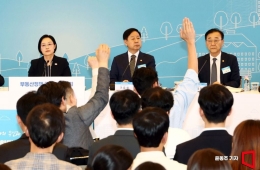
President Lee Jae-myung is speaking at the ministry briefing held at the State Guest House of the Blue House on the 16th. Photo by Yonhap News Agency, Blue House Press Photographers Group
View original imageKORAIL has openly argued that fare increases are unavoidable to address its accumulated financial deterioration over the years. The company claims that a 15-year fare freeze has significantly burdened its finances. Although KORAIL’s sales last year reached KRW 7.317 trillion, marking a 6.6% increase over the previous year, its operating loss widened to KRW 352.4 billion, up from KRW 73.6 billion in 2022. In particular, with more than 20 years since the introduction of high-speed rail and many trains aging, KORAIL has emphasized that raising fares is necessary to fund the introduction of new trains that require substantial investment.
Despite fiscal authorities' opposition, KORAIL has consistently made the case for fare increases. However, with the current government pursuing integration between high-speed rail operators, discussions on fare adjustments have stalled. In fact, once integration is complete, KORAIL is expected to align its fare system with SR’s, which is about 10% lower, further lowering the perceived cost for users. KORAIL has previously justified integration on the basis that it would expand seat supply and enable cost reductions. These arguments have removed the rationale for raising fares after the integration.

Last October, participants at the railway workers' general resolution rally held near Samgakji Station in Yongsan-gu, Seoul, raised placards calling for the integration of high-speed rail services (KTX and SRT). Photo by Yonhap News Agency
View original imageThere is also the possibility that competition authorities will directly regulate fares. When companies merge, regulators typically examine whether this could lead to higher prices for products or services. It is common for the companies involved to publicly pledge not to increase fares for a certain period. For example, when Korean Air and Asiana Airlines merged, they agreed not to raise fares for 10 years.
Raising fares after a merger is typically regarded as a clear reduction of consumer benefits. A Ministry of Land, Infrastructure and Transport official commented, "The fare structure after the integration will be determined following the corporate merger review process. Until the Fair Trade Commission makes its decision, we cannot disclose any details regarding changes in the fare system."
Hot Picks Today
 Is the Stock Market Decline Just Beginning? "An Even Bigger Crisis Is Coming," Warns Rich Dad Author
- [Exclusive] SK hynix to Build Headquarters in Central Seoul... Plans New Office on Former Le Meridien Gangnam Site
- "With My Young Daughter Present": Active Police Officer Goes Shirtless and Verbally Abuses Parent... Police "Fact-Finding Underway"
- It Was a Sensation in Korea Too..."Can't Live Without It" - Japanese Elementary Students Also Obsessed With This
- "Prettier Than Idols?" "Tight Outfits Stir Debate"... Why the Virtual Female Weathercaster Is Causing a Stir
Tae-Seung Kim, CEO of KORAIL, stressed the need for political and governmental discussions on fare increases. At a press meeting in Gwangsan-gu, Gwangju in May, Kim said, "Fares have not increased even once in the past 15 years, which places enormous financial pressure on us. If this continues, trains will keep running, but a crisis could arise as we will not be able to make a profit." He added, "I would like to consider a flexible system that adjusts fares, such as raising fares during peak periods, to help balance demand. However, this basically requires public consent and agreement with the relevant economic ministries and the political sector."
© The Asia Business Daily. All rights reserved. Unauthorized AI training and use prohibited.