'Shinan's Wind' to Power Semiconductors... Construction Begins on Shinan Uii Offshore Wind Power Complex
First Project of the National Growth Fund: 1.3 Trillion Won Invested
From Energy Production Site to a Power Base for Advanced Industries
The First Demonstration Project Linking Offshore Wind, AI, and Semiconductors
The Shinan Uii Offshore Wind Power Complex, which began construction on July 16, is more than just a renewable energy project. Its significance lies in being the first experiment in an "energy-based growth model" that will supply electricity generated off the coast of Shinan directly to AI data centers and the semiconductor industry. Until now, Jeonnam has been the nation’s largest power generation region, but its role was limited to supplying electricity to the Seoul metropolitan area and other regions. However, with the Honam semiconductor cluster and AI industry development strategies promoted by the Lee Jaemyung administration now in full swing, the situation is changing.
The Shinan Uii Offshore Wind Power Complex (390MW), with a total project investment of 3.4 trillion won, is targeting commercial operations in 2029. Although this represents one of the largest offshore wind projects in Korea by capacity, what is more notable is the project's location and its intended role.
Jeonnam-Gwangju is a core area for the 7.3GW offshore wind cluster (Shinan 3.7GW, Jindo 3.6GW) designated by the government. If the 21GW offshore wind plan being promoted by Jeonnam Gwangju Integrated Special City (targeted for completion by 2035) becomes a reality, Shinan and the southwestern coast will establish themselves as the nation’s primary renewable energy production bases.

Min Hyungbae, Mayor of Jeonnam Gwangju Integrated Special City, is performing the groundbreaking ceremony with key guests at the ‘Shinan-Ui Offshore Wind Power Plant Groundbreaking Ceremony’ held on the 16th at Shinan National Sports Center. Provided by Jeonnam Gwangju Integrated Special City
View original imageThis move is also closely linked to the recently approved national project for the Honam Semiconductor Cluster, which has a scale of 896 trillion won.
Semiconductor plants require massive electricity consumption. As leading global semiconductor firms now make RE100 (100% renewable energy use) a key management standard, the ability to ensure stable renewable energy supply has become one of the core criteria for site selection.
Ultimately, the Shinan Uii Offshore Wind Power Project is not just about generating electricity; it can also be seen as an "industrial infrastructure project" aimed at attracting future semiconductor plants and AI data centers.
This is precisely why the project was chosen as the first project of the National Growth Fund.
The government recognized the industrial transformation effects, rather than simply viewing this as a power generation project. In fact, around 1.3 trillion won, or about 40% of the total investment, is being contributed via the National Growth Fund and the Future Energy Fund. It is highly unusual for the government to provide this scale of policy finance for a single offshore wind project.
The industrial ecosystem implications are also significant.
Korean offshore wind projects have long faced criticism for their high dependence on foreign equipment. However, the Shinan Uii project has achieved localization for 97% of major components, excluding turbines. Hanwha Ocean is in charge of the offshore substation, Hyundai Steel Industries manufactures the substructures, and LS Cable is responsible for the subsea cables.
This is not simply a project to build a power plant; rather, it is about establishing a supply chain that integrates the domestic shipbuilding, steel, cable, and construction industries.
For the Integrated Special City, in particular, this initiative also aligns with its balanced regional development strategy.

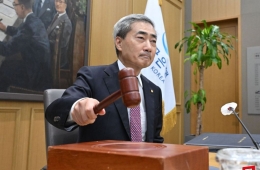
Min Hyung-bae, mayor of Jeonnam Gwangju Integrated Special City, is delivering a congratulatory speech at the groundbreaking ceremony for the Shinan Ui Offshore Wind Power Complex held on the 16th at Shinan National Sports Center. Provided by Jeonnam Gwangju Integrated Special City
View original imageIf the Gwangju region is positioned as a hub for AI and semiconductor production, then the southwest will serve as the base for renewable energy generation. Analysts say that this offers Mokpo, Shinan, Yeongam, Haenam, and other southwestern areas—which have so far felt relatively marginalized in the semiconductor cluster discourse—a new opportunity to emerge as a central axis in the national energy supply network.
However, there are remaining challenges.
While the 390MW project is highly symbolic, it is only the starting point toward the 21GW target set by the Integrated Special City. Without progress in transmission network construction, securing local acceptance, resolving system connectivity issues, and fostering domestic offshore wind equipment industries, the goal of becoming an "energy capital" will also be difficult to accelerate.
Thus, the significance of the groundbreaking ceremony held on this day does not lie solely in the installation of 26 wind turbines. Its true meaning is that the national strategy to transform Shinan’s wind into industrial competitiveness and secure an energy base for the AI and semiconductor era has now begun to materialize as a concrete project.
The success of Shinan Uii Offshore Wind Power will likely serve as a litmus test for the "overwhelming growth" strategy put forth by Jeonnam Gwangju Integrated Special City.
Mayor Min Hyungbae said, "The clean electricity generated from Shinan's wind will power the artificial intelligence (AI) sector and semiconductor factories, providing citizens with high-quality jobs and a stable 'wind pension' as tangible results."
Hot Picks Today
 "Are You Okay, Dad? Brother?"... 1 in 18 Men Deficient, U.S. Military to Begin Annual Screenings
- "What Did He See?"... Warren Buffett Sells Stocks and Piles Up Cash
- "Home-Cooked Meals Were the Only Affordable Option, but Now Even Hetbahn and Dumplings Are Going Up"
- "One Year from Now Will Be Worse Hell"... 9 Out of 10 Japanese Fear 'Runaway Inflation'
- "How Can So Many Fit on One Boat?"...Crowds in Red: What Is This?
He added, "As our goal is to commence commercial operation by January 2029, the city will provide comprehensive support to minimize inconvenience for residents and remove obstacles for companies, ensuring the project’s successful completion."
© The Asia Business Daily. All rights reserved. Unauthorized AI training and use prohibited.