Another Rate Hike in August? Shin Hyun-song Says "Answers Lie in Q2 GDI and July Core Inflation" (Roundup 2)
"Monetary Policy Response Until Inflation Converges to Target Level"
Indirect Price Effects Remain Ongoing… Demand-Side Pressures Must Not Be Overlooked
Growth Rate Set for Significant Upward Revision, "All Components of GDP Are Strong"
Shin Hyun-Song, Governor of the Bank of Korea, emphasized that the central bank will continue its monetary policy response (such as raising the benchmark interest rate) until he is convinced that the inflation rate is converging stably to the target level of 2.0%. This statement was made following the 0.25 percentage point hike of the benchmark rate to 2.75% per annum on July 16, 2026. Through this, he also left open the possibility of another rate hike at the next rate-setting meeting in August. However, the market is placing more weight on a rate hike in October.
With regard to the market’s key interest in the “timing and speed of interest rate increases,” Governor Shin stressed, “All possibilities remain on the table, and I will focus on the indicators released going forward.” In particular, he explained that this month’s release of the second quarter national income statistics and the announcement of July’s consumer price index (CPI) in early August would be closely monitored, with special attention paid to second quarter gross domestic income (GDI) and July core inflation.

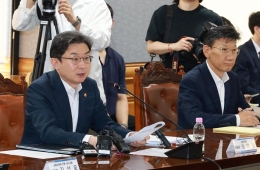
Shin Hyun-Song, Governor of the Bank of Korea, is attending the Monetary Policy Committee plenary meeting held at the Bank of Korea in Jung-gu, Seoul on the morning of the 16th, striking the gavel. Photo by Joint Press Corps
View original image“Indirect Effects on Inflation Are Ongoing... Demand-Side Pressure Should Not Be Overlooked”
At the press conference following the Monetary Policy Board meeting, Governor Shin emphasized, “The indirect effects are currently at work, exerting upward pressure on prices.” He explained, “When there is an energy shock, there are not only direct effects such as higher fuel and oil surcharges, but also indirect effects via cost channels.” The indirect effects, he added, are the process by which rising energy prices increase costs, in turn raising the prices of goods or services. “The largest impact occurs within six months, and the effects can last for more than a year in a parabolic curve,” he analyzed, noting that “the impact of indirect effects is still ongoing.”
He also warned that, if the semiconductor boom sharply improves incomes, demand-side inflationary pressures must be closely watched. Shin said, “The Board reached a consensus that, in such exceptional situations (like wars), demand-side pressure cannot be overlooked.” On this day, the Monetary Policy Board commented, “As household income conditions improve, demand-side pressure will gradually increase,” and that “prices will remain above target for a considerable period.”
Governor Shin reiterated, “We will continue monetary policy actions until there is confidence that inflation is stably converging to the 2.0% target.” He explained the extent of policy action would depend on incoming data. Regarding changes in the Monetary Policy Board members’ rate outlooks, he stated, “The internal discussion this time was generally consistent with the dot plot presented in May, and newly acquired information was reflected.”

“Every Component of GDP Is Strong”... Significantly Upgraded Growth Forecast Expected
During the press conference, Shin repeatedly emphasized that the economic growth outlook for Korea this year would be revised up significantly. “Every component of gross domestic product (GDP)—exports, investment, and consumption—is showing strength,” he said, describing the present as an exceptional situation. He noted, “Due to the exceptionally favorable semiconductor market, export prices have risen above import prices, leading to a significant divergence between GDP and GDI statistics.” For example, “GDP grew by 3.8% year-on-year in the first quarter, but GDI increased by 13.2%. Whether this is merely temporary or will have a material impact on the economy requires further examination.”
To confirm this, he stressed the need to closely monitor the second quarter national income statistics to be released next week. Shin explained, “We will look at how long GDP growth has continued; how sustainable GDI growth is; whether the unprecedented figure in the first quarter gets revised down; or if, due to strong exports, it is maintained.”
Early next month, July’s inflation report will be released, and Governor Shin highlighted the importance of monitoring core inflation as a key indicator of future price trends. He added, “We will also closely observe the cost of living index, which plays a critical role in shaping inflation expectations.”
He reiterated that the policy of rate hikes would continue until there is confidence that inflation is stably converging to the 2.0% target rate. “How long inflation remains above the target depends on the strength of monetary policy. If we maintain a strong stance, it is unlikely inflation will stay above the target for long,” he added.

Shin Hyun-Song, Governor of the Bank of Korea, attended the Monetary Policy Committee plenary meeting held at the Bank of Korea in Jung-gu, Seoul on the morning of the 16th and struck the gavel. Photo by the Joint Press Corps
View original imageDoes a Rate Hike Spur a Stock Market Drop? Disagreement... "Look at Semiconductor Prices"
On the criticism that the rate hike trend would drive the Korean stock market lower, Governor Shin disagreed and pointed out that semiconductor prices are far more important. He explained that the driver of Korea’s 13.2% year-on-year GDI growth in the first quarter was soaring semiconductor demand and resulting price increases, so future stock market trends would be influenced by the direction of semiconductor prices. “There are many other variables at play now. It is better to watch semiconductor prices themselves rather than the share prices of chip makers,” he said. “As the artificial intelligence (AI) industry enters a new era and semiconductors become the key infrastructure for future AI development—not just a commodity—this may have significant implications for the Korean economy.”
He also played down the argument that stock market volatility would limit pressure for further rate hikes: “Unlike other liquidity indicators, stocks do not have many channels linking them to systemic risk.” He further noted, “When stock assets rise by KRW 1 million, consumption increases by KRW 13,000. In 2000, the U.S. NASDAQ surged and then fell sharply, but the impact on the financial system was limited.”

Shin Hyun-sung, the Governor of the Bank of Korea, is attending the Monetary Policy Committee main meeting held at the Bank of Korea in Jung-gu, Seoul, on the morning of the 16th, exchanging opinions with the Monetary Policy Committee members. Photo by Joint Press Corps
View original imageSupport for Vulnerable Borrowers Requires Proper Interest Relief... Selective Fiscal and Financial Policies Needed
With mounting household debt, some have pointed out that raising the base rate would increase the interest burden for vulnerable borrowers. Governor Shin argued that appropriate government interest relief measures, rather than monetary policy alone, are needed. “For vulnerable groups, if their debt burdens are not sustainable, adjustment policies are needed to help vulnerable borrowers navigate these difficulties. These efforts should be conducted at an appropriate level, considering moral hazard,” he said. “Rather than monetary policy, it is fiscal and financial policy—implemented selectively to maximize policy effectiveness—which would be most appropriate.” On measures for mortgage lending, he remarked, “It is difficult to control house prices through monetary policy alone. Complementary effects may arise if macroprudential policy is used and monetary policy serves as a supplement.”
Regarding sluggish employment rates, he cited both structural changes in the economy and the Middle East war as key causes. “In the long term, as the economic structure grows more sophisticated, the share shifts from manufacturing to services. In the short term, uncertainties resulting from the Middle East war—especially in petroleum, chemicals, and construction sectors closely linked to fuel prices—caused companies to be cautious about hiring.” He also projected that, if the Middle East conflict eases, a modest increase in employment centering on the service sector could be expected.
Korea-U.S. Rate Gap Narrowing to Attract Offshore NDF Funds to Onshore Market
Governor Shin expressed optimism that the narrowing interest rate gap between Korea and the United States would draw offshore non-deliverable forward (NDF) funds into the domestic market. “As the Bank continues to raise rates, the spread with U.S. rates is expected to shrink, which will likely impact NDF trading,” he stated. He evaluated that, although the KRW-USD exchange rate retreated from the 1,500 won range to the high 1,400 won range this week, the introduction of 24-hour foreign exchange trading on July 6 has not yet had a significant effect on shrinking the offshore NDF market. Governor Shin also remarked that an offshore won settlement system—whereby foreigners can freely trade KRW overseas and settled funds are deposited at the central bank’s reserves—could attract more NDF funds domestically.
Meanwhile, regarding criticism that not raising the benchmark rate preemptively in May was a policy misstep, he flatly denied this. “A rate hike could have been possible then, but we refrained because the data was insufficient. Now there is a clear trend; at that time, things were still unstable. Above all, there was significant uncertainty due to the Middle East war at the time,” he explained.
Hot Picks Today
![[Exclusive] Hyundai Motor Retirees Face Crackdown on “Car-Tech”...25% Discount Benefits Also Taxed](https://cwcontent.asiae.co.kr/asiaresize/93/2026081408361880693_1786664179.jpg) [Exclusive] Hyundai Motor Retirees Face Crackdown on “Car-Tech”...25% Discount Benefits Also Taxed
[Exclusive] Hyundai Motor Retirees Face Crackdown on “Car-Tech”...25% Discount Benefits Also Taxed
- Will Health Insurance Premiums Rise Next Year After Five Years of Surplus End? ... Additional Premiums for Interest and Dividend Income Possible [Why&Next]
- "Though He Was a Student Like Ahn Sangho"... Kim Iknam, Who Took a Different Path Amid Controversy Over the Actress's Great-Grandfather's Pro-Japanese Past
- Chey Taewon and Noh Soyoung Face Deadline for 944 Billion Won Asset Division... Final Appeal Closes at Midnight Today
- 7,000 Stranded at Airport, Many Koreans Among Them... Emergency as Record-Breaking Rain Hits Greater Tokyo Area
On concerns that the Bank’s rate hike policy may be out of sync with the government’s expansionary fiscal stance, he said, “If fiscal policy leads to investment that increases overall growth potential, this will not necessarily result in a policy mismatch. Especially if fiscal measures boost productivity and raise the potential growth rate, monetary policy and fiscal policy are, in fact, aligned.”
© The Asia Business Daily. All rights reserved. Unauthorized AI training and use prohibited.