[Second Half Policy Report] "Formulating a Strategy to Promote Paid Broadcasting and Strengthening Response to False Information"
Broadcasting Media and Communications Committee Briefing
“Basic Media Society” Set as Core Initiative
The Broadcasting, Media and Communications Commission has set the creation of a "Basic Media Society" as its core project for the second half of this year, and will push forward with related national policy tasks. In response to growing concerns over a possible repeat of the "second JTBC incident," the commission is preparing a strategy to promote paid broadcasting and supporting the stable implementation of the revised Information and Communications Network Act to address false and manipulated information.

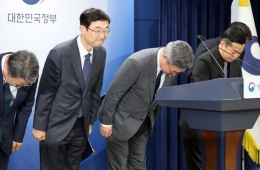
Kim Jongchul, Chairman of the Broadcasting, Media and Communications Commission, is reporting at the work briefing hosted by President Lee Jae-myung on the 16th at the Blue House State Guest House. On the right is Tae seog Oh, Administrator of the Korea Aerospace Administration (KASA). Photo by Blue House Press Photographers Group
View original imageOn July 16, at the Blue House State Guest House, the Broadcasting, Media and Communications Commission (BMCC) presented its major policy achievements since its inauguration and outlined key projects for the second half of the year. Its primary objectives include guaranteeing the public's media sovereignty with a focus on participation, access, and the right of choice; strengthening a sustainable industrial and institutional foundation to support media rights; and preparing for the next 100 years of broadcasting, media, and communications in Korea.
First, to enhance the competitiveness of the broadcasting and media industry, the commission plans to reasonably improve ownership, cross-ownership, advertising, and programming regulations, and formulate strategies to support paid broadcasting media. Paid broadcasting providers, including cable TV operators, are experiencing a decline in subscribers and falling profits as online video service (OTT) platforms expand. Some operators are unable to pay the broadcasting development fund due to ongoing deficits. The BMCC explained, “We have formed a working group of industry experts and stakeholders to gather opinions, and plan to announce promotion policies in the second half of the year. With regard to easing advertising regulations, amendments to the enforcement decree of the Broadcasting Act are underway, and additional decrees are also being prepared.”
The commission is also pursuing the establishment of the Korea Broadcasting, Media and Communications Promotion Agency (tentative name) under its authority. This agency is expected to support the broadcasting and OTT industries, stimulate the broadcasting advertising market, create policies for digital user protection, and foster a fair competition environment in the media sector. The bill to establish this agency is currently pending in the National Assembly’s Legislation and Judiciary Committee, and the commission stated that it is communicating with the Ministry of Science and ICT, the Ministry of Culture, Sports and Tourism, the Office for Government Policy Coordination, and other related agencies regarding OTT jurisdiction.
In the communications sector, the commission aims to create an environment where the public can safely use digital media in response to the expansion of AI and changes in the digital landscape. In particular, since the enforcement of the revised Information and Communications Network Act on July 7, platforms with more than 1 million daily active users (DAU) are now subject to an accountability process to review their self-regulation policies. According to the BMCC, “Currently, the only platform operator to submit explanation materials is DC Inside. After review, we will determine whether to designate it as subject to obligations for preventing false or manipulated information circulation. We will also strengthen the related response system to enhance platform accountability.”
Additionally, the scope of measures to prevent the distribution of illegal recordings will be expanded from video to include images, and on-site inspections will be conducted to check how information and communications service providers are implementing technical and administrative measures. A Transparency Center will be established to promote verification activities by major service providers. For illegal information, including drug-related content, the commission will introduce emergency blocking rights and advance blocking technologies.
Furthermore, the commission aims to strengthen the regional media ecosystem so that the basic media society leads to tangible participation and growth for local communities and youth. Key initiatives include expanding support for the production of community-based programs, building collaborative systems between regional broadcasters, AI companies, and universities, nurturing young creators, and increasing the number of regional media hubs and audience media centers. Through these efforts, the commission plans to bolster content production capabilities and create a virtuous ecosystem where regional talent and content can thrive.
The commission also declared its commitment to ushering in a new century of Korean broadcasting starting from the centenary next year. To this end, it will host the "2027 Asia Media Summit (AMS)," a high-level international broadcasting conference for the Asia-Pacific region, and will accelerate the launch of the "Media Development Committee" in cooperation with related agencies. The committee will function as a public forum for discussing development directions that align with the rapidly changing media environment.
Hot Picks Today
 "Ppalli-ppalli Korea, No Wonder It Stings": Plunges from No. 1 to 22nd, Falls Behind Vietnam and Thailand
- "'Some Get KRW 74 Million, While a One-Day Difference Means a KRW 34 Million Gap' Sparks Outrage... President Weighs In"
- [Exclusive] Delinquencies and defaults among low-credit borrowers fuel vicious cycle... Government-backed inclusive finance subrogation payments to hit KRW 1.35 trillion next year
- "Feeds on blood and is hard to eradicate"... the 'terrifying bug' that grounded a plane
- 220 cm-Tall 26-Year-Old Woman Dies Less Than a Year After Giving Birth... Deadly Complications Hidden Behind 'Gigantism'
Kim Jongchul, Chairman of the BMCC, stated, “Media is an essential foundation that supports the daily lives of the public and society as a whole. We will build a basic media society that guarantees everyone the right to safely and reliably choose their media, and confidently open a new 100-year era for broadcasting, media, and communications in Korea.”
© The Asia Business Daily. All rights reserved. Unauthorized AI training and use prohibited.