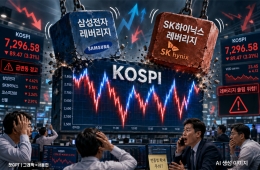
"KOSPI Faces Record Volatility Amid Doubts Over Semiconductor-Only Dominance"
‘AI Capex Skepticism’ Echoes the Dot-Com Bubble
But Suppliers Rallied Despite Weakening Demand in 1999
Recent Fears of Big Tech’s Surging Corporate Bond Issuance and Investment Slowdown
Yet Firms Like Microsoft Have 2–4 Years Before Hitti
As the KOSPI index exhibits unprecedented volatility and once again fell below the 7,000-point threshold, growing doubts have emerged regarding whether the Artificial Intelligence (AI) infrastructure investment cycle can be sustained amid a deterioration in the cash flows of large information technology companies, or "Big Tech." However, considering historical examples from the dot-com bubble era, as well as the robust bond financing capabilities of Big Tech firms, some analysts argue that market concerns may be somewhat premature.

Employees monitor the stock market and exchange rates at the dealing room of Hana Bank headquarters in Jung-gu, Seoul, on the 16th, as the KOSPI index failed to maintain its upward trend and plunged sharply. On the day, the KOSPI opened at 6,960.50, down 323.91 points (4.45%) from the previous session, while the KOSDAQ index opened at 813.32, down 16.11 points (1.94%). Photo by Jo Yongjun, July 14, 2026.
View original imageOn July 16, the KOSPI opened at 6,960.50, a 4.45% decline from the previous trading session, and by 9:50 a.m. was trading at 6,837.31, marking a 6.14% drop. Early in the session, the sharp plunge triggered a temporary suspension of program sell orders (sidecar mechanism) at around 9:10 a.m. At the same time, the KOSDAQ was trading at 798.20, down 3.77%.
Overnight in the United States, the three major New York stock indices closed higher. On the 15th (local time), the Dow Jones Industrial Average finished at 52,658.64, up 150.37 points (0.29%) from the previous session. The Standard & Poor's (S&P) 500 index increased by 28.81 points (0.38%) to close at 7,572.40, and the tech-heavy NASDAQ Composite ended at 26,269.23, up 162.22 points (0.62%).

Even as indices led by Big Tech continued to rise, skepticism over the pace of AI infrastructure investment began to surface, prompting a sharp decline in semiconductor stocks. Apple rose by 4% to reach an all-time high, while Amazon, Alphabet, and Microsoft each gained close to 3%. In contrast, Micron Technology declined by 8.02%, Intel by 4.43%, and AMD by 3.46%. SK hynix's American Depositary Receipts (ADR) also fell by 9.00%, ending at $176.46 per share.
Recently, doubts have surfaced about whether semiconductor and equipment suppliers can continue to outperform on their own. However, according to KB Securities, the current debate about AI infrastructure investment closely mirrors the debate over telecommunications infrastructure investment seen in the second half of 1999. At that time, long-distance carriers such as WorldCom were the main investors in telecom infrastructure, with companies like Cisco supplying the equipment. In the late 1990s, telecom companies committed substantial capital to fiber optic and data networks, driven by their belief in the explosive growth of internet traffic.

The problem arose as revenue growth among most telecom operators began to slow in the second half of 1999. The market began to doubt whether telecom operators could continue purchasing network equipment when they were struggling to make money, and Cisco's share price also stalled, as concerns about valuation burdens and an investment gap in information technology (IT) loomed after the end of 1999.
What ultimately broke through the market’s concerns was the announcement of financial results. In August 1999, Cisco reported a 48% year-on-year surge in fourth-quarter sales, and the results released in November also dispelled market fears. Once the robust financials were confirmed, Cisco's share price continued to rally and became decoupled from WorldCom, which was declining, with Cisco extending its rally through the first quarter of 2000. Ultimately, once again, the key determinant for the market will be to directly verify the scale and persistence of AI infrastructure investment and assess real customer demand through earnings reports and conference calls.
The securities industry anticipates a high likelihood that Big Tech firms will deliver solid earnings and guidance. Samsung Securities noted that while it is true that Big Tech's free cash flow (FCF) is under downward pressure due to enormous AI infrastructure investment expenses—having declined from $62.8 billion at the end of 2024 to just $19.1 billion as of the first quarter of this year—the source of capital is simply shifting from cash assets to bond issuance, making concerns over credit risk premature. The amount of bonds issued by these companies has increased steadily, from $20.1 billion in 2024, to $108.4 billion in 2025, and to $194.1 billion as of July 2026.
According to a simulation of the 'bond issuance threshold'—akin to a market-permitted overdraft limit—the remaining years before reaching the market-accepted credit coverage (total borrowing/EBITDA ratio) threshold are as follows: Microsoft, 4.0 years; Alphabet, 4.9 years; Meta, 3.9 years; Amazon, 3.1 years; Oracle, 1.9 years. This means there are at least two years before Big Tech faces a real credit risk, and it is somewhat early to worry about a slowdown in AI infrastructure investment momentum due to current bond financing issues.
Meritz Securities cited the diversification of investors as a key reason for the continued sustainability of AI infrastructure investments. While the market remains excessively fearful of Big Tech's moves, the actual AI ecosystem continues to expand. Meritz Securities' analysis finds that investment in AI data centers has shifted from an initial phase driven by Big Tech’s internal cash to a new phase involving neo-cloud providers, colocation providers, joint ventures and special purpose vehicles (JV/SPV), as well as 'contract-collateralized leveraged investments' through the bond market. In fact, Nvidia's data center revenue has entered an accelerated growth phase, with the proportion accounted for by Big Tech actually declining during this period, while the shares represented by AI cloud, industrial, and enterprise segments have grown noticeably.
Hot Picks Today
 "Are You Okay, Dad? Brother?"... 1 in 18 Men Deficient, U.S. Military to Begin Annual Screenings
- "What Did He See?"... Warren Buffett Sells Stocks and Piles Up Cash
- "Home-Cooked Meals Were the Only Affordable Option, but Now Even Hetbahn and Dumplings Are Going Up"
- Half a Cucumber Sends Man to ER... "If You Taste This, Spit It Out Immediately"
- "Earned 100 Million Won in Three Days After Leaving a Major Corporation"... The Identity of the Woman Who Resigned from LG Electronics
Suuk Hwang, a researcher at Meritz Securities, commented, "The probability that any individual Big Tech firm will halt its investments, even temporarily, remains low, and even if that were to happen, the investment structure is such that other players can continue the infrastructure investment without interruption."
© The Asia Business Daily. All rights reserved. Unauthorized AI training and use prohibited.