Industry Minister Kim Jungkwan: "AI, Local Communities, and Ecosystem Are Key for Korean Economy... Semiconductor Investment Must Accelerate"
"Korean Economy Near Zero Growth, Standing at a Crossroads"
Stresses Utilization of Manufacturing Data and Semiconductor Investment
Limits of Metropolitan Investment, Regional Areas Are the Key to Growth
Kim Jungkwan, Minister of Trade, Industry and Energy, identified artificial intelligence (AI) transformation, region-centric growth, and the establishment of an industrial ecosystem as the key factors that will shape the future of the Korean economy. He also warned that without accelerating investment and innovation in the midst of rapid changes in the global economic order and industrial landscape, even the competitiveness of Korea’s core industries could be shaken.
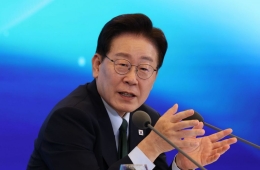
During his lecture on July 16 at the "49th Korea Chamber of Commerce and Industry Jeju Forum" held at Shilla Hotel Jeju, Minister Kim stated, "Our economy stands at a critical crossroads where it must achieve a turnaround. Right now, a single wrong decision at this pivotal moment could put both companies and the economy itself on a path to failure."
He pointed out that Korea’s current phase of low economic growth is a serious concern. Minister Kim remarked, "We are facing a situation where the growth rate is approaching zero. A growth rate of zero means that new jobs will not be created, tax revenues will dry up, and the entire country will face contraction and reduction." He also emphasized that this is a time when the global order is undergoing significant change.
He highlighted AI as the first core area on which the Korean economy should focus. He explained that it is not only important to lead in AI technology itself, but also to ensure that both industry and society are ready to embrace AI transformation and that the necessary infrastructure and ecosystem for utilizing AI are in place.

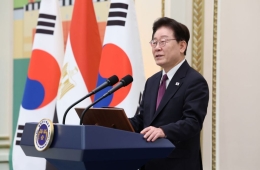
Kim Jungkwan, Minister of Trade, Industry and Energy, is giving a lecture on the topic of "Industrial Policy Direction" at the "49th Korea Chamber of Commerce and Industry Jeju Forum" held at Shilla Hotel Jeju on the 16th. Korea Chamber of Commerce and Industry.
View original imageIn particular, he suggested that the AI transformation of the manufacturing sector is an area where Korea could achieve a competitive edge. Minister Kim said, "Although we did not invent the internet, we utilized it better than any other country and rose to the forefront of the information age. Likewise, while the United States and China may develop AI, using it to its fullest potential is something that we can do better than any other country."
He added that it is essential to leverage the manufacturing data Korea possesses to enhance productivity and competitiveness within the manufacturing industry. Minister Kim stated, "The direction we should pursue is the transformation of manufacturing through AI driven by data utilization—'M.AX'. The government intends to form alliances by bringing together manufacturing companies, AI companies, financial institutions, universities, research institutes, and local governments to support AI-driven transformation across the entire industrial sector."
He also called for faster investment in the semiconductor industry. Minister Kim cautioned against mistaking the recent upturn in the semiconductor market as a sign of prosperity for the entire industry, stressing, "Semiconductors are a quintessentially cyclical industry, and no sector can experience a perpetual boom."
He continued, "A boom in semiconductors does not mean all industries are thriving, and if we fail to accelerate future investments in semiconductors, even this industry will inevitably lose its competitiveness."
As the second focal point, he chose region-centric growth. Minister Kim likened the metropolitan area to a fully grown tree and regional areas to saplings with high growth potential, saying, "Watering a big tree will not lead to immediate changes, but watering a sapling can create a dramatically different picture after just one month."
He further remarked, "Despite discussing growth stagnation, investment has continued to be concentrated in the capital area. Relying solely on giving more water to the large tree that is the metropolitan area has its limits for rebounding growth." He added, "Even the establishment of a single factory in a region can create jobs and change the local economy. Even if the results are not immediate, sustained and forward-looking investment will ensure that the real battle for growth will eventually take place in the regions."
The third point of focus was the industrial ecosystem, which requires participation from businesses, the government, research institutes, universities, and local communities. Minister Kim diagnosed, "The weakest part of the Korean economy is its ecosystem approach. In the AI era, it is nearly impossible for a single company to succeed alone."
He stated, "No single company can shoulder massive technology development and investment alone; building a semiconductor plant, for example, requires electricity, water, land, and partner companies. If we fail to change the structure in which companies, government, universities, research institutes, and local governments are scattered, we are destined to lose in the AI era."
Minister Kim also stressed the need to address potential conflicts among generations, regions, and social strata emerging from the AI transformation within the ecosystem. He said, "The younger generation fears losing jobs to AI the most, yet they are also the generation best equipped to utilize AI. The older generation must nurture and support young people so that they can realize their potential."
He asserted that the ultimate stage for growth is the global market. Minister Kim explained, "Our domestic market of 50 million people is increasingly shrinking. Korea’s share of world exports is only about 4%, leaving 96% of the market as untapped potential for expansion."
He added, "The real battleground to be created by revitalizing regions through AI and building out the industrial ecosystem is the global market. The true economic players who can make a difference in these focal areas—AI, regions, the ecosystem, and the global market—are the business leaders."
Hot Picks Today
 Chey Tae-won's One Remark Sends Stocks Soaring to 'Limit-Up'... This Stock Jumps Despite SK hynix's 3% Drop
- "Only healthy seniors welcome - get sick and leave?"... Senior welfare housing, this eligibility rule is changing
- "Now We're in Our 30s and 40s, and My Husband's the Only One Still Going Strong?" ... Women Tire First While Shopping: What's Happening in Japan?
- "I Thought Only Koreans Were Crazy About It"... This Dish Ranks No. 1 in the World
- "'100% Cat Fur' - It Seemed Unbelievable, but It Was Real... Chinese Shopping Mall Rocked by Shocking Revelation"
Minister Kim also noted that government and businesses must work together based on trust and respect, rather than engaging in mutual criticism. He said, "When companies face difficulties, the government will provide support and actively pursue regulatory reforms and R&D support for small and medium-sized enterprises. The government’s role is not to directly create new growth engines, but to help ensure that new opportunities naturally emerge from the market, startups, and venture companies."
© The Asia Business Daily. All rights reserved. Unauthorized AI training and use prohibited.