Ahead of F4 Meeting, Lee Eogwon Says "Leverage ETF Measures Coming Soon"... Avoids Answer on Trading Halt
"Stock Market Volatility Attributed to Growing Weight of Samsung Electronics and SK hynix in KOSPI"
President Also Raises Concern... Countermeasures to Be Discussed at F4 Meeting on the Afternoon of the 16th
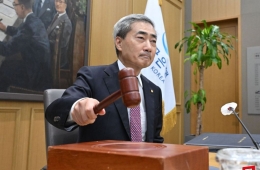
Lee Eogwon, chairman of the Financial Services Commission, announced on July 16 that measures regarding single-stock leveraged exchange-traded funds (ETFs) focused on Samsung Electronics and SK hynix—which have been identified as the main drivers of volatility in the Korean stock market—would be made public soon. However, he declined to give specific details regarding the timing of the announcement or whether potential measures, such as temporary trading halts, would be included. Attention is now focused on whether a clearer outline of the response will emerge at the Macroeconomic and Financial Issues Meeting (F4 meeting) taking place later this afternoon.
Appearing on the YouTube program "Kim Eojun's Humility Is Difficult News Factory" on the morning of July 16, Chairman Lee explained, "The Ministry of Economy and Finance, the Bank of Korea, the Financial Supervisory Service, and the Financial Services Commission are currently discussing measures for leveraged ETFs together." This is a response to widespread criticism that leveraged ETF products have effectively turned the domestic stock market into a "betting ground" by amplifying market volatility amid recent sharp market swings.

Lee Eokwon, chairman of the Financial Services Commission, is speaking on the morning of the 16th on the YouTube program "Kim Eojun's Humility Is Difficult News Factory." YouTube screenshot
View original imageAcknowledging the Impact of Leverage: "The Degree Is the Issue"
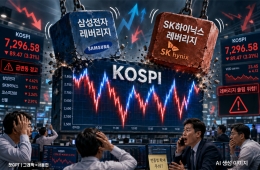
As the chief of financial regulation, Chairman Lee pointed to global semiconductor market volatility and the increasing share of "Samjeon-nix" (Samsung Electronics and SK hynix) within the KOSPI as the primary causes of recent market fluctuations. He noted, "Fundamentally, global semiconductor volatility has become extremely large. The semiconductor cycle is growing rapidly into a supercycle, and stock prices have risen substantially. This has led to crosscurrents of expectation and concern, which react to news coverage every day and drive volatility." He also observed, "When semiconductors move, the impact on the Korean market has become immense. The market capitalization of Samsung Electronics and SK hynix as a share of KOSPI rose from 22% at the end of June 2025, to 30% at the end of last year, and now stands at 52–53%; when adding related stocks like SK Square and Samsung C&T, the total reaches 60%."
On July 16, Chairman Lee also acknowledged the market’s criticism that the launch of single-stock leveraged ETFs based on "Samjeon-nix" in May directly contributed to the surge in volatility. "The issue is how substantial the impact is," he said, "and we have been closely monitoring those aspects, preparing supplementary measures swiftly, and plan to announce them soon."
The total net asset value of 16 single-stock leveraged ETFs crossed 1 trillion 74 billion won (5.074 trillion won) on their first trading day, and within just one month exceeded 17 trillion won. Even after a recent market correction, they are holding above the 10 trillion won level. Notably, the "short gamma" structure—where investors sell more as the market drops and buy more as it rises—has aggravated volatility. Since the introduction of leveraged ETFs, the KOSPI sidecar was triggered 18 times and the circuit breaker was activated 5 times. This prompted President Lee Jaemyeong to publicly remark during a policy briefing the previous day, "Aren’t things noisy because of leveraged ETFs? Please prepare supplemental measures swiftly."
Declining to Answer on Temporary Trading Suspension: Not Easy to Find Solutions
Asked about the timing for announcing measures on leveraged ETFs, Chairman Lee stated, "We will announce them soon." When pressed about the importance of maintaining trust in the financial market as volatility is confirmed daily, he replied only, "We are aiming to announce quickly." When asked specifically whether temporary trading suspensions are under consideration, he said, "There are several possible options, but some could cause bigger side effects in the market, so we have to consider everything comprehensively," thus avoiding a direct answer.
He continued, "Fundamentally, leveraged ETFs are high-risk, short-term products," and said, "We have continually warned investors about the risks." Regarding media reports that the measures might be announced in several stages, not all at once, he said, "I will explain everything in detail at the announcement" and assured that "the focus will be on investor protection and market stability." Explaining the reason for introducing single-stock leveraged ETF products in Korea, he stated, "It was an issue of asymmetry: these products are available overseas but not domestically. Rather than forcing domestic investors to go abroad, we wanted to bring the products into the domestic regulatory framework, manage them more transparently, and enhance investor protection."
As a result, the market's attention is now drawn to the F4 meeting to be held at the Bankers Club in Myeong-dong this afternoon. Kim Yongbeom, policy chief at the Blue House, said on July 10, "The impact of leveraged ETFs on the market will be closely reviewed at the F4 meeting, and we expect to discuss and reach a conclusion on response measures at the meeting." Attending will be Deputy Prime Minister and Minister of Economy and Finance Koo Yooncheol, Chairman Lee Eogwon, as well as Financial Supervisory Service Governor Lee Chanjin—who recently drew attention at a press conference with the remark, "I regret not having blocked it by lying down in front of it at the time"—and Bank of Korea Governor Shin Hyunsong. Although F4 meetings are usually held in the morning, it was rescheduled to the afternoon due to the Bank of Korea's Monetary Policy Committee meeting and other events.
Nevertheless, despite calls for urgent safeguards, preparing concrete measures has proved to be a challenge. At a meeting with chief executive officers of asset management firms on July 13, Governor Lee Chanjin reportedly remarked that it would be difficult to find clear solutions. Immediately after, the Korea Financial Investment Association and chief executive officers of ten major brokerage firms held an emergency meeting and decided to implement voluntary investor protection measures such as raising the basic deposit requirement (currently 10 million won) and dispersing rebalancing trades. Nevertheless, critics argue that these measures have limited effectiveness, given the now-enormous scale of deposit funds and the difficulty of retrospectively applying new regulations. Adjusting the leverage ratio is also cited as an implausible measure, as it would limit potential returns in a rising market.
"Financial Companies Should Take Initiative in Debt Adjustment"
In the interview, Chairman Lee also emphasized that, in order to fundamentally mitigate market volatility, a culture based on long-term investment must be fostered. "For example, the inclusion in the MSCI Developed Markets Index would ensure stable inflows of foreign long-term capital," he said. "In Korea as well, we need to encourage dispersed long-term investment through retirement pensions and ISAs (Individual Savings Accounts). To achieve this, it is important to foster trustworthy companies and to create a second and third wave of semiconductors and other industries through industrial policy." He added, "If shareholders are investing short-term, it means they lack trust in the company. It is crucial to create an environment where shareholder value is protected, allowing for long-term growth bets on companies."
Chairman Lee also called on financial companies to be more proactive in debt restructuring. "In any society, there are people who, due to failure, lose their foundation and are unable to handle their debts," he said. "The question is whether to support their recovery or to pursue them until the end." He continued, "It is important to settle debts to an appropriate and manageable level, allowing people to get a fresh start. Broadening the financial base so more people can participate in economic life is essential for financial companies to achieve sustainable growth."
Regarding the controversy over long-term debt collection by Sangroksu, Chairman Lee attributed the issue more to management problems than to moral hazard on the part of financial companies. Sangroksu is a bad loan management company established in 2003 to handle the aftermath of the credit card crisis, and sparked controversy in May when its long-term collection practices were reported by the media.
Chairman Lee commented, "After the issue surfaced, a problem that had persisted for more than 20 years was resolved within a single day. If management at financial institutions takes an interest, such problems can be solved," and reiterated, "This is not a problem of moral hazard, but of management."
Hot Picks Today
 "Are You Okay, Dad? Brother?"... 1 in 18 Men Deficient, U.S. Military to Begin Annual Screenings
- "What Did He See?"... Warren Buffett Sells Stocks and Piles Up Cash
- "Home-Cooked Meals Were the Only Affordable Option, but Now Even Hetbahn and Dumplings Are Going Up"
- Half a Cucumber Sends Man to ER... "If You Taste This, Spit It Out Immediately"
- "Earned 100 Million Won in Three Days After Leaving a Major Corporation"... The Identity of the Woman Who Resigned from LG Electronics
He also highlighted the need for financial support for the young generation. "The Youth Future Savings Account is a first step in helping young people establish seed money, with 2.34 million participants," he explained, "and it is a policy designed to create opportunities for young people." He further stated, "We will provide support such as one-on-one financial counseling to help young people take their first steps." Chairman Lee added, "I am also telling staff that the Financial Services Commission needs to transition from being a B2B institution to one that deals directly with consumers (B2C)."
© The Asia Business Daily. All rights reserved. Unauthorized AI training and use prohibited.