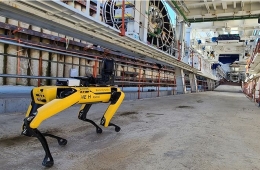
Preventing Hazards on the Tracks in Advance...Hyundai Rotem Develops Advanced Driver Assistance System
Completion of ADAS Development for Railway Vehicles
Advancement of AI Collision Avoidance Technology
Technological Maturity Achieved with Eyes on Taiwan Export
Hyundai Rotem has embarked on advancing its physical AI-based autonomous driving technology for railway vehicles.

On July 16, Hyundai Rotem announced that it has completed the development of its Advanced Driver Assistance System (ADAS) specialized for railway vehicles.
The ADAS for railway vehicles is a technology that detects obstacles on the track by taking into account track conditions and operational environments, alerting the driver to potential hazards and preventing collisions.
Hyundai Rotem began developing ADAS for railway vehicles as a result of its participation in the hydrogen electric tram demonstration project led by the Ministry of Trade, Industry, and Energy in 2023. Since then, the company has enhanced the technological completeness of the system by upgrading the AI-powered collision avoidance algorithm based on actual operation data.
The advancement of this technology utilized data from real-world commercial operations. Hyundai Rotem installed sensors in trams operating in Warsaw, Poland to collect driving data, which was then used to repeatedly analyze driving patterns and simulate hazardous situations in order to verify the performance and safety of the ADAS. The company is also improving the user interface (UI) and alert system by reflecting feedback from local drivers, and plans to link the system with central control platforms in the future.
Similar to automotive ADAS, the railway vehicle ADAS uses LiDAR and cameras to perceive conditions ahead. However, it must detect obstacles at longer distances and predict a wider range of operational variables because of the longer braking distances and complex track environments involved.
For example, it not only distinguishes whether an obstacle is a person or a structure but also assesses the likelihood of a person entering the tracks, issuing warnings to the driver as needed. To achieve this, a high-performance LiDAR sensor capable of detecting over 100 meters ahead has been applied.
This ADAS development is considered a core technology for realizing full autonomous driving in trams. Unlike subways, where track access is generally restricted, trams must continuously predict the possibility of pedestrians and vehicles entering the tracks in real time across various environments such as straight, curved, and branching tracks. Therefore, a higher level of environmental perception technology is required compared to driverless subway autonomy.
Hyundai Rotem plans to accelerate its efforts to enter the global railway market with its proprietary autonomous driving technology. In particular, the company aims to export railway vehicles equipped with ADAS to the Taiwanese market, which has stringent technology verification standards, while continuing to focus on improving the technological maturity and reliability of its system. Recently, the presence of ADAS has become a key evaluation factor in global railway vehicle tenders.
A Hyundai Rotem official stated, "Based on active government support and public-private cooperation, we have been able to proactively secure autonomous driving technology—an essential competitive edge for the future railway market. Through ongoing research and development, we intend to lead the global market with Korean physical AI technology and drive innovation in railway safety."
Hot Picks Today
 "I Might End Up Paying My Entire Salary Just for Interest"... Annual Per-Person Interest Could Reach 6.73 Million Won, 'Yeongkeul-jok' Lament
- "Biggest 'Supply Cliff' in 70 Years of Memory History Approaching... Now Is the Time to Buy Samsung Electronics" [Click eStock]
- "Will I Really Be Left Out If I Don't Use It?"... The App Used by 23 Million Koreans Monthly, Is Naver Feeling the Pressure?
- Oil Prices Now Driven More by Supply Than Geopolitics... Q3 WTI Projected at $70–90
- "Die from Heat or Starve": Amid Unprecedented Heatwave and Delivery Ban, Italian Riders Go on Strike
© The Asia Business Daily. All rights reserved. Unauthorized AI training and use prohibited.