SG Stands Out as Sole Supplier for SK hynix amid 1,500 Trillion Won Semiconductor Mega Project

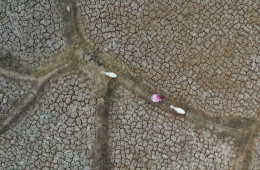
Samsung Electronics P5 Ecos Steel Ascon Test Paving Site at Pyeongtaek Campus. Photo by SG
View original imageAs the government continues to roll out large-scale national projects focused on semiconductors, artificial intelligence (AI), and data centers, there is growing attention on the related infrastructure market. Given that building advanced industrial complexes and surrounding cities inevitably requires the creation of extensive road networks, infrastructure companies—especially those involved in road pavement—are expected to find new opportunities for growth.
Recently, the government has been accelerating efforts to strengthen the competitiveness of advanced industries by pursuing the so-called "three mega projects," with semiconductors, physical AI, and AI data centers as its main pillars. The combined scale of these projects reaches approximately 1,500 trillion won. Since these include massive semiconductor manufacturing facilities, R&D complexes, and supporting cities, infrastructure such as access roads, internal road networks, and logistics systems will be simultaneously developed.
Industry experts believe the importance of road infrastructure will become even greater during the construction of advanced industrial complexes. Semiconductor plants require the installation of production equipment weighing tens of tons, and large logistics vehicles operate around the clock. As a result, these facilities demand higher durability and quality standards than general industrial parks. Especially once operations start, it is difficult to restrict vehicle movement for a prolonged period in order to repair roads, underscoring the need for highly durable pavement technologies that minimize maintenance cycles.
Against this backdrop, SG, a company specializing in asphalt concrete, has been drawing attention. SG has demonstrated its technology by securing supply references at Korea’s major semiconductor production sites with its eco-friendly, highly durable asphalt "Ecos Steel Ascon," which utilizes steel slag.
SG is currently the sole supplier providing all asphalt concrete needed at the approximately 122 trillion won Yongin Advanced System Semiconductor Cluster construction site, led by SK hynix. At Samsung Electronics’ Pyeongtaek Campus, SG has also completed test paving using Ecos Steel Ascon for the fifth semiconductor plant (P5) and is moving forward with on-site implementation. In this way, the company has gained supply experience at both of Korea's primary semiconductor production bases.
Such supply references are seen as a potential competitive advantage in future national projects. Notably, as the government pursues the creation of a massive semiconductor manufacturing base (four fabs) around the site of the relocated Gwangju military airport—an endeavor worth about 800 trillion won—the Honam region is emerging as a new market for road infrastructure. Simultaneous demand is expected for large-scale road paving to connect semiconductor facilities, their supporting cities, and logistics infrastructure.
Ecos Steel Ascon is an eco-friendly, highly durable asphalt created using steel slag as aggregate. It is designed to maintain pavement performance for extended periods even under repeated high-load conditions, offering greater durability than conventional asphalt concrete. In addition, it reduces fine dust emissions by 85.7% compared to standard asphalt, making it particularly well-suited for the dust-sensitive environments of semiconductor production sites.
Its ability to fully prevent logistics paralysis due to road damage caused by recurrent heavy vehicle traffic has also been demonstrated. According to a survey by the Korean Society of Road Engineers, a bus-only lane test section paved with Ecos Steel Ascon on Seoul’s Yanghwa Boulevard showed no potholes even after intense rainfall. Even nine months after paving, the section maintained a pavement performance index (SPI) of 7.80, demonstrating the sustained quality of the initial construction.
According to a 30-year life cycle cost (LCC) analysis by the Korea Industrial Economy Research Institute, Ecos Steel Ascon has a service life of 15.3 years, which is roughly 2.3 times longer than the 6.7 years of standard pavement. As a result, the number of repaving operations can be dramatically reduced, leading to an estimated 57.4% savings in maintenance and management budgets. This implies that facilities like semiconductor industrial parks, where post-construction maintenance is challenging, can also expect significant long-term operating cost reductions.
Changho Park, CEO of SG, stated, "As national strategic projects focused on semiconductors and AI are expanded, the quality and supply stability of road infrastructure will become ever more important. Based on our supply experience with production facilities expansion and infrastructure construction at SK hynix and Samsung Electronics’ semiconductor industrial sites, we plan to further expand our opportunities to supply materials for major national projects in the future."
Hot Picks Today
 Changing Outfits and Snapping Photos in Hotels... "Please Don't Take Pictures": Europe Cracks Down on Influencers Over Privacy Concerns
- "Tried leveraged semiconductor stocks, watched 3.5 billion won shrink to 200 million won": Salaried investor in tears
- "Please Let Me Go Home"... Customers Trapped in Department Store Parking Lot for 5 Hours Vent Their Anger
- "I Should Enjoy It After Retirement": Prices Quadruple... Memberships Over 100 Million Won Popular, but Closures Mount
- "Come Live With Me on My Farm": Man Sells Everything and Travels 1,930 km, Trusting a Beautiful Woman
He continued, "We aim to increase our market share in the high-durability asphalt segment by leveraging the construction experience we’ve accumulated on major arterial roads and bus lanes in Seoul, as well as our supply references at Korea’s leading semiconductor production sites. Additionally, with next-generation road pavement technologies that combine eco-friendliness and cost-effectiveness, we will accelerate efforts to capture both domestic and overseas infrastructure markets."
© The Asia Business Daily. All rights reserved. Unauthorized AI training and use prohibited.