Lee: "Those Unable to Repay Debt Should Be Allowed Bankruptcy and a Fresh Start"
“Settling Long-Term Delinquent Debt Is a Social Necessity,
Not a Moral Hazard”
“We Must Not Avoid Action Because of Criticism or Agitation...
Finance Should Not Destroy Lives”
On July 15, President Lee Jae-myung stated, "If someone is in debt but unable to repay, allowing them to file for bankruptcy and receive a discharge so they can start anew helps not only the individual but also society and creditors." He emphasized that, rather than persistently collecting on long-term delinquent loans with no chance of recovery, promptly resolving these debts and enabling debtors to return to normal economic life is the way to reduce overall social costs.
![President Lee Jae-myung is attentively listening to the ministry's work report at the Blue House State Guest House on the 15th. July 15, 2026 [Photo by Blue House Press Photographers Group] Yonhap News Agency](http://www.asiae.co.kr/news/img_view.htm?img=2026071511364346938_1784083002.jpg)
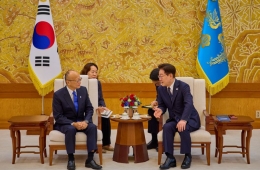
President Lee Jae-myung is attentively listening to the ministry's work report at the Blue House State Guest House on the 15th. July 15, 2026 [Photo by Blue House Press Photographers Group] Yonhap News Agency
View original imageDuring the Financial Services Commission's work briefing at the Blue House State Guest House that day, President Lee raised the issue of long-term delinquent debt adjustment, stating, "Long-term delinquent debtors who are unable to repay should have their cases resolved quickly." When Lee Eog-weon, Chairman of the Financial Services Commission, outlined “finance that saves lives” as the policy direction, President Lee responded that “finance often becomes finance that destroys lives,” instructing a more proactive approach toward bankruptcy, discharge, and debt adjustment for long-term delinquent borrowers.
He directly countered criticisms claiming that debt adjustment could foster resentment among diligent payers and promote moral hazard. President Lee pointed out, "When overdue debts are resolved, many people question, ‘Who would repay debt honestly?’ As a result, our country is excessively strict—almost harsh—about debt forgiveness," adding, "Such irresponsible incitement makes those who repay responsibly feel wronged."
He went on to say, "In advanced economies, resolving debt that is five or ten years overdue is standard practice," and added, "Even if the debt is not long-term, if the debtor is unable to repay, bankruptcy and discharge—allowing a fresh start—benefit society, the individual, and creditors alike."
President Lee also noted that it is highly unrealistic for someone with the ability to repay debt to intentionally withdraw from economic activity for an extended period just to qualify for debt relief. He remarked, "Who would forgo employment, the ability to open a bank account, or finding housing, and endure asset seizures as a credit delinquent for seven years, just to escape debt worth tens of millions of won? That itself is a much greater loss."
He further asserted, "Only by swiftly granting debt relief to those who truly cannot pay can we enable them to resume economic activity and ensure the economy as a whole functions normally. If we fail to do what is necessary because of criticism or agitation, what will become of our society?"
President Lee also voiced concerns that prolonged delinquency can escalate individual issues into broader social losses. He stressed the need to break the vicious cycle in which interest and late fees surpass the principal, forcing debtors out of economic participation for extended periods, or even driving some to extreme choices.
He emphasized, "No one should lose their life, be isolated from society, or be unable to participate in economic activity because of unpayable debts—this would ultimately harm the social community as a whole."
![Lee Eog-weon, Financial Services Commission Chairman, is reporting at the ministry work briefing chaired by President Lee Jae-myung at the Blue House on the 15th. From left: Im Kwanghyun, Commissioner of the National Tax Service; Lee Eog-weon, Financial Services Commission Chairman; Koo Yooncheol, Deputy Prime Minister and Minister of Economy and Finance. 2026.7.15 [Photo by the Blue House Press Photographers Group] Yonhap News](http://www.asiae.co.kr/news/img_view.htm?img=2026071513561147070_1784091372.jpg)
Lee Eog-weon, Financial Services Commission Chairman, is reporting at the ministry work briefing chaired by President Lee Jae-myung at the Blue House on the 15th. From left: Im Kwanghyun, Commissioner of the National Tax Service; Lee Eog-weon, Financial Services Commission Chairman; Koo Yooncheol, Deputy Prime Minister and Minister of Economy and Finance. 2026.7.15 [Photo by the Blue House Press Photographers Group] Yonhap News
View original imagePresident Lee reiterated this point by referencing the structure of financial companies’ lending practices. Since financial institutions already account for the risk of some borrowers defaulting by reflecting these costs in interest rates and loan loss provisions, he argued that pursuing the collection of unrecoverable debts over long periods is difficult to justify.
President Lee stated, "When financial institutions extend credit, they anticipate that a certain percentage of loans will go unpaid and incorporate that risk into the interest rate and loan loss write-offs." He added, "Nonetheless, if they continue to manage long-term delinquent borrowers harshly and recover excessive amounts, it could constitute unjust enrichment."
During the briefing, the Financial Services Commission announced plans to reform the system so that a single instance of delinquency in the exit phase of finance does not result in a lifetime of collection and stigma. The commission presented its intention to resolve long-term overdue loans through a new leap fund, proceed swiftly with debt write-offs and adjustment, and establish a comprehensive support center for debtors that integrates financial, welfare, and employment services.
Hot Picks Today
 "You Can't Settle for Less Just Because You're Eating Alone" Dining Alone for 100,000 Won a Meal... Solo Buffet Reservations Soar by 216%
- "Unimaginable in Korea"...Koreans Surprised by Secondhand Smoke in Japan and China Restaurants
- "The Unexpected Background of the Bride Who Won the Heart of Nongshim's Third-Generation Heir: 'Just an Ordinary Office Worker...'"
- Korean Air Begins Full-Scale Preparation for Integration with Asiana, Transfers Reservation Information
- "Canceled After Five Days and Lost 770,000 Won"... Hit by Steep Fees After Pressing the Cancel Button
President Lee urged Chairman Lee, "Be bold. If necessary, create new systems and persuade the public so that debtors who are unable to repay can return to economic activity."
© The Asia Business Daily. All rights reserved. Unauthorized AI training and use prohibited.

![How Did Tacos Come to Have Two Shells [Delicious Stories]](https://cwcontent.asiae.co.kr/asiaresize/307/2026091410392626963_1789349966.jpg)