[Work Report] Blocking the "Inflated" Effect of Large Bonuses... Bonus DSR Calculation Period Extended from 2 to 3 Years
If annual income rises by more than 20% from the previous year,
three-year average income will be applied
Capital regulations to be tightened on high-risk home loans;
stricter lending for non-resident single-home owners
The financial authorities will revise the debt service ratio (DSR) calculation system so that, if an individual’s annual income in a particular year increases by more than 20% compared to the previous year, a three-year average income will be reflected instead of a two-year average. This move is aimed at preventing the loan limit from being calculated excessively, beyond the actual repayment capacity, for employees at semiconductor companies such as Samsung Electronics and SK hynix whose annual incomes temporarily soar due to large bonuses.
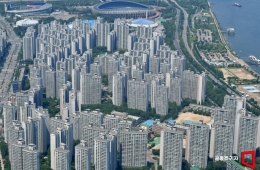
![[Work Report] Blocking the "Inflated" Effect of Large Bonuses... Bonus DSR Calculation Period Extended from 2 to 3 Years](http://www.asiae.co.kr/news/img_view.htm?img=2026071509390646572_1784075946.jpg)
The Financial Services Commission, which tightened lending regulations at the start of the year by capping household debt growth at 1.5%, plans to maintain this policy stance in the second half of the year by adjusting the DSR calculation system.
On July 15, Financial Services Commission Vice Chairman Lee Eogwon said during a government joint work report, "In order to establish a lending practice based on the borrower’s repayment capacity, we will strengthen income screening, such as reflecting bonuses, when calculating DSR." Specifically, if an individual’s annual income in a particular year increases by more than 20% from the previous year, the period for averaging income will be expanded from the current two years to three years. This is intended to prevent cases where loan limits are calculated higher than actual repayment capacity due to temporary income surges from bonuses and similar financial windfalls. Effectively, these measures are interpreted as targeting employees at companies like Samsung Electronics and SK hynix, where large bonuses are paid. DSR, or debt service ratio, is the proportion of a borrower's annual income used to repay principal and interest. The higher the annual income, the greater the loan limit available to the borrower.
Shin Jinchang, Secretary General of the Financial Services Commission, stated, "If the current year’s income exceeds the previous year by more than 20% due to bonuses or extraordinary earnings, we currently calculate the average with just last year’s income. By expanding this to a three-year average, we aim to smooth out unusually high income spikes that occur in certain periods." The Financial Services Commission will continue to manage the household loan growth rate to remain within 1.5%. This policy remains in place because Korea’s household debt-to-GDP ratio (80%) is still much higher than the mid-60% average for advanced economies.
Additionally, for high-risk mortgage loans—such as those to high-income or high-DSR borrowers, those for high-priced homes, high loan-to-value (LTV) ratio loans, and multi-homeowners—the authorities will strengthen capital regulations, encouraging financial companies to set aside additional capital, with the aim of reducing incentives to supply such loans. In addition, measures will be pursued to block speculative home purchases using leverage by tightening loan regulations on non-resident single-homeowners and lowering the guarantee ratio for "jeonse" (lease) loans. However, these regulations will exclude individuals without homes from the targets.
Support for inclusive financing targeting financial vulnerable groups such as subprime borrowers and young people will be expanded. The Financial Services Commission is introducing a new policy loan, which can be borrowed through in-person screening at up to KRW 1 million with an annual interest rate of 4.5% for a maximum of 10 years. In order to prevent moral hazard, in-person screening will be a requirement (rather than non-face-to-face screening), and support will be carefully targeted at vulnerable groups with actual financial needs.
The Financial Stability Support Fund for Low-Income Households will also be introduced. Through this fund, the authorities plan to reduce the interest burden of the Sunshine Loan Special Guarantee and expand the supply of Sunshine Loan Youth. Secretary General Shin stated, "For borrowers who faithfully repay the Sunshine Loan Special Guarantee, we are discussing with the budget authorities a plan to refund half of the existing 12.5% interest rate, lowering the final interest burden to 6.3%."
Hot Picks Today
 "I Ate at Home to Save Money, But My Account Balance Was Still a Shock"
- Suddenly Called Out During Class, Awarded $100,000 as Students Cheer in the Gym
- "Bought It Cheaper in Japan Than Korea"... Improper Use Leads to Vomiting and Abdominal Pain, Official Warning Issued
- "After a Dream About Feces, Bought a Lottery Ticket and Won 20,000 Won... Scratched Again and Hit a 2 Billion Won Jackpot"
- "Uncle Will Buy Them All for Wonie"... Men in Their 30s Sweep Up 600,000 'RESCENE Bread'
Furthermore, a program to help young people build assets will also be launched. The Financial Services Commission will introduce an early asset-building program for young people using the capital market by the end of this year, and will link it with existing youth support policies such as the "Youth Leap Account" to establish a medium- to long-term asset-building ladder.
© The Asia Business Daily. All rights reserved. Unauthorized AI training and use prohibited.