"I Shouldn't Have Sold Yesterday": SK hynix Soars Over 10% on Surging U.S. ADRs, Forecasts Reach 4.92 Million Won
U.S. June Inflation More Stable Than Expected, Rate Hike Concerns Ease
Barclays Issues 'KRW 4.92 Million Target for SK hynix' Report

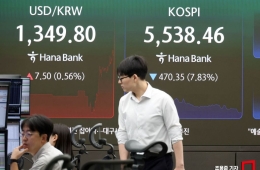
On the 15th, as the KOSPI index started with a sharp rise and quickly regained the 7200 level, the exchange rate, KOSPI, and KOSDAQ indices were displayed on the index status board in the dealing room at the Hana Bank headquarters in Jung-gu, Seoul. July 15, 2026 Photo by Dongjoo Yoon
View original imageWith concerns over U.S. inflation easing, the KOSPI also achieved a strong rebound. Shares of SK hynix surged more than 10% as the price gap between the common shares and the American Depositary Receipts (ADR) widened to as much as 51%, fueling perceptions of severe undervaluation.
U.S. CPI Posts Largest Drop in Six Years...Wall Street Rebounds
On July 15, the KOSPI opened at 7,082.91, up 3.30% from the previous trading day, and extended its gains to trade at 7,329.60 as of 10:00 a.m., an increase of 6.89%. The index spiked at the open, triggering a buy-side sidecar at around 9:06 a.m. The KOSDAQ also traded at 827.52, up 5.55% from the previous session. Following the KOSPI, a buy-side sidecar was also triggered for the KOSDAQ at about 9:17 a.m.
Overnight, the New York stock market rose on news of easing inflation, which influenced the Korean market as well. The Dow Jones gained 0.02%, the S&P 500 climbed 0.38%, and the Nasdaq increased by 0.90%. Major semiconductor stocks such as Nvidia (4.06%), Micron (4.92%), SanDisk (5.01%), Intel (4.50%), and AMD (2.57%) all posted strong performances, leading the Philadelphia Semiconductor Index to close up 2.54%.
A lower-than-expected increase in the U.S. Consumer Price Index (CPI) for June tempered expectations for further rate hikes, fueling renewed investor sentiment. The CPI for June, announced on this day, rose 3.5% year-on-year, below the 3.8% forecast compiled by Dow Jones. On a month-on-month basis, it declined by 0.4%, also more than the expected -0.2%. The month-on-month fall was the largest in six years since April 2020 during the COVID-19 pandemic (-0.8%). Lee Euntaek, an analyst at KB Securities, commented, "The U.S. CPI was much more stable than expected," and assessed, "Expectations for price stabilization and stocks of major companies entering oversold territory have driven the rebound of U.S. semiconductor stocks."

The KOSPI's rebound is also being driven by gains in semiconductor stocks. Notably, as of 10:02 a.m., shares of SK hynix were trading at 2,121,000 won, up 10.87% from the previous session, leading the KOSPI rally. Other major semiconductor blue chips that had recently plunged, such as Samsung Electronics (4.37%), SK Square (17.48%), and Samsung Electro-Mechanics (11.27%), also rebounded simultaneously.
Overnight, the surge in SK hynix's ADR on the New York stock market helped lift the common shares. On this day, global investment bank Barclays issued a report stating SK hynix's ADR has upside potential up to 330 dollars. Simon Coles, a research analyst at Barclays, predicted, "The supply shortage in the memory semiconductor industry will intensify through 2027, and improvement will remain limited even in 2028, so supply constraints will persist for several years."
After the Barclays report was released, the SK hynix ADR soared 27.29% to close at 193.92 dollars. One SK hynix ADR is equivalent to one-tenth of one Korean common share. Ten ADRs correspond to 2,890,000 won, while the closing price of a Korean common share was only 1,910,000 won the day before. Bloomberg reported that the 27% jump in ADRs expanded the premium gap between the common share and ADR to as much as 51%, far exceeding the 3% level that had been set at the time of the ADR's initial listing.
New York Stock Exchange Begins Trading SK hynix ADR Leverage Products
Experts also analyzed that the official start of derivative trading based on SK hynix ADRs on the New York Stock Exchange from today was another factor boosting the share price. Up to midday at the Chicago Board Options Exchange (CBOE), about 150,000 SK hynix options contracts were traded. Trading of leveraged exchange-traded funds (ETFs) linked to SK hynix ADRs also began in earnest. Nearly ten U.S. ETF managers, including Leverage Shares, GraniteShares, ProShares, and Kogep Funds, have applied to launch SK hynix leveraged ETFs, and many of them started trading today.
Sunwoo Kim, a research analyst at Meritz Securities, stated, "The recent sharp decline in SK hynix's share price was due to market misunderstandings about long-term supply agreement (LTA) structures and the mistaken belief that the semiconductor cycle had already peaked," adding, "LTA sales prices are expected to continue rising, and with limited supply capacity, the memory cycle will see solid improvement through the end of next year, during which time the company's value will also keep rising."

Meanwhile, although the KOSPI has succeeded in rebounding, a number of so-called 'emperor stocks' (stocks priced over 1 million won per share) that had previously soared have nearly halved in value due to sharp declines. Samsung Electro-Mechanics, which became an emperor stock this year with a peak of 2.41 million won, dropped to 1.26 million won as of the previous day, posting a 48% plunge from the high. SK Square also declined by about 48% from its peak of 2.33 million won, while LG Innotek fell by 64.2% and LS Electric by 45.2%, with most large-cap stocks that fueled this year's market rally experiencing significant corrections.
Hot Picks Today
 "Samsung Electronics at 70,000 won, SK hynix at 200,000 won"... Why the gloomy outlook despite 'record-breaking earnings'?
- "I Was Just Going Barefoot at Home"... "Absolutely Not": Why Doctors Warn Against It
- "There's a Drink Like This?"... Chinese Beverage With "Korean" in Its Name Rakes in 85 Million Won in Monthly Sales
- Just 13.9 Seconds to Wash Hands After Using the Restroom... "So Many" Use Water Alone, No Soap
- "No Need to Hire a Model"... The 25-Year-Old Woman Who Entered Social Media with a Face That Cost Just 1,500 Won [AI Content: The Bright and Dark Sides] 1
Securities experts believe that for the Korean market to continue its full-fledged rebound, the upcoming earnings announcements from U.S. big tech companies later this month must not only show profit improvements, but also provide positive signals for increased capital expenditures (CAPEX) related to artificial intelligence (AI). Jiyoung Han, a research analyst at Kiwoom Securities, predicted, "With the domestic stock market having undergone an unprecedented correction, worse declines in stock prices and valuations seem unlikely," and added, "If positive news emerges in upcoming earnings releases from U.S. big tech, further gains in our stock market are likely."
© The Asia Business Daily. All rights reserved. Unauthorized AI training and use prohibited.