"Factional Interests Block Youth Supreme Council, Exposing Democratic Party Crisis"... 24-Year-Old Supreme Council Candidate Jung Minchul's Challenge [Ruling Party Convention Interview]
A Bid for Supreme Council of the Democratic Party
Pledging a Blue Wave to Shift Public Opinion Among the 2030 Generation
Youth Supreme Council Member Proposal Voted Down by Factional Interests,
Highlighting the Crisis Within the Democratic Party
"I'll give it a shot."
On July 14, when the agenda to introduce a Youth Supreme Council Member was voted down by the Supreme Council of the Democratic Party of Korea, Jung Minchul, Vice Chairman of the Policy Committee of the Democratic Party, reaffirmed his intention to run for Supreme Council member. Jung had originally declared his candidacy for Supreme Council alongside established politicians. Subsequently, in order to amplify the voices of the 2030 generation—a red flag that the Democratic Party’s National Convention Preparation Committee had highlighted—he proposed the introduction of a Youth Supreme Council Member and shifted his candidacy to that position. However, as the Supreme Council ultimately decided not to implement the Youth Supreme Council Member system after a vote, he will now be competing on the same stage as incumbent lawmakers and other candidates.
He commented on the rejection of the Youth Supreme Council Member agenda, saying, "Despite a sense of crisis regarding the general and presidential elections and the need to regain government control, the Democratic Party is failing to engage in healthy debate because of certain factions' political calculations. This makes it clear that the party is undeniably in a critical crisis."

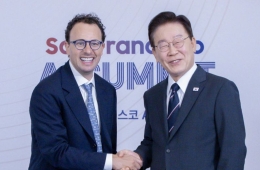
Jung Mincheol, Vice Chairman of the Policy Committee who is running for the Supreme Council Member of the Democratic Party of Korea, is being interviewed by The Asia Business Daily in Yeouido, Seoul. July 10, 2026 Photo by Hyunmin Kim
View original imageJung said, "For young people, the preliminary nomination process was essentially a barrier," and added, "It is disheartening that only the introduction of the Youth Supreme Council Member was discussed, when these hurdles should have also been addressed." The Democratic Party currently narrows its candidate pool to eight through a preliminary nomination process in which Central Committee members make up 50% of the vote and dues-paying party members the other 50%. There are concerns that the 50% threshold set for Central Committee members is a barrier for young politicians.
The interview was conducted in person on the 10th and by phone on the 14th.
-What prompted you to decide to run?
▲Clearly, the Democratic Party is disconnected from the younger generation and from the issues they face. In the meantime, far-right content has drawn our children away. While working as a political influencer, I was often asked, "Why doesn't the Democratic Party talk about our children's issues?" and couldn't answer. The Democratic Party's stance was often absent, unknown, or unspecified, and in that vacuum, young people fell prey to conspiracy theories—a situation that people seem largely unaware of. If elected as a Supreme Council member, I intend to coordinate everything from the party’s Digital Strategy Office and Communications Team staff, to communications aides in each member's office, and hold weekly strategy meetings and workshops to get everyone on the same page and build up our communications front. In addition, I will give a sense of efficacy to women in their 20s and 30s, as well as what I call the "cheering stick generation." More important than youth policy itself is delivering hope.
-You are creating a significant volume of content.
▲One of the key reasons for the rise of the far-right is that people are not consuming media. In response to this tendency to ignore the media and fall for conspiracy theories, I have produced card news and similar content, generating around 80 million monthly views. If I become a Supreme Council member and am able to systematize this effort, the productivity would be extraordinary.
-What kind of content will you spread?
▲While the three major mega projects received much attention from the press, in reality they were barely covered on social media. Instead, fake news such as "Samsung Electronics and SK hynix performance bonuses being scrapped" spread widely. It was alarming that government achievements did not reach the younger generation, while they only consumed fake news from far-right accounts. If you do the work, you need to communicate it; if there are misunderstandings, you need to address them; and if there are accomplishments, you should publicize them. We need to break this bottleneck. We have to expand the doors for Democratic Party reporters to outlets such as Instagram magazines, too.
-What is your strength compared to other candidates?
▲Has there ever been such strong support for a 24-year-old non-incumbent politician running for elected Supreme Council member? Until now, opportunities for youth politicians have been by appointment or nomination. After the writer Rhyu Si-min described me as a "juvenile critic," I received encouragement, and when I wrote a piece countering historical distortion regarding the 5·18 Democratic Movement, President Lee Jaemyung shared it, joining me in the cultural battle. While the Democratic Party is embroiled in demonization and fake news, I believe I am the only candidate who has actually overcome and demonstrated results in this environment. That's what sets me apart.

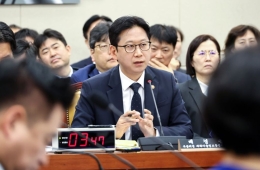
Jeong Mincheol, Vice Chairman of the Policy Committee running for the Supreme Council Member of the Democratic Party of Korea, is being interviewed by The Asia Business Daily in Yeouido, Seoul. 2026.7.10 Photo by Hyunmin Kim
View original image-You were also active online during the Jamsil protests.
▲I survived on two or three hours of sleep a night for two weeks, uploading nearly 20 to 30 pieces of content daily. Seeing this, young people who support the democratic camp also joined in. Now the democratic camp has a chance to turn things around, so we need to mobilize party resources, establish a communications front, and create an ecosystem.
-Internal conflict within the party has recently become severe.
▲I view this as an inevitable conflict. If, in the process, people attack each other personally or talk as though certain people shouldn't belong to the party, it only serves to sap the strength from the democratic faction. After the passing of former leader Lee Haechan, people in the democratic camp commented that 'the party has lost its elder statesman.' I expected that the next generation would step into that role, and I wanted to be able to rely on them. But after observing these dynamics, I felt that our generation needs to take more responsibility and do things ourselves. The world is so difficult right now that adults can't help or guide us, because they're struggling too. That's why we've been thinking more and more that we have to stand up and take on these tasks ourselves.
-What kind of content do you think is needed?
▲Stock prices have risen, but the far-right claims it's because of "national pension fund injections" or "illegal Chinese capital collusion." When the Democratic Party simply says, "How can you say such things?" it does not resonate with the 2030 generation. Even complex issues such as commercial law amendments need to be explained in plain language. While lawmakers claim YouTube is important, their content tends to be food shows, dancing, or comedy, which viewers don't respond to. I believe we've returned to an age of public speeches, but the format has become extremely brief and the reach much wider.
-How do you assess the leadership of the current party leadership, led by Jeong Cheongrae?
▲I've often thought to myself, 'Why is communication so poor?' The members say 'The leadership doesn't communicate'; the leadership says 'The leader doesn't communicate.' I think these dynamics show the limitations of Representative Jeong Cheongrae's leadership. There has been talk of "performative politics," but in my view, a party leader should clearly show what kind of world they envision, articulate that vision, and demonstrate how they've changed things. They pledged "to devote themselves to the success of the Jaemyung Lee administration," but then suffered the most damaging blow with the Seoul Mayoral election loss.
Hot Picks Today
 "They're Coming After My Pension Too?" Public Unease Mounts... Spain Sees Mass Protest Over Reform Push
- "Where Do You Go Every Lunch Break?"... 'Time-Poor' Men in Their 40s: Where They Spend Their Money.
- "K-Nuclear Power to Become a Global Production Hub"... Government Hosts IAEA Nuclear Power Ministerial Conference in South Korea for First Time
- "Naked Again?" Controversial Actress Crosses a Line... Slammed for Sexualizing 'Child Characters'
- "A Really Beautiful Butt"... How Did Nicki Minaj React to Trump's Unexpected Remark?
-Among the candidates for the next party leader, do you have someone you support?
▲I believe Kim Minseok is the one. How much frustration must he have felt on his path from serving as Prime Minister to running for party leader? He understands better than anyone what kind of party the government needs at this time. From what I see, Kim is also the candidate who is most clearly articulating the strategy the Democratic Party needs going forward.
© The Asia Business Daily. All rights reserved. Unauthorized AI training and use prohibited.