"Work Time for Offshore Wind Substructure Reduced by 55%"...SK Ocean Plant Develops Welding Automation
First Applied to Anode Welding
Construction Time Reduced from 44 to 20 Minutes

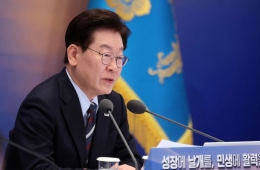
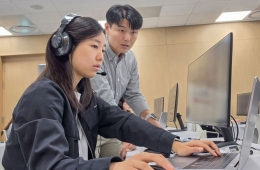
At the SK Ocean Plant offshore wind substructure production factory located in Goseong-gun, Gyeongnam Province, a 'Welding Automation Collaborative Robot Demonstration' was held, where CEO Younggyu Kang and attendees observed the robot welding scene. SK Ocean Plant
View original imageSK Ocean Plant (CEO Kang Younggyu) announced on the 15th that it has introduced welding automation using collaborative robots into its offshore wind power substructure production process, dramatically reducing work time.
SK Ocean Plant established a Business Innovation Task Force earlier this year, and since March, has developed a welding automation process and verified the feasibility of its application to the actual production line through on-site demonstrations.
The collaborative robots feature the ability to safely work alongside human workers in the same space, allowing for flexible operation even in complex working environments.
The initial application targets the welding of anodes (sacrificial anodes), which serve to prevent corrosion of offshore wind power substructures. An anode is a component designed to corrode prior to the structure itself and thus plays a key role in maintaining the durability and lifespan of offshore wind substructures.
This is a repetitive task, involving the installation of approximately 130 anodes per structure. In the current substructure fabrication project, a total of about 2,800 anodes (roughly 5,600 welding points) are being installed.
SK Ocean Plant selected this process as a priority for collaborative robot implementation, considering the impact of automation and its applicability on the production floor.
As a result of field application, the process—where a worker previously required about 44 minutes to install a single anode—has been reduced to 20 minutes. Work time was cut by approximately 55%. While welders previously had to execute the weld in more than 12 separate passes due to welding posture and other factors, the robot can now complete it in just two consecutive passes, increasing bead uniformity and minimizing spatter occurrence.
SK Ocean Plant also explained that the collaborative robots have reduced fatigue among workers by taking on repetitive and high-load tasks, allowing workers to focus on expertise-driven tasks, such as quality assurance and high-skill welding.
Hot Picks Today
![Selling Like Crazy Every Year... 30-Year-Old Hetbahn Takes on a New Challenge: Tastes Better Than "Mom's Home Cooking" [On-Site Report]](https://cwcontent.asiae.co.kr/asiaresize/93/2026102216175071025_1792653470.jpg) Selling Like Crazy Every Year... 30-Year-Old Hetbahn Takes on a New Challenge: Tastes Better Than "Mom's Home Cooking" [On-Site Report]
Selling Like Crazy Every Year... 30-Year-Old Hetbahn Takes on a New Challenge: Tastes Better Than "Mom's Home Cooking" [On-Site Report]
- "Please Pay Me at Least 3 Million Won a Month": More Than Half of Young People Today Prioritize "Working Conditions" Over Company Size
- A 12-Year-Old Girl Went to the Hospital After Her Blood Pressure Hit 225 and Was Stunned: "What Is This Coral Reef-Like Thing in Her Aorta?"
- "Hey, Lady, Teach Your Kids to Behave!" ... 300,000 Won in Cash and a Bodily Injury Claim Demanded Over Child's Door Ding
- Beachgoer Finds 'Plastic' That Turns Out to Be Perfume Ingredient Worth More Than Twice as Much as Gold
Kang Younggyu, CEO of SK Ocean Plant, stated, "We will expand the application of welding automation to various welding processes in the future to strengthen our smart manufacturing foundation and continuously enhance our production competitiveness in the global offshore wind power market."
© The Asia Business Daily. All rights reserved. Unauthorized AI training and use prohibited.