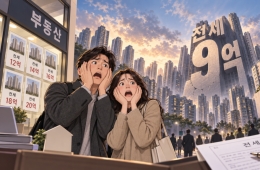
[Home-Tech] Aristotle’s "Good Life" and the Real Estate Market Today
Population, Jobs, and Finance Determine Urban Competitiveness
Large-Scale Housing Supply Alone Cannot Drive City Growth
In his work "Politics," Aristotle stated, "A polis comes into existence for the sake of life, but exists for the good life (EuZen)." He defined humans as "zoon politikon"—political animals—because humans can only realize their full potential within a community. Remarkably, this single sentence from a philosopher thousands of years ago remains highly relevant in understanding the real estate market in Korea today.
South Korea has already entered a super-aged society. As of the end of 2024, the population aged 65 and over exceeded 20% of the total population, while the birthrate remains the lowest in the world. Declining population is no longer a future concern but a present reality. Yet, the real issue is not simply the shrinking population but the accelerating concentration of people into specific cities.

According to the domestic migration statistics from Statistics Korea, the most important reason for young people moving is still employment. Ultimately, people go where jobs are, and where people gather, consumption and services are concentrated, drawing capital back into those cities. In an era of population decline, the time when all cities could grow together has ended, and polarization is deepening as only "chosen" cities continue to expand. Aristotle’s idea of self-sufficiency can be interpreted differently in this context. While self-sufficiency in the polis once meant politics and the military, today’s urban self-sufficiency is built upon three pillars: people (population), industry (jobs), and finance (capital).
These three factors do not move independently but rather reinforce each other, creating greater synergy. The emergence of industries creates more jobs, and more jobs lead to an influx of people. As the population grows, residential and commercial districts expand, followed by the arrival of financial institutions and investment capital. Finance, in turn, supports businesses and development, further enhancing a city’s competitiveness. Ultimately, the competitiveness of a modern city depends on how well population, industry, and finance form a virtuous cycle.
Indeed, this dynamic is repeatedly observed in the recent real estate market. Growth in areas like Seoul’s Gangnam district, Pangyo, Magok, Gwanggyo, Pyeongtaek Godeok, and Yongin Platform City did not happen merely because new apartments were built. Advanced industries, major corporations, and R&D centers established themselves first, and as the population moved in, financial and commercial functions expanded. Conversely, some new towns developed solely through large-scale housing supply have faced unsold units and stagnant commercial areas over time. Urban development cannot be achieved by supply alone.
This offers a key insight for real estate investment as well. Many investors focus on supply volumes and interest rate changes, but in the long run, it is a city’s ecosystem that determines asset value. In the future, valuable real estate will more likely be found not just in places with good locations, but in cities that attract population through their industries and experience a sustained inflow of capital.
Of course, the "good life" Aristotle spoke of did not mean rising property prices. His concept of happiness was the fulfillment of human virtue and the pursuit of a complete life within a community. Nevertheless, his insights remain applicable even today: people cannot prosper alone, nor can cities grow on their own. Only spaces where people, industry, and finance converge can achieve sustainable prosperity. In this era of contraction, the focus in real estate should shift from individual complexes to the broader perspective of the city. In the market ahead, the ability to recognize which city is best equipped for sustainable growth will be the key to long-term asset management.
Hot Picks Today
 "Quit Job to Start Life in Canada, Now Forced to Return Home"… Language School Closure Leaves Korean Students Stranded
- 'Japan in Chaos' as Unprecedented Outbreak Spreads ... "Four Days Is Too Short," Yet Japan Remains Top Travel Pick
- Trump Holds Three-Hour Negotiations With Iran on Day of 'Annihilation' Threat... Iranian Military Calls It 'Domestic Political Propaganda'
- "Is That Family's Daughter Unemployed? My Son Is Too" ... Sri Lanka's Youth Unemployment Rate Among Graduates Hits 43%
- "Thought It Was a Student Meal at This Price"... A 2,400-Won Meal at a Five-Star Hotel, What's Going On?
Hyosun Kim, Chief Real Estate Expert, KB Kookmin Bank Star Advisory Group
![[Home-Tech] Aristotle’s "Good Life" and the Real Estate Market Today](http://www.asiae.co.kr/news/img_view.htm?img=2026071417361745930_1784018177.jpg)
© The Asia Business Daily. All rights reserved. Unauthorized AI training and use prohibited.